Well Evaluations & Completions Technique
$3500.00
Well Evaluations & Completions Technique: 5-Day Professional Training Course
Course Overview
This intensive 5-day training program provides comprehensive knowledge of well evaluation methods and advanced completion techniques for maximizing well productivity and asset value. Specifically designed for professionals in the Kingdom of Saudi Arabia (KSA), Oman, GCC countries, and Africa, this course covers formation evaluation, petrophysical analysis, completion design, intelligent well systems, and intervention operations essential for optimizing hydrocarbon recovery in diverse reservoir conditions.
Target Audience
Completion engineers and supervisors
Production engineers and reservoir technologists
Petrophysicists and formation evaluation specialists
Drilling engineers involved in completions
Well intervention and workover engineers
Reservoir engineers requiring completion knowledge
Operations geologists and production geologists
Technical professionals from Saudi Aramco, PDO, ADNOC, and African operators
Petroleum engineering graduates
Asset integrity and well integrity specialists
Day 1: Formation Evaluation Fundamentals
Morning Session: Wireline Logging and Petrophysics
Module 1.1: Introduction to Formation Evaluation
Formation evaluation role in upstream operations
Evaluation workflow: drilling to production
Integration with geology, drilling, and reservoir engineering
Data acquisition timeline and decision points
Real-time vs. post-drill evaluation
Evaluation objectives: exploration, appraisal, development
Cost-benefit analysis of evaluation programs
Regional evaluation challenges in Middle East and Africa
Module 1.2: Wireline Logging Principles
Logging tool physics and measurement principles
Resistivity tools: laterolog, induction, array resistivity
Porosity tools: density, neutron, sonic, NMR
Gamma ray and spectral gamma ray logging
Spontaneous potential (SP) and caliper logs
Temperature and pressure measurement tools
Dipmeter and formation imaging logs
Logging tool limitations and quality control
Module 1.3: Log Interpretation Fundamentals
Quick-look interpretation techniques
Shale volume estimation methods
Porosity determination from multiple logs
Water saturation calculation: Archie equation
Dual water model for shaly sands
Permeability estimation from logs
Net pay determination criteria
Hydrocarbon typing: oil vs. gas identification
Afternoon Session: Advanced Formation Evaluation
Module 1.4: Logging While Drilling (LWD) and MWD
LWD/MWD technology overview
Real-time formation evaluation capabilities
Gamma ray, resistivity, and density while drilling
Azimuthal measurements and geosteering
Formation pressure while drilling
Integration with directional drilling operations
LWD advantages in challenging environments
Horizontal well geosteering in Saudi tight reservoirs
Module 1.5: Advanced Petrophysical Analysis
Nuclear magnetic resonance (NMR) logging applications
Fluid typing and movable hydrocarbon estimation
Permeability from NMR: free fluid index, bound fluid
Formation imaging interpretation
Dip analysis and structural characterization
Fracture identification and quantification
Thin-bed analysis and laminated reservoirs
Carbonate reservoir evaluation in GCC fields
Day 2: Core Analysis and Reservoir Testing
Morning Session: Core Analysis Techniques
Module 2.1: Coring Operations and Core Handling
Coring methods: conventional, sidewall, oriented coring
Pressure coring for fluid retention
Core preservation and handling procedures
Core gamma ray and CT scanning
Core-log integration and depth matching
Representative sampling strategies
Core analysis planning and objectives
Coring in high-angle and horizontal wells
Module 2.2: Laboratory Core Analysis
Routine core analysis (RCA): porosity, permeability, saturation
Grain density and lithology determination
Special core analysis (SCAL) overview
Relative permeability measurements
Capillary pressure curves and applications
Wettability assessment and implications
Rock mechanics and geomechanical testing
Core analysis integration with petrophysics
Afternoon Session: Well Testing and Pressure Analysis
Module 2.3: Drill Stem Testing (DST)
DST objectives and planning
DST tool string configuration
Test procedure: flow and buildup periods
Surface equipment and safety systems
Fluid sampling techniques and quality
Pressure analysis and interpretation
Flow rate measurement and well deliverability
DST in HPHT and sour gas environments
Module 2.4: Formation Pressure Testing
Wireline formation testing tools: MDT, RFT
Pretesting and mobility measurement
Pressure gradient analysis and fluid contacts
Permeability estimation from pressure tests
Fluid sampling with wireline tools
Formation testing in horizontal wells
Pressure testing challenges in tight formations
Integration with reservoir characterization
Day 3: Well Completion Design and Operations
Morning Session: Completion Fundamentals
Module 3.1: Completion Types and Selection
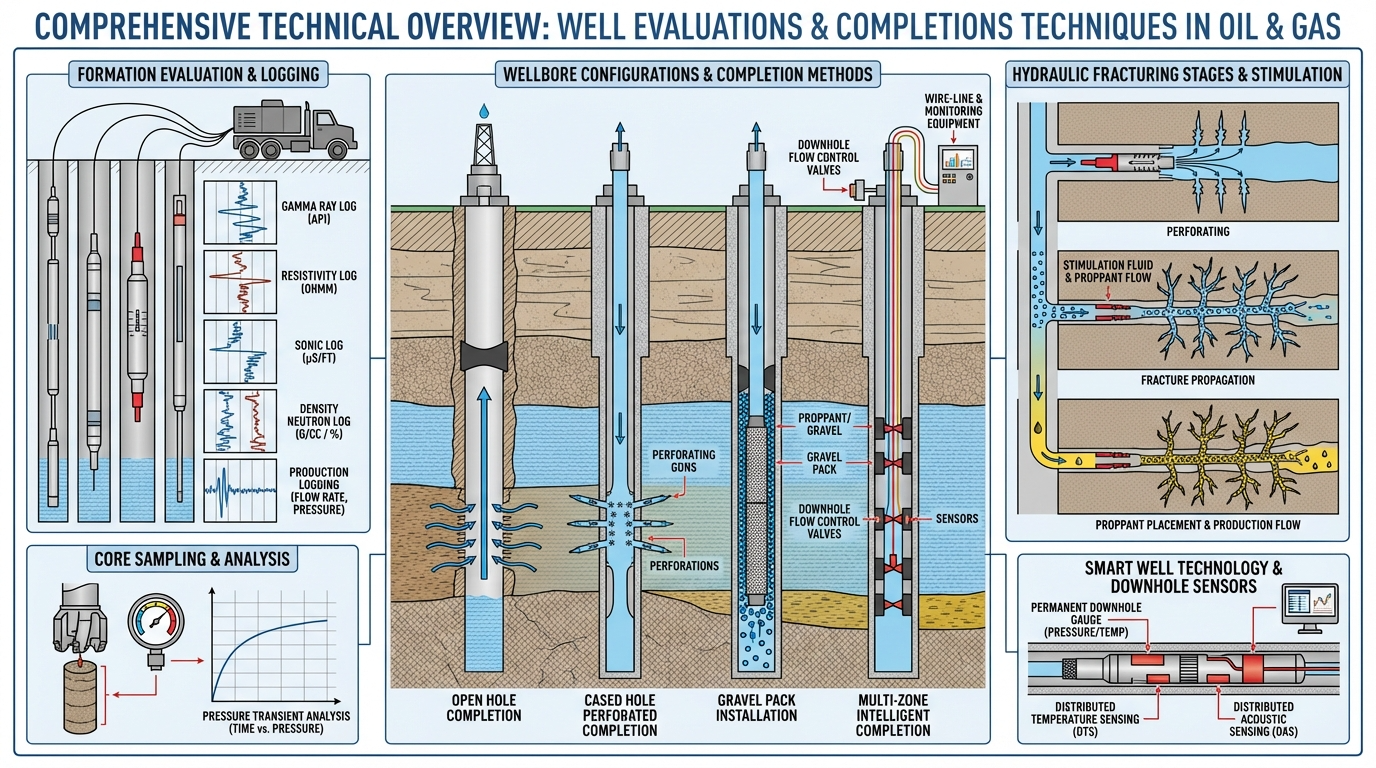
Openhole completions: advantages and limitations
Cased and perforated completions
Liner completions and expandable systems
Gravel pack completions for sand control
Slotted liner and pre-packed screens
Completion selection criteria
Economic considerations and optimization
Regional completion practices in Middle East and Africa
Module 3.2: Perforating Technology
Perforating gun systems: wireline, tubing-conveyed, through-tubing
Shaped charge design and performance
Perforation parameters: shot density, phasing, penetration
Underbalanced vs. overbalanced perforating
Extreme overbalance perforating techniques
Perforation damage and cleanup
Perforating strategy for horizontal wells
Oriented perforating in fractured reservoirs
Afternoon Session: Sand Control and Production Enhancement
Module 3.3: Sand Control Techniques
Sand production mechanisms and prediction
Sanding criteria and risk assessment
Gravel pack design: conventional and high-rate
Frac-and-pack completions
Expandable sand screens technology
Standalone screen completions
Chemical consolidation methods
Sand control in Oman weak sandstone formations
Module 3.4: Well Stimulation Methods
Acidizing Treatments:
Matrix acidizing fundamentals
Acid types: HCl, HF, organic acids
Carbonate acidizing: wormhole creation
Sandstone acidizing: clay stabilization
Acid placement techniques
Diversion methods: mechanical, chemical
Post-acidizing evaluation
Hydraulic Fracturing:
Fracture mechanics and geometry
Proppant selection and placement
Fracture design optimization
Horizontal well multi-stage fracturing
Unconventional reservoir stimulation
Saudi Arabia’s tight gas fracturing programs
Environmental considerations and regulations
Day 4: Advanced Completions and Intelligent Systems
Morning Session: Horizontal and Complex Well Completions
Module 4.1: Horizontal Well Completions
Openhole horizontal completions
Cased-hole horizontal completions
Multi-stage fracturing systems: plug-and-perf, sliding sleeves
Cemented vs. uncemented completions
Liner hanger systems and accessories
Swellable packer technology
Extended reach drilling (ERD) completions
Maximum reservoir contact (MRC) well completions in Saudi fields
Module 4.2: Multilateral and Multi-zone Completions
Multilateral well classification (TAML levels 1-6)
Junction design and integrity
Multi-zone completion strategies
Selective completion techniques
Zone isolation: packers, bridge plugs, valves
Commingled production considerations
Dual completion systems
Multi-lateral wells in Oman mature fields
Afternoon Session: Intelligent Well Technology
Module 4.3: Intelligent Completion Systems
Intelligent well objectives and benefits
Downhole monitoring sensors: pressure, temperature, flow
Inflow control devices (ICD): passive flow control
Inflow control valves (ICV): active flow control
Interval control valves and sliding sleeves
Downhole gauges: permanent monitoring systems
Fiber optic distributed sensing: DTS, DAS
Real-time reservoir management applications
Module 4.4: Completion Optimization
Production optimization through intelligent systems
Water and gas conformance control
Reservoir surveillance using downhole data
Remote well control and automation
Integration with digital oilfield platforms
Economic justification of intelligent completions
Case studies: ADNOC intelligent field implementations
Lessons learned from GCC intelligent well projects
Day 5: Well Intervention and Integrity Management
Morning Session: Workover and Intervention Operations
Module 5.1: Well Intervention Techniques
Workover vs. intervention definitions
Intervention objectives: production enhancement, remedial, abandonment
Rig-based workover operations
Coiled tubing interventions
Wireline operations: slickline and e