Welding Safety and Equipment Operation
$5500.00
Welding Safety and Equipment Operation: 5-Day Professional Training Course
Course Overview
This comprehensive 5-day welding safety course delivers essential training in occupational health protocols, hazard prevention, equipment operation, and workplace safety management across Saudi Arabia (KSA), Oman, UAE, Qatar, Kuwait, Bahrain, and African industrial markets. This OSHA-aligned safety certification program covers PPE requirements, fire prevention, electrical safety, fume control, and confined space procedures essential for construction, oil and gas, manufacturing, and maintenance operations throughout the GCC region and Africa.
Target Audience
Safety officers and HSE supervisors in Saudi Aramco, ADNOC, and GCC facilities
Welding supervisors managing safety compliance in Oman and UAE manufacturing
New welders requiring fundamental safety training before hands-on practice
Maintenance technicians in African mining and energy sectors
Plant managers responsible for workplace safety standards across Middle East
Day 1: Welding Hazards and Personal Protective Equipment
Morning Session: Workplace Hazards Identification
Arc radiation dangers: UV, visible light, infrared exposure and “welder’s flash”
Toxic fume exposure: manganese, chromium, nickel health effects
Electrical shock hazards: primary/secondary voltage dangers in welding circuits
Fire and explosion risks: flammable materials, compressed gases, hot work
Heat stress management in Saudi Arabian desert conditions
Ergonomic hazards: repetitive motion, awkward positioning, physical strain
Case studies: accidents in GCC construction and African facilities
Afternoon Session: Personal Protective Equipment Standards
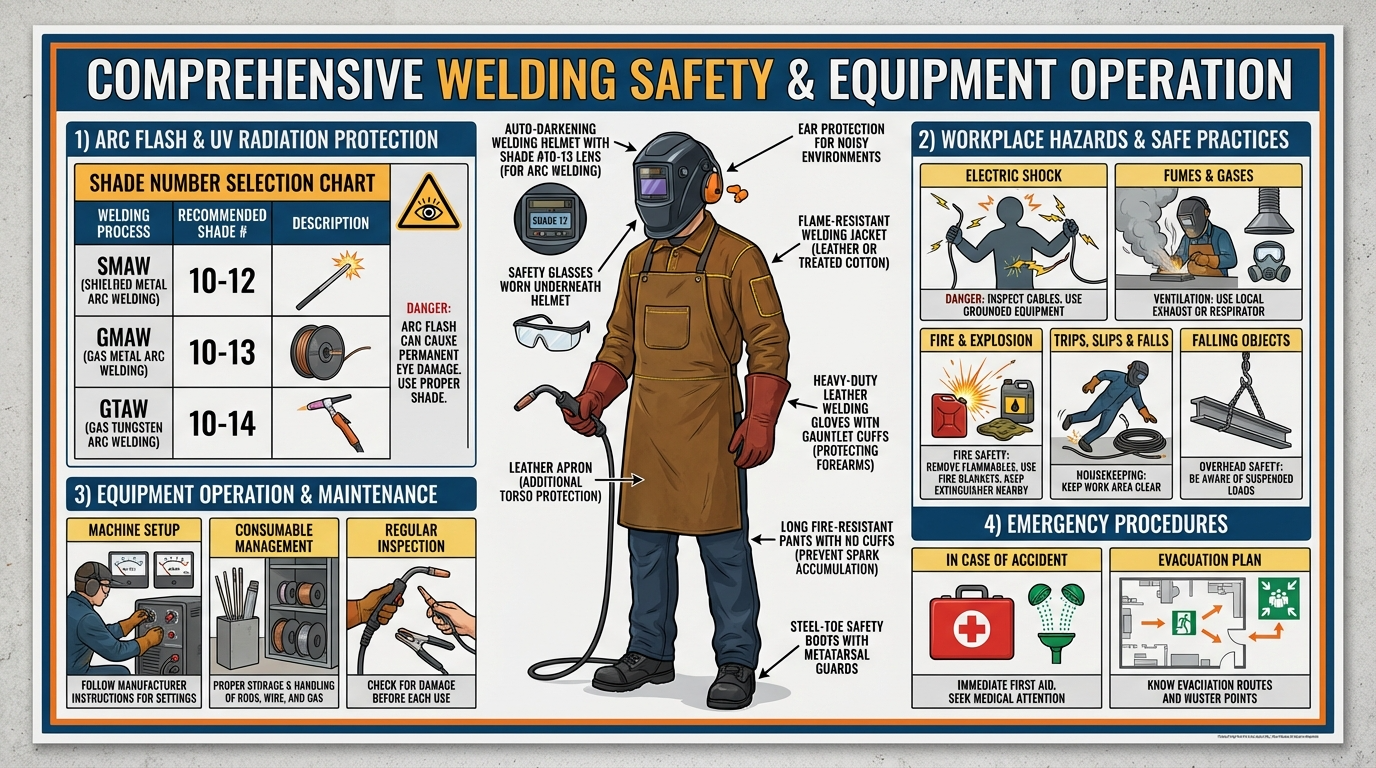
Welding helmets: ANSI Z87.1 standards, shade selection (#8-#14)
Auto-darkening technology: benefits, maintenance, productivity improvement
Protective clothing: flame-resistant materials, leather jackets, aprons
Hand protection: welding gloves, TIG gloves, heat-resistant specifications
Respiratory protection: half-mask respirators, PAPRs for confined spaces
PPE inspection: daily checks, replacement criteria, documentation
Employer responsibilities per KSA labor law and GCC regulations
Hands-on practice: proper PPE donning, fit testing procedures
Learning Outcomes: Comprehensive hazard awareness and PPE competency ensuring compliance with GCC occupational health standards and African workplace safety requirements.
Day 2: Fire Prevention and Electrical Safety
Morning Session: Fire Prevention and Hot Work Permits
Fire triangle principles: fuel, oxygen, heat in welding environments
Safe distances: 35-foot radius clearance per NFPA 51B
Fire watch requirements: during and 30-minute post-welding monitoring
Hot work permit systems for Saudi Aramco and ADNOC facilities
Compressed gas cylinder safety: storage, handling, transportation
Fire extinguisher types: Class A, B, C, D selection and PASS technique
Emergency evacuation procedures: assembly points, communication
Practical exercises: fire extinguisher training, permit completion
Afternoon Session: Electrical Safety Standards
Voltage dangers: primary (230V/460V) and secondary (20-100V) hazards
Wet conditions risks: moisture increasing electrical conductivity
Proper grounding techniques: workpiece connection, fault protection
Cable inspection: damage assessment, insulation integrity
Lockout/Tagout (LOTO): de-energization for maintenance
Electrical safety in confined spaces: low-voltage systems, platforms
Emergency response: electrical shock first aid, CPR
GCC compliance: Saudi Electrical Code, UAE Fire and Life Safety Code
Learning Outcomes: Fire prevention expertise and electrical safety competency preventing workplace incidents in GCC industrial facilities and African construction environments.
Day 3: Ventilation, Fume Control and Respiratory Protection
Morning Session: Welding Fumes and Toxic Exposure
Fume composition: base metal, filler metal, coating particulates
Hexavalent chromium: stainless steel welding carcinogenic compounds
Manganese exposure: neurological effects from high-manganese electrodes
Zinc oxide fumes: galvanized steel causing metal fume fever
Nitrogen dioxide and ozone: gas-shielded welding respiratory irritants
Exposure limits: OSHA PELs, ACGIH TLVs for fume components
Health surveillance: medical monitoring programs
Afternoon Session: Ventilation Systems
General ventilation: building air exchange, natural vs mechanical
Local exhaust ventilation (LEV): fume extraction guns, flexible arms
Source capture: positioning extraction within 6-12 inches of arc
Portable fume extractors: mobile units for field welding
Confined space ventilation: forced air, continuous monitoring
Respirator types: N95, P100, half-mask, full-face, PAPR systems
Fit testing requirements: qualitative and quantitative protocols
Practical exercises: ventilation inspection, respirator fit testing
GCC compliance: Saudi OSHA, Oman Ministry of Manpower
Learning Outcomes: Comprehensive fume control knowledge protecting long-term health in GCC petrochemical and African industrial welding environments.
Day 4: Confined Space Entry and Specialized Environments
Morning Session: Confined Space Hazards
Confined space definition: limited entry/exit, not continuous occupancy
Examples: tanks, vessels, pipelines in GCC oil facilities
Atmospheric hazards: oxygen deficiency/enrichment, LEL monitoring
Toxic gases: H2S in petrochemical environments, carbon monoxide
Permit-required spaces: OSHA 1910.146 compliance procedures
Entry permits: atmospheric testing, authorized entrants, supervisors
Gas monitoring: multi-gas detectors, calibration, bump testing
Rescue procedures: non-entry systems, emergency response planning
Case studies: incidents in Saudi industrial facilities
Afternoon Session: Specialized Welding Environments
Underwater welding: hyperbaric conditions, electrical hazards
High-altitude welding: GCC skyscrapers, fall protection
Explosive atmospheres: Zone classification, intrinsically safe equipment
Cryogenic environments: LNG facilities in Qatar and Oman
Offshore platform welding: marine challenges, weather conditions
Pipeline welding: outdoor hazards in African terrain, remote locations
Practical exercises: confined space simulation, atmospheric monitoring
Emergency drills: rescue scenarios, evacuation procedures
Learning Outcomes: Advanced safety competency for specialized GCC offshore platforms, refineries, and African mining operations requiring confined space certification.
Day 5: Equipment Operation and Safety Management
Morning Session: Welding Equipment Safe Operation
Arc welding machine safety: power source inspection, operation
Cable management: proper sizing, routing, avoiding hazards
Gas cylinder handling: transportation, securing, valve protection
Regulator operation: installation, leak testing, pressure settings
Cutting torch safety: flashback arrestors, reverse flow valves
Plasma cutting: high-frequency EMI, arc voltage safety
Grinding equipment: guard installation, wheel inspection, RPM ratings
Preventive maintenance: daily inspections, servicing, documentation
Afternoon Session: Safety Management Systems
Safety culture development: leadership commitment in GCC organizations
Hazard communication: SDS, chemical labeling, training
Job safety analysis (JSA): task breakdown, hazard identification
Safety audits: workplace examinations, corrective action tracking
Incident investigation: root cause analysis, preventive action
Welding safety standards: ANSI Z49.1, ISO 45001, AWS requirements
GCC regulatory compliance: Saudi Civil Defense, UAE OSHAD, Oman OSHA
African standards: South African OHSA, regional regulations
Documentation: training records, inspection reports, incident logs
Safety performance metrics: TRIR, DART, leading indicators
Mock safety audit: hazard identification exercise
Final examination and certification issuance
Learning Outcomes: Complete safety management competency enabling safety officer and HSE coordinator roles in GCC industrial facilities and African construction projects.
Course Benefits for GCC and African Markets
✓ OSHA-aligned curriculum meeting Saudi Aramco, ADNOC safety requirements
✓ Practical hazard recognition reducing workplace incidents by 60-80%
✓ Confined space certification for high-paying petrochemical positions
✓ Regulatory compliance for KSA, UAE, Oman, Qatar regulations
✓ Bilingual instruction (English/Arabic) for Middle East accessibility
✓ Industry-recognized certification across GCC and African sectors
✓ Career advancement: pathways to safety supervisor (SAR 10,000-18,000)
Investment in Safety Excellence
Welding safety expertise is mandatory across GCC industrial sectors and increasingly required in African manufacturing. With Vision 2030 safety initiatives and zero-harm goals, demand for certified safety professionals continues growing. Safety-trained welders command 15-30% salary premiums and access leadership positions in oil and gas, construction, manufacturing, and power generation sectors.
Register now to protect lives, ensure compliance, and advance your career in the safety-focused GCC industrial economy and Africa’s developing markets!
Keywords: welding safety course KSA, welding safety training Saudi Arabia, HSE welding certification Oman, welding safety officer GCC, OSHA welding safety Africa, confined space welding training, PPE welding course Middle East, fire safety welding Gulf, electrical safety welding UAE, Saudi Aramco safety requirements, ADNOC HSE training, welding fume control, hot work permit training Qatar Kuwait, welding equipment safety, industrial safety certification Africa, welding supervisor safety course