Upstream Production for Oil and Gas
$5500.00
Upstream Production for Oil and Gas: 5-Day Professional Training Course
Course Overview
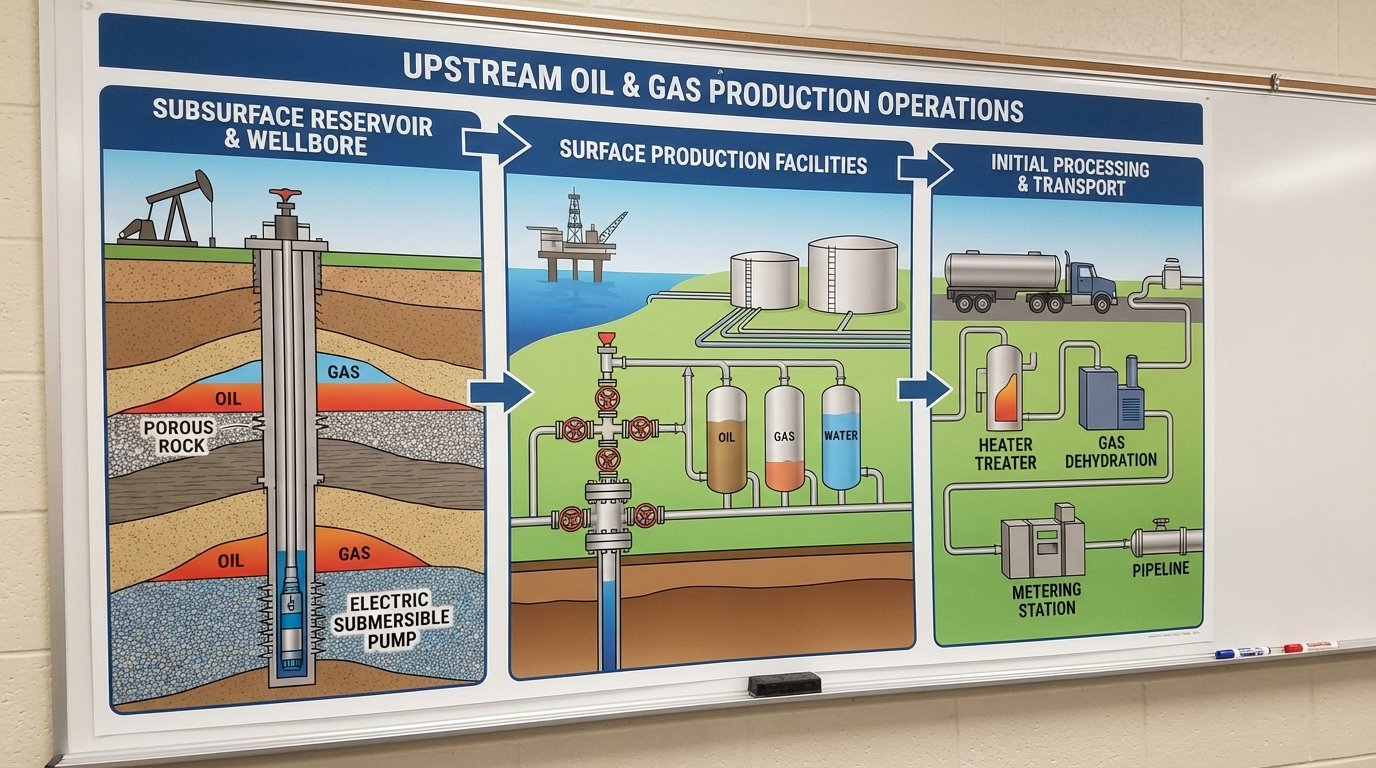
This intensive 5-day training program provides comprehensive knowledge of upstream oil and gas production operations, from reservoir to surface facilities. Specifically designed for professionals in the Kingdom of Saudi Arabia (KSA), Oman, GCC countries, and Africa, this course covers production engineering fundamentals, artificial lift systems, well performance optimization, and facility operations essential for maximizing hydrocarbon recovery.
Who Should Attend
Production engineers and supervisors
Reservoir engineers and petroleum technologists
Operations engineers and field operators
Facility engineers and process technicians
Asset managers and production optimization specialists
Maintenance engineers in upstream operations
Technical professionals from Saudi Aramco, PDO, ADNOC, and African operators
Engineering graduates entering upstream production
Day 1: Fundamentals of Oil and Gas Production
Morning Session: Production System Overview
Module 1.1: Introduction to Upstream Production
Upstream production value chain overview
Well completion and production lifecycle
Primary, secondary, and tertiary recovery methods
Production phases: exploration, development, plateau, and decline
Regional production landscape: KSA’s super-giant fields, Oman’s mature assets, GCC offshore platforms
African production environments: Nigeria, Angola, Egypt, Algeria, and emerging basins
Module 1.2: Reservoir and Well Performance
Reservoir drive mechanisms: solution gas, gas cap, water drive, gravity drainage
Productivity index (PI) and inflow performance relationships (IPR)
Vogel’s correlation and composite IPR curves
Well deliverability and AOF (absolute open flow)
Skin factor and formation damage assessment
Pressure transient analysis fundamentals
Decline curve analysis: exponential, hyperbolic, harmonic
Afternoon Session: Well Completion and Production Systems
Module 1.3: Well Completion Design
Completion types: openhole, cased-hole, liner completions
Perforating strategies and techniques
Sand control methods: gravel pack, frac-pack, screens
Intelligent well completions and downhole monitoring
Multilateral and multi-zone completions
Horizontal well completions in Saudi tight reservoirs
HPHT completions in GCC sour gas fields
Module 1.4: Production Tubing and Wellhead Equipment
Tubing design and selection criteria
Production packers and subsurface safety valves
Wellhead and Christmas tree configurations
Surface safety systems and emergency shutdown devices
Corrosion-resistant alloys for sour service
Material selection for H2S and CO2 environments
API standards and regional regulatory requirements
Day 2: Artificial Lift Systems
Morning Session: Natural Flow and Artificial Lift Selection
Module 2.1: Natural Flow Production
Vertical lift performance and pressure losses
Multiphase flow in tubing: flow regimes and correlations
Gas lift valve spacing and gradient curves
Critical flow rate and liquid loading
Tubing performance relationships (TPR)
Systems analysis and nodal analysis
Well performance optimization
Module 2.2: Artificial Lift Methods Overview
Artificial lift selection criteria and decision matrix
Economic evaluation of lift methods
Regional applications in Middle East and Africa
Lifting challenges in mature fields
High water cut and heavy oil production
Deepwater and subsea lift considerations
Afternoon Session: Artificial Lift Technologies
Module 2.3: Gas Lift Systems
Continuous and intermittent gas lift principles
Gas lift valve design and operation
Gas lift design: valve spacing and mandrel selection
Unloading procedures and troubleshooting
Gas lift optimization in Saudi Arabia and Kuwait fields
Compressed gas availability and allocation
Plunger lift for low-volume wells
Module 2.4: Sucker Rod Pumping and ESP
Sucker rod pumping system components
Pump sizing and design calculations
Rod string design and optimization
Dynamometer analysis and beam pump troubleshooting
Electric submersible pumps (ESP): design and selection
ESP applications in high-volume Oman wells
Variable speed drive control and optimization
ESP monitoring and failure analysis
Module 2.5: Other Artificial Lift Methods
Progressive cavity pumps (PCP) for heavy oil
Hydraulic pumping systems
Jet pumps and their applications
Hybrid lift systems
Artificial lift in African heavy oil fields
Cost-benefit analysis of lift systems
Day 3: Production Operations and Well Testing
Morning Session: Well Testing and Analysis
Module 3.1: Production Testing Fundamentals
Well test objectives and planning
Surface and downhole test equipment
Separator testing and metering systems
Multiphase flow meters and allocation
Test separator principles and sizing
Data acquisition and quality control
Safety considerations during testing operations
Module 3.2: Pressure Transient Testing
Buildup and drawdown tests
Falloff and injection tests
Test design and duration estimation
Wellbore storage and skin effects
Boundary detection and reservoir characterization
Interference and pulse testing
Modern pressure gauge technology
Interpretation software and analysis techniques
Afternoon Session: Production Monitoring and Optimization
Module 3.3: Production Monitoring Systems
Real-time production monitoring and SCADA systems
Downhole sensors and permanent monitoring
Production logging tools: spinner, flowmeter, temperature
Production profiling in multilateral wells
Surveillance techniques for mature fields
Data analytics and machine learning applications
Digital oilfield technology in Saudi Aramco and ADNOC
Module 3.4: Production Optimization Strategies
Field development optimization
Production forecasting and allocation
Choke management and flow optimization
Water cut and gas-oil ratio (GOR) management
Production decline mitigation strategies
Integrated asset modeling
Production enhancement in Oman’s mature fields
Cost per barrel optimization techniques
Day 4: Production Facilities and Surface Processing
Morning Session: Separation and Processing
Module 4.1: Oil and Gas Separation
Phase behavior and separation principles
Two-phase and three-phase separators
Separator sizing and design criteria
Stage separation and pressure optimization
Separator internals and efficiency enhancement
Foam and emulsion handling
Separator performance monitoring
Free water knockout (FWKO) systems
Module 4.2: Crude Oil Processing and Stabilization
Crude oil treating and dehydration
Electrostatic desalting processes
Oil stabilization and vapor recovery
Storage tank design and operations
Crude oil blending and quality control
Export specifications: Arab Light, Arab Heavy, Oman crude
Heating systems and heat exchanger networks
Afternoon Session: Gas Processing and Water Handling
Module 4.3: Gas Processing and Treatment
Natural gas conditioning and sweetening
Gas dehydration: glycol and molecular sieve systems
Hydrocarbon dew point control
Gas compression and export systems
Sulfur recovery and acid gas treatment
Associated gas management in African flare reduction programs
Sales gas specifications for GCC markets
NGL recovery and LPG production
Module 4.4: Produced Water Management
Produced water characteristics and treatment
Oil-water separation technologies
Dissolved gas flotation and hydrocyclones
Water injection systems for pressure maintenance
Water quality requirements for injection
Disposal methods and environmental regulations
Zero discharge initiatives in GCC
Water treatment in African operations
Day 5: Advanced Production Topics and Best Practices
Morning Session: Enhanced Oil Recovery and Special Operations
Module 5.1: Enhanced Oil Recovery (EOR) Methods
Secondary recovery: waterflooding and pressure maintenance
Chemical EOR: polymer, surfactant, alkaline flooding
Thermal EOR: steam injection, SAGD, in-situ combustion
Gas injection: CO2, nitrogen, hydrocarbon gas
Miscible and immiscible displacement
EOR screening criteria and economics
Saudi Arabia’s Shaybah CO2 EOR project
Oman’s polymer flooding initiatives in Marmul field
Module 5.2: Special Production Challenges
Heavy oil production in Kuwait and Venezuela
Sour gas production in Saudi Arabia and UAE
HPHT production operations
Deepwater production systems in West Africa
Sand production control and management
Scale, wax, and asphaltene prevention
Corrosion management and inhibition programs
Production from tight and unconventional reservoirs
Afternoon Session: HSE and Future Technologies
Module 5.3: Production Safety and Environmental Management
Process safety management in production operations
Hazard identification and risk assessment (HAZID/HAZOP)
H2S safety protocols in GCC sour fields
Flare reduction and gas conservation
Environmental regulations: Saudi, Omani, and African standards
Methane emissions monitoring and control
Spill prevention and response procedures
Occupational health in production facilities
Module 5.4: Emerging Technologies and Case Studies
Digital transformation in upstream production
Artificial intelligence for production optimization
Predictive maintenance and IoT sensors
Autonomous operations and robotics
Carbon capture utilization and storage (CCUS)
Geothermal energy integration
Energy transition implications for upstream
Module 5.5: Regional Case Studies Workshop
Saudi Arabia: Ghawar field maximum reservoir contact production
Oman: Mature field rejuvenation strategies at Yibal field
UAE: Offshore ADNOC sour gas production optimization
Kuwait: Heavy oil production enhancement in Greater Burgan
Qatar: North Field gas condensate handling
Nigeria: Deepwater production operations management
Angola: Subsea production systems and FPSO operations
Egypt: Mediterranean gas production and processing
Interactive troubleshooting exercises
Production problem diagnostic workshop
Q&A and knowledge sharing session
Course Learning Outcomes
Participants will gain:
Comprehensive understanding of oil and gas production systems and operations
Practical skills in well performance analysis and optimization
Technical knowledge of artificial lift selection and design
Operational expertise in surface facilities and processing systems
Problem-solving abilities for production challenges
Regional insights specific to KSA, Oman, GCC, and African operations
Safety awareness for HPHT and sour service environments
Economic evaluation skills for production optimization projects
Regional Applications: KSA, Oman, GCC & Africa
Kingdom of Saudi Arabia: Covering super-giant field management, maximum reservoir contact wells, sour gas handling, unconventional tight oil production, and Saudi Aramco’s production excellence standards.
Oman: Focusing on mature field management, enhanced oil recovery implementation, thermal EOR in heavy oil, tight gas production from Khazzan, and PDO operational best practices.
GCC Region: Including ADNOC’s offshore production optimization, Qatar’s gas condensate operations, Kuwait’s heavy oil challenges, Bahrain’s tight oil production, and regional HSE requirements.
Africa: Addressing deepwater production systems, FPSO operations, gas flaring reduction programs, marginal field development, and diverse regulatory environments across Nigeria, Angola, Egypt, Ghana, and Mozambique.
Training Methodology
Expert-led technical lectures with industry examples
Hands-on engineering calculations and simulations
Production optimization software demonstrations
Case study analysis from regional operations
Interactive problem-solving workshops
Group discussions and experience sharing
Video demonstrations of field operations
Comprehensive technical handouts and references
Duration: 5 days (40 training hours)
Delivery: In-person, virtual, or hybrid format
Language: English (Arabic translation available)
Certification: Professional completion certificate recognized by industry
Keywords: upstream production training, oil and gas production course KSA, production engineering Oman, GCC production operations, African petroleum production, artificial lift training, production optimization Middle East, reservoir production management, Saudi Aramco production, PDO operations training, surface facilities course, well testing and analysis