Safety leadership and culture
$5500.00
Safety Leadership & Culture: Executive 5-Day Training Course
Course Overview
This transformational Safety Leadership and Culture training program delivers strategic expertise for executives and managers across the Kingdom of Saudi Arabia (KSA), Oman, GCC countries (UAE, Qatar, Kuwait, Bahrain), and Africa. The course covers leadership behaviors, safety culture assessment, behavioral safety, organizational change, performance measurement, and employee engagement strategies essential for building world-class safety performance in oil & gas, petrochemical, construction, mining, and industrial sectors.
With the Middle East and Africa operating high-hazard industries employing millions, this training addresses critical competencies for leaders at Saudi Aramco, SABIC, Ma’aden, PDO (Petroleum Development Oman), ADNOC, Qatar Energy, Dangote, Sasol, driving transformation from compliance-based to values-based safety, achieving zero-harm goals, supporting Saudi Vision 2030 safety excellence and regional industrial competitiveness.
Target Audience
Senior Executives and C-suite leaders in oil & gas, petrochemical, industrial sectors
Operations Directors and Plant Managers across Saudi Arabia, Oman, GCC, Africa
HSE Directors and Safety Managers leading safety programs
Project Managers managing major construction and industrial projects
HR Directors integrating safety into organizational culture
Department Heads responsible for team safety performance
Site Managers building safety leadership at operational level
Day 1: Safety Leadership Fundamentals
Morning Session: Leadership’s Role in Safety
Leadership vs. management: inspiring vs. controlling, vision vs. tasks
Business case for safety: moral, legal, financial imperatives, operational excellence
Cost of incidents: fatalities, injuries, property damage, business interruption, reputation
Statistics: GCC industrial safety performance, regional incident trends, benchmarking
Leadership impact: correlation between leadership engagement and safety outcomes
Visible felt leadership: site visits, safety conversations, leading by example
Leadership theories: transformational, servant, authentic leadership applied to safety
Personal commitment: leaders’ safety values, beliefs, walking the talk
Regional considerations: diverse workforce (100+ nationalities in GCC), cultural sensitivity
Case studies: Saudi Aramco safety culture transformation, DuPont safety excellence
Afternoon Session: Safety Culture Framework
Culture definition: shared values, beliefs, attitudes, behaviors regarding safety
Culture maturity models: Hudson (pathological to generative), Bradley Curve (reactive to interdependent)
Five stages: pathological, reactive, calculative, proactive, generative/interdependent
Characteristics of each stage: blame culture vs. learning culture, compliance vs. commitment
Current state assessment: where is your organization on maturity curve?
Vision for target culture: interdependent safety, collective responsibility, continuous learning
Culture change journey: long-term commitment (3-5 years typical), sustained leadership
Resistance to change: understanding barriers, addressing skepticism, building momentum
Workshop: Self-assessment of organizational safety culture maturity
Day 2: Behavioral Safety & Human Factors
Morning Session: Understanding Human Behavior
Human error: slips, lapses, mistakes, violations, system-induced errors
Error causation: Swiss cheese model (Reason), latent vs. active failures
At-risk behaviors: shortcuts, normalization of deviance, production pressure
Psychological factors: complacency, overconfidence, fatigue, stress
Situational awareness: recognizing hazards, maintaining focus in routine tasks
Cognitive biases: confirmation bias, optimism bias, availability heuristic
Motivation theories: Maslow’s hierarchy, Herzberg two-factor, intrinsic vs. extrinsic
Why people take risks: time pressure, peer influence, perceived low probability
Cultural dimensions: Hofstede’s framework (power distance, collectivism) in GCC/Africa context
Communication across cultures: hierarchical vs. flat, direct vs. indirect
Afternoon Session: Behavioral Safety Programs
Behavior-Based Safety (BBS): observation, feedback, reinforcement of safe behaviors
BBS process: define critical behaviors, observe, provide feedback, track trends, intervene
Observation techniques: non-punitive, focused on behaviors not people, positive reinforcement
Feedback delivery: timely, specific, constructive, two-way conversation
Peer-to-peer observations: empowering workforce, building accountability
Common BBS pitfalls: blame focus, data collection without action, management disengagement
Integration with systems: combining behavioral and engineering controls
Stop Work Authority: empowering all employees to intervene, removing fear of retribution
Near-miss reporting: encouraging proactive hazard identification, learning culture
Recognition programs: celebrating safe behaviors, team achievements, individual contributions
Case studies: BBS success at SABIC, ADNOC behavioral programs
Workshop: Designing effective safety observation process
Day 3: Communication, Engagement & Influence
Morning Session: Safety Communication
Communication principles: clarity, consistency, frequency, multi-channel approach
Leadership communication: town halls, toolbox talks, safety moments, personal stories
Storytelling: using real incidents, near-misses, personal experiences to influence behavior
Active listening: understanding concerns, addressing barriers, building trust
Two-way dialogue: encouraging questions, feedback, open discussion without fear
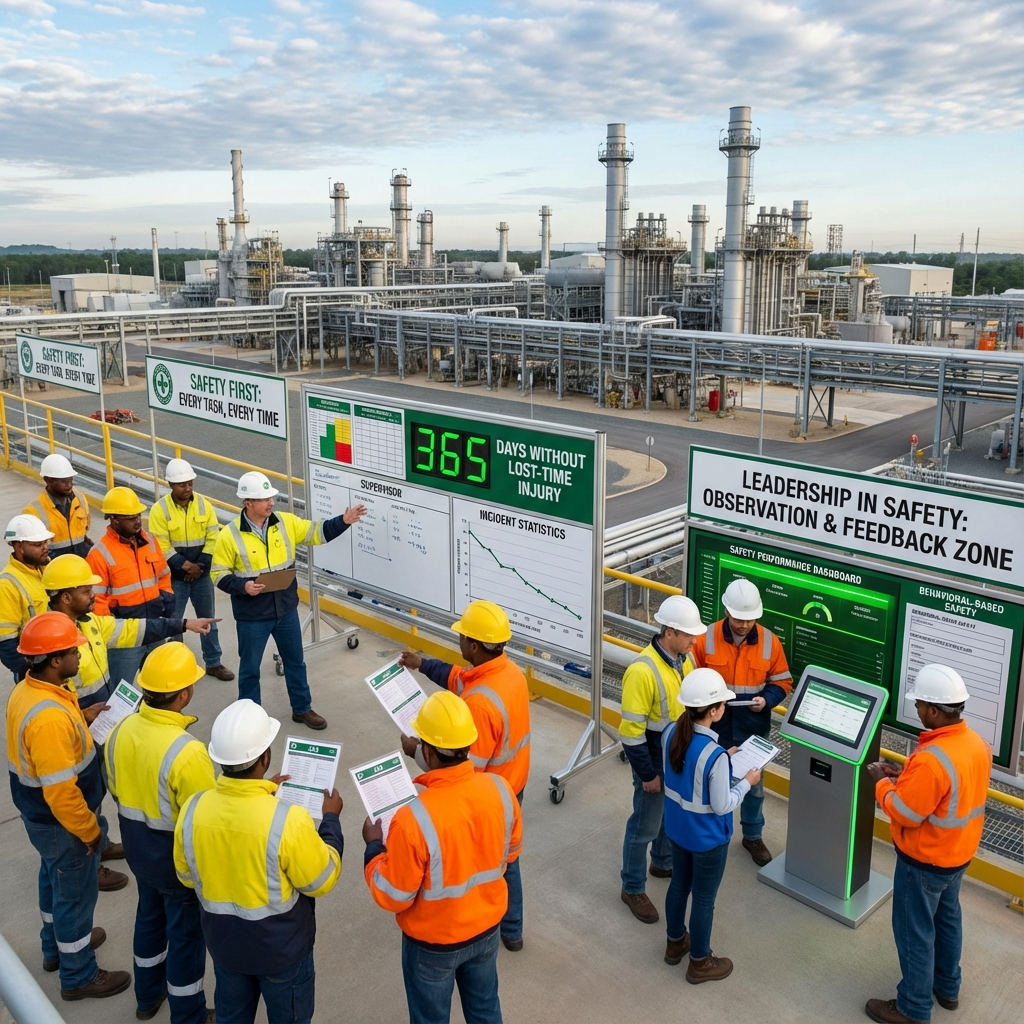
Visual communication: safety posters, digital displays, dashboards, videos
Effectiveness in multi-lingual workforce: translation, pictorial, universal symbols
Safety meetings: effective facilitation, engaging participation, action tracking
Toolbox talks: short, focused, interactive, relevant to work activities
Pre-job briefings: hazard identification, task planning, team alignment
Safety campaigns: themes, sustained messaging, measuring impact
Digital tools: mobile apps, social media, intranet for safety engagement
Regional considerations: communication styles in Saudi Arabia, Oman, UAE, Africa
Afternoon Session: Employee Engagement & Empowerment
Engagement definition: emotional commitment, discretionary effort, ownership
Engaged vs. disengaged workforce: safety performance correlation
Building trust: transparency, keeping commitments, admitting mistakes, fairness
Empowerment: giving authority, resources, training to make safety decisions
Safety committees: cross-functional, representative, empowered to drive change
Worker participation: hazard identification, risk assessment, procedure development
Suggestion programs: encouraging ideas, responding promptly, implementing improvements
Recognition and reward: monetary vs. non-monetary, individual vs. team
Fairness and consistency: just culture, accountability without fear
Frontline supervisor role: critical bridge between management and workforce
Supervisor development: coaching, leadership skills, safety competencies
Workshop: Designing employee engagement strategy for your organization
Day 4: Performance Measurement & Continuous Improvement
Morning Session: Safety Performance Metrics
Lagging indicators: TRIR (Total Recordable Incident Rate), LTIR, fatality rate, severity
Limitations of lagging indicators: reactive, historical, manipulation risk
Leading indicators: observations, inspections, training completion, near-miss reports, audits
Predictive value: correlating leading indicators with injury prevention
Balanced scorecard approach: combining lagging, leading, culture indicators
Process safety metrics: API RP 754 Tier 1, Tier 2, Tier 3 events
OSHA recordkeeping: Saudi Arabia GOSI reporting, GCC requirements, international standards
Benchmarking: comparing performance against industry, best-in-class (Saudi Aramco, Shell, ExxonMobil)
Data quality: accurate recording, classification consistency, avoiding underreporting
Dashboards and visualization: real-time displays, trend analysis, accessibility
Goal setting: SMART objectives, zero-harm vision, interim targets
Dangerous metrics: focusing solely on TRIR, unintended consequences, gaming the system
Afternoon Session: Audits, Inspections & Root Cause Analysis
Safety audits: compliance verification, management system effectiveness
Behavioral safety audits: assessing leadership, culture, workforce engagement
Inspection programs: workplace, equipment, PPE, systematic coverage
Hazard identification: JSA (Job Safety Analysis), HAZOP, pre-task risk assessment
Incident investigation: comprehensive, timely, blame-free focus on system failures
Root cause analysis: 5-Why, fishbone, Apollo, TapRooT methodologies
Learning from incidents: sharing lessons, implementing corrective actions, verification
Near-miss potential: Heinrich’s pyramid, recognizing warning signals
Continuous improvement: PDCA (Plan-Do-Check-Act), Kaizen principles
Management of change (MOC): assessing safety impact of changes, formal process
Workshop: Root cause analysis exercise, corrective action development
Day 5: Driving Cultural Transformation
Morning Session: Leading Organizational Change
Change management models: Kotter’s 8 steps, ADKAR, Lewin’s force field analysis
Creating urgency: compelling case for change, leadership alignment
Vision and strategy: defining desired culture, roadmap, milestones
Communication plan: consistent messaging, addressing concerns, celebrating wins
Coalition building: engaging champions, middle management buy-in, influencer network
Overcoming resistance: understanding sources, addressing fears, involving skeptics
Quick wins: demonstrating progress, building momentum, reinforcing commitment
Sustaining change: embedding in systems, processes, leadership routines
Cultural assessment tools: surveys, focus groups, observations, safety perception studies
Integration with business: connecting safety to operational excellence, quality, reliability
Contractor safety management: extending culture to contractors (critical in GCC projects)
Afternoon Session: Personal Leadership Development Plan
Self-assessment: leadership strengths, development areas, blind spots
Leadership behaviors: visible commitment, vulnerability, courageous conversations
Psychological safety: creating environment where people speak up without fear
Emotional intelligence: self-awareness, empathy, relationship management
Conflict resolution: addressing safety violations, difficult conversations, accountability
Coaching and mentoring: developing safety leaders at all levels
Succession planning: building leadership pipeline, identifying high potentials
Personal action plan: 90-day priorities, behavior changes, measurable outcomes
Peer accountability: leaders supporting each other, shared commitment
Measuring leadership impact: 360 feedback, safety climate surveys, observable behaviors
Organizational roadmap: 1-year, 3-year culture transformation plan
Commitment and accountability: public declaration, follow-through, review mechanisms
Final workshop: Personal and organizational safety leadership action plans
Group presentations and peer feedback
Learning Outcomes
Upon completion, participants will be able to:
Demonstrate visible felt leadership driving safety culture transformation
Assess organizational safety culture maturity and develop improvement strategies
Implement behavioral safety programs changing at-risk behaviors
Communicate effectively engaging workforce across cultures and languages
Empower employees fostering ownership and accountability for safety
Establish meaningful metrics combining lagging and leading indicators
Lead organizational change overcoming resistance, sustaining momentum
Develop personal leadership skills enhancing safety influence
Build interdependent safety culture achieving zero-harm objectives
Course Delivery & Certification
Format: Interactive workshops, self-assessments, case studies, group discussions, role-plays, action planning
Facilitator expertise: International safety culture consultants with GCC/Africa experience
Materials: Leadership manual, assessment tools, action plan templates, case study library
Certification: Executive certificate recognized across KSA, Oman, UAE, Qatar, Kuwait, Bahrain, Africa
Language: English (Arabic support available)
CPD Credits: Senior leadership development recognition
Locations: Riyadh, Dhahran (KSA), Muscat (Oman), Dubai, Abu Dhabi, Doha, Lagos, Johannesburg
Why This Course is Strategic
Leadership drives 70-80% of safety culture. Organizations with strong safety leadership achieve 5-10x better safety performance than industry average. GCC Vision 2030 initiatives demand world-class safety. Contractor-heavy projects (NEOM, Duqm, Dangote) require unified safety culture. Reputational risk from incidents threatens social license, investor confidence, government relations. Best performers (Saudi Aramco 0.06 TRIR, Shell, ExxonMobil) attribute success to leadership commitment and strong culture.
This course delivers proven methodologies from global best practices, Saudi Aramco excellence programs, DuPont safety culture, addressing regional workforce diversity, hierarchical cultures, rapid industrial growth, building sustainable safety transformation aligned with Saudi Vision 2030 and regional competitiveness.
Lead with conviction. Transform culture. Achieve zero harm.