Rework, Modification & Repair of Electronic Assemblies IPC-7711/7721 — Certified IPC Specialist (CIS) Certification | 5-Day Training Course
$5500.00
IPC-7711/7721 — Rework, Modification & Repair of Electronic Assemblies
Certified IPC Specialist (CIS) | 5-Day Training Course Outline
Course Overview
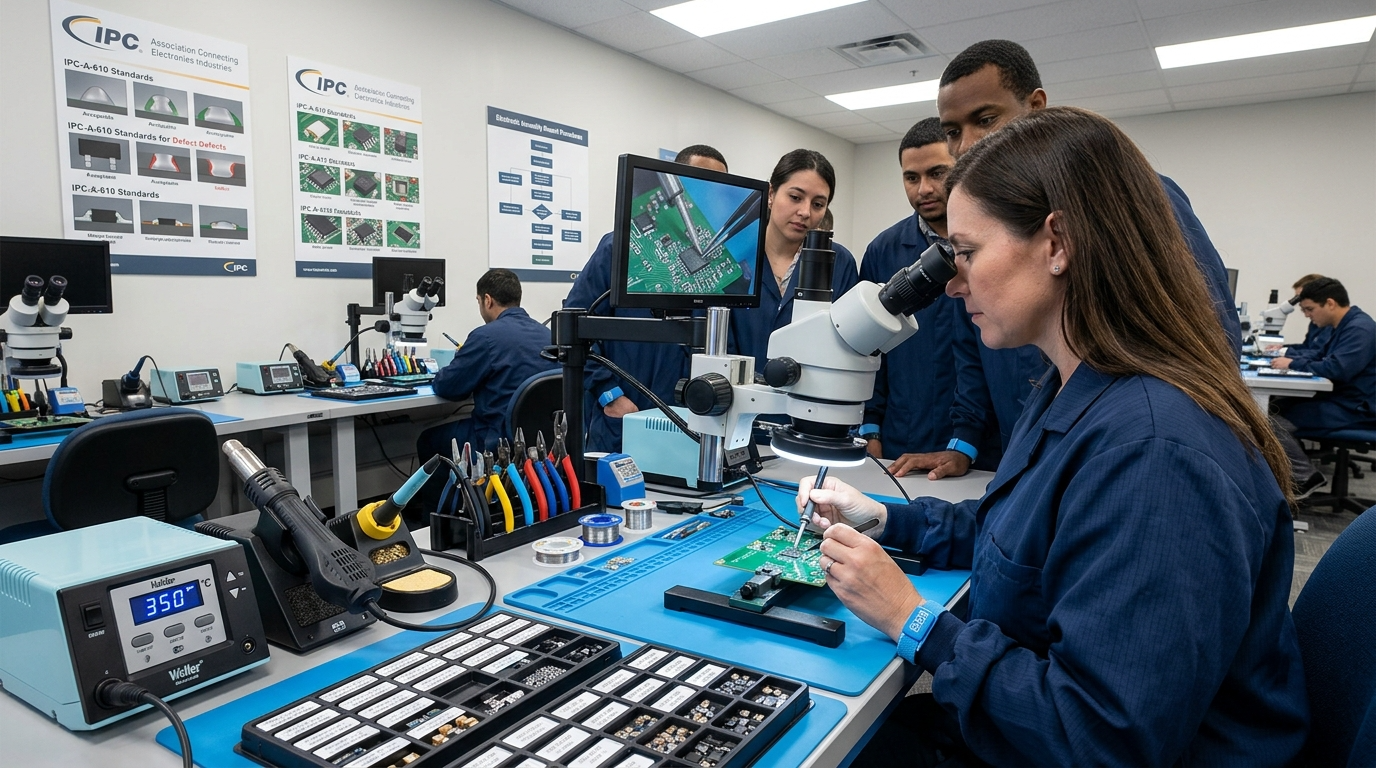
The IPC-7711/7721 Certified IPC Specialist (CIS) certification course is the electronics industry’s gold standard for professionals responsible for the rework, modification, and repair of electronic assemblies. Delivered across five intensive days, this program combines lecture-based instruction with approximately 85% hands-on lab practice, equipping participants with the skills to work on plated through-hole (PTH) and surface mount (SMT) assemblies in full compliance with IPC standards.
Upon successful completion of the written exam (≥70%) and practical workmanship evaluations, participants are awarded the internationally recognised IPC CIS Certification, valid for 24 months.
Who Should Attend: PCB rework technicians, electronics repair specialists, quality assurance personnel, production engineers, and anyone working in aerospace, defense, medical device, or high-reliability electronics manufacturing.
Prerequisite: Proficient soldering skills, including fine-pitch work, are required prior to enrolment.
🎯 Learning Objectives
By the end of this 5-day course, participants will be able to:
Interpret and apply IPC-7711/7721 standard procedures for rework, repair, and modification
Correctly classify products under IPC Class 1, 2, and 3 requirements
Perform hands-on rework on through-hole, SMD, and area array (BGA) components
Execute conformal coating identification, removal, and re-application
Carry out conductor, pad, and laminate repair to IPC-conformance levels
Apply ESD control, lead-free soldering practices, and quality documentation protocols
📅 5-Day Course Structure
Day 1 — Module 1 (Mandatory): Foundations, Policies & IPC-7711/7721 Introduction
This foundational module is mandatory for all CIS candidates and establishes the framework for the entire programme.
Topics Covered:
Introduction to IPC-7711 (Rework) vs. IPC-7721 (Repair & Modification) — understanding the combined standard
IPC Product Classifications — Class 1 (General), Class 2 (Dedicated Service), Class 3 (High Reliability)
Key definitions: Rework vs. Repair vs. Modification and why the distinction matters
Skill levels — Intermediate, Advanced, and Expert
Conformance levels — High (H), Medium (M), Low (L)
Tools, equipment, and materials overview: soldering stations, hot-air systems, desoldering tools, microscopes
ESD control and handling requirements (ESD S20.20)
Lead-free vs. tin-lead soldering considerations
Documentation, traceability, and quality system requirements
Relationship with companion standards: IPC-A-610, J-STD-001, IPC-A-620
Day 2 — Modules 2–4: Wire Splicing, Conformal Coatings & Through-Hole Rework
Module 2 — Wire Splicing Procedures
Mesh, wrap, hook, and lap splice techniques
Wire preparation, insulation removal, and strain relief
Acceptance criteria and conformance levels per product class
Module 3 — Conformal Coating Removal & Replacement
Identifying coating types: Acrylic, Epoxy, Silicone, Urethane, and Parylene
Removal methods: solvent, mechanical, thermal, micro-abrasion, and laser
Localized coating re-application: brush and spray techniques
Visual inspection and test methods
Module 4 — Through-Hole Component Rework
Desoldering methods: continuous vacuum, wicking, partial- and full-clinch techniques
PGA and connector removal procedures
Land preparation and tin/lead vs. lead-free alloy considerations
Component installation and solder joint inspection
Hands-on Lab: Through-hole desoldering and reinstatement on live practice boards
Day 3 — Modules 5–7: Surface Mount Component Rework
Module 5 — Chip & MELF Component Rework
Hot-air and conduction removal of passive chip components (0201–2512) and MELF
Land preparation, solder paste application, and placement
Inspection to IPC-A-610 acceptance criteria
Module 6 — Gull-Wing SMD Rework (SOIC, QFP, SOT)
Focused hot-air removal and installation procedures
Bridging, tombstoning, and misalignment corrective techniques
Fine-pitch gull-wing rework best practices
Module 7 — J-Lead Component Rework (PLCC)
Hot-air removal and controlled site preparation
Correct placement orientation and solder reflow methodology
Inspection of J-lead joints per Class 2 and Class 3 requirements
Hands-on Lab: SMD chip, SOIC, QFP, and PLCC removal and replacement under magnification
Day 4 — Module 8 & 9: BGA Rework & Laminate Repair
Module 8 — BGA & Area Array Component Rework (Expert Level)
BGA, CSP, QFN, and LGA package types and challenges
Thermal profile development for lead-free BGA rework (peak ≤245°C)
Bottom-side preheat requirements and nitrogen atmosphere use
BGA removal using focused IR reflow systems
Site cleaning, pad inspection, and flux residue management
BGA reballing: fixture method, paper carrier method, and polyimide stencil method
BGA installation, X-ray inspection, and failure analysis overview
Note: BGA module includes lecture plus supervised lab demonstration
Module 9 — Laminate Repair
Delamination and blister repair — epoxy injection method
Bow and twist correction
Hole repair: epoxy and transplant methods
Base material repair for burn damage and mechanical trauma
Skill and conformance level requirements for Class 3 laminate repair
Hands-on Lab: BGA site preparation and reballing demonstration; laminate repair exercises
Day 5 — Module 10 & Certification Exams: Circuit Repair & Assessment
Module 10 — Circuit Repair (Conductors, Pads & Modifications)
Lifted land repair: epoxy and film adhesive methods
Surface conductor repair and inner-layer conductor procedures
Plated through-hole repair: eyelet, epoxy, and solder methods
Edge connector repair techniques
Circuit modification: trace cutting, jumper wire installation, BGA foil jumper and through-board methods
Component addition for engineering change orders (ECOs)
Certification Examination Block:
Written Exam — Open-book, 70% pass mark required (two attempts included)
Practical Workmanship Exams — Hands-on evaluation for each selected optional module
Certification review, feedback session, and certification award
📜 Certification Details
Detail | Information |
|---|---|
Certification | Certified IPC Specialist (CIS) — IPC-7711/7721 |
Validity | 24 months |
Written Exam | Open-book, minimum 70% |
Practical Exam | Hands-on pass for each attended module |
Included Materials | IPC-7711/7721 Standard Manual + Rework & Repair Kits |
Recertification | Available at any IPC Authorised Training Centre |
🔗 Related IPC Standards & Complementary Courses
J-STD-001 — Requirements for Soldered Electrical & Electronic Assemblies (CIS)
IPC-A-610 — Acceptability of Electronic Assemblies (CIS)
IPC-A-620 — Requirements for Cable and Wire Harness Assemblies
IPC-7711/7721 CIT — Certified IPC Trainer (Train-the-Trainer, 5 days)
Certification granted through an IPC Authorised Training Centre. All course content aligned with the current IPC-7711/7721 Revision D (2024) standard. Course duration may vary slightly based on participant skill levels. IPC | Blackfox Training | EPTAC | PCBSync IPC Guide