
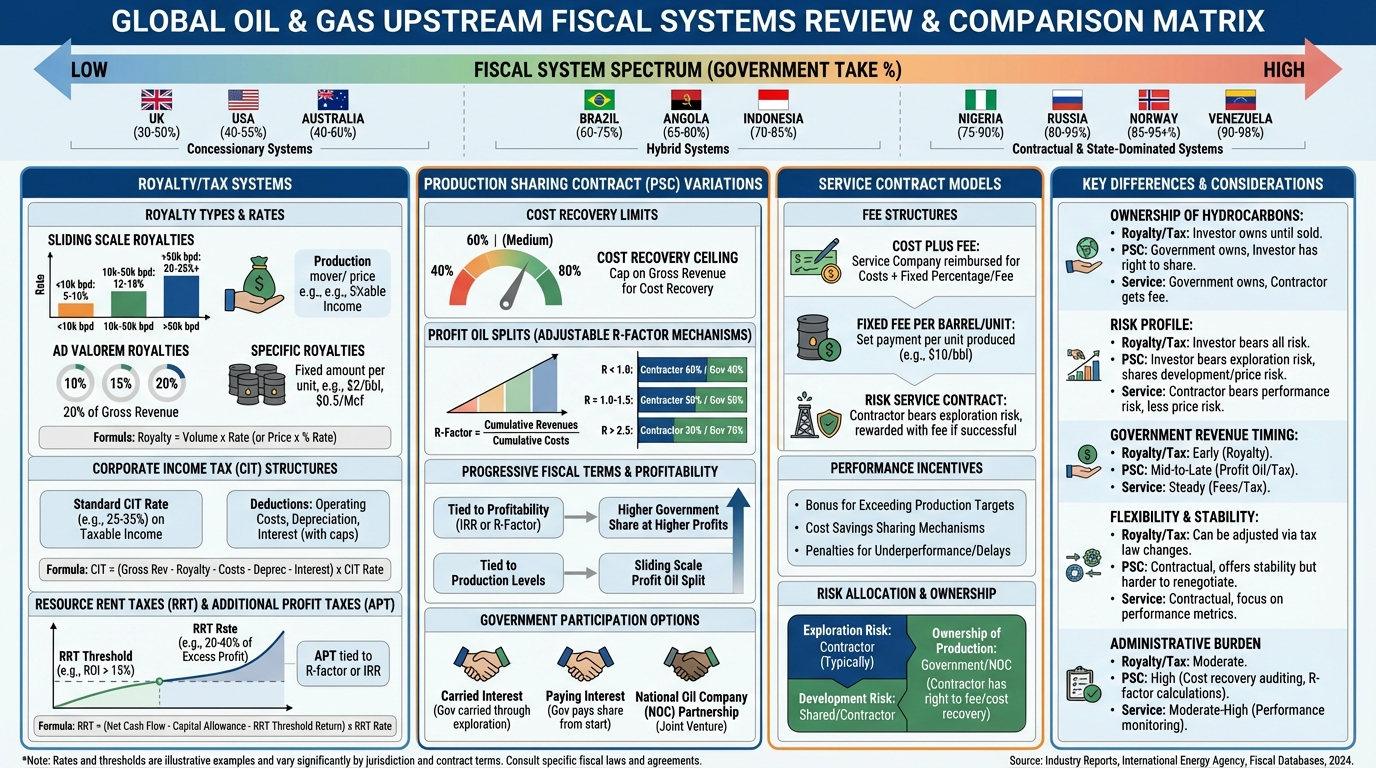
Review & Comparison of Different Fiscal Systems
$5500.00
Review & Comparison of Different Fiscal Systems: 5-Day Professional Training Course
Course Overview
This specialized 5-day training program provides in-depth analysis and comparison of petroleum fiscal systems worldwide. Designed for professionals in the Kingdom of Saudi Arabia (KSA), Oman, GCC countries, and Africa, this course covers fiscal regime design, government take analysis, comparative evaluation, and optimization strategies essential for maximizing value in upstream investments across diverse regulatory environments.
Target Audience
Government officials and petroleum ministry staff
Economic analysts and fiscal policy advisors
Commercial managers and negotiators
Investment analysts and portfolio managers
Legal and tax specialists
Business development professionals
Technical professionals from Saudi Aramco, PDO, ADNOC, and African operators
Consultants advising governments and companies
Financial institutions in energy sector
Day 1: Fiscal System Fundamentals and Classification
Morning Session: Introduction to Petroleum Fiscal Systems
Module 1.1: Fiscal System Objectives and Principles
Host government objectives: revenue, control, technology transfer
Investor requirements: return on investment, risk mitigation
Balancing government and contractor interests
Fiscal neutrality and progressivity concepts
Investment attractiveness and competitiveness
Stability vs. flexibility trade-offs
Sovereignty and resource nationalism
International best practices and trends
Module 1.2: Fiscal System Classification
Concessionary systems (royalty/tax)
Contractual systems (PSC, service contracts)
Hybrid and mixed systems
Production sharing vs. profit sharing
Tax/royalty vs. production sharing comparison
Evolution of fiscal systems globally
Regional fiscal system preferences
Factors influencing system selection
Afternoon Session: Key Fiscal Instruments
Module 1.3: Revenue Collection Mechanisms
Royalties: ad valorem, specific, sliding scale
Corporate income tax structures
Petroleum revenue tax and resource rent tax
Signature and production bonuses
Surface rentals and fees
Export taxes and levies
State participation mechanisms
Carried interest and back-in rights
Module 1.4: Cost Recovery and Deductions
Capital expenditure recovery mechanisms
Operating expenditure treatment
Depreciation methods: straight-line, declining balance, unit-of-production
Depletion allowances
Loss carry-forward provisions
Cost recovery limits and ceilings
Uplift and investment credits
Abandonment cost treatment
Day 2: Concessionary and Royalty/Tax Systems
Morning Session: Traditional Concession Systems
Module 2.1: Royalty Mechanisms
Fixed percentage royalties
Progressive royalty structures
Price-responsive royalties
Profit-based royalties
Production-based sliding scales
Royalty valuation points
Gross vs. net royalty systems
Regional royalty rates comparison
Module 2.2: Tax-Based Fiscal Systems
Corporate income tax rates globally
Petroleum-specific taxation
Resource rent taxation: Brown tax, PRRT
Ring-fencing and consolidation rules
Tax depreciation schedules
Thin capitalization rules
Withholding taxes
Tax holidays and incentives
Afternoon Session: Advanced Royalty/Tax Systems
Module 2.3: United States Fiscal System
Federal vs. state fiscal terms
Offshore lease bonus bidding system
Royalty rates: onshore and offshore
Gulf of Mexico fiscal framework
Alaska and Texas fiscal variations
Tight oil and shale gas fiscal incentives
Module 2.4: United Kingdom and Norway Models
UK North Sea fiscal evolution
Ring-fence corporation tax
Petroleum revenue tax (historical)
Supplementary charge mechanism
Investment allowances and reliefs
Norway’s government participation model
State Direct Financial Interest (SDFI)
Resource rent tax application
Decommissioning cost relief
Day 3: Production Sharing Contracts (PSCs)
Morning Session: PSC Structures and Variations
Module 3.1: Classic PSC Framework
Indonesian PSC model (first generation)
Cost recovery ceiling mechanisms
Fixed profit split arrangements
First Tranche Petroleum (FTP) concept
Investment credit systems
Domestic Market Obligation (DMO)
Contractor lifting entitlements
Government take calculation
Module 3.2: Modern PSC Variations
Malaysian PSC structure
Sliding scale profit sharing
R-factor (revenue/cost) based systems
Production-based sharing mechanisms
Rate of return-based sharing
Price-responsive PSC terms
Progressive vs. regressive characteristics
Hybrid PSC-concession systems
Afternoon Session: Regional PSC Comparisons
Module 3.3: Middle East and North Africa PSCs
Egypt PSC framework and evolution
Libya EPSA (Exploration and Production Sharing Agreement)
Kurdistan Region PSC terms
Oman PSC block structure
Yemen PSC characteristics
Syria and Iraq PSC variations
Fiscal competitiveness analysis
Module 3.4: Sub-Saharan Africa PSCs
Nigeria PSC and deep offshore terms
Angola PSC evolution and reforms
Ghana petroleum agreements
Mozambique PSC framework
Tanzania and Kenya PSC terms
Uganda PSC structure
Senegal and Mauritania fiscal systems
Frontier exploration incentives
Day 4: Service Contracts and Comparative Analysis
Morning Session: Service Contract Models
Module 4.1: Risk Service Contracts
Iraq Technical Service Contracts (TSCs)
Remuneration fee structures
Per-barrel payment mechanisms
Plateau production targets
Cost recovery in service contracts
R/C (remuneration fee/cost) ratios
Signature and production bonuses
Comparison with PSCs and concessions
Module 4.2: Pure Service and Management Contracts
Iran buyback contracts evolution
IPC (Iran Petroleum Contract) framework
Venezuela Empresas Mixtas model
Mexico’s migration to production sharing
Kuwait operating service agreements
Technical service agreements (TSAs)
Fixed fee vs. incentive-based remuneration
Risk allocation comparison
Afternoon Session: Government Take Analysis
Module 4.3: Government Take Calculation
Government take definition and components
Undiscounted vs. discounted government take
Effective royalty rate calculation
Marginal government take concept
Break-even analysis across systems
Sensitivity to oil prices and costs
Time profile of government revenues
International benchmarking studies
Module 4.4: Fiscal System Indicators
Average Effective Tax Rate (AETR)
Marginal Effective Tax Rate (METR)
Progressivity and regressivity measures
Contractor Internal Rate of Return (IRR)
Government IRR calculation
NPV sharing between parties
Investment hurdle rates
Comparative ranking methodologies
Day 5: Optimization and Strategic Applications
Morning Session: Fiscal System Design and Reform
Module 5.1: Designing Optimal Fiscal Systems
Balancing revenue and investment objectives
Simplicity vs. sophistication trade-offs
Administrative capacity considerations
Transparency and predictability
Incentivizing exploration and development
Marginal field fiscal provisions
Deepwater and frontier incentives
Enhanced oil recovery (EOR) fiscal benefits
Gas development fiscal frameworks
Module 5.2: Fiscal Reform Case Studies
Mexico’s 2014 energy reform
Brazil’s pre-salt fiscal regime
Angola’s fiscal modernization
Egypt’s recent PSC modifications
Ghana petroleum revenue management
Nigeria’s PIB (Petroleum Industry Bill/Act)
Uganda’s fiscal framework development
Regional reform trends and drivers
Afternoon Session: Strategic Applications
Module 5.3: Investment Decision Making
Fiscal system impact on investment economics
Portfolio optimization across jurisdictions
Bid strategy under different fiscal terms
Farm-in/farm-out valuation considerations
Economic modeling across fiscal systems
Risk-adjusted returns comparison
Political and fiscal risk assessment
Negotiation strategies for fiscal terms
Module 5.4: Emerging Trends and Special Topics
Carbon and Environmental Fiscal Measures:
Carbon taxes and pricing mechanisms
Flaring penalties and gas conservation
Environmental levies and fees
CCUS fiscal incentives
Renewable energy integration incentives
Digital Economy and Fiscal Systems:
Transfer pricing in digital services
Data ownership and taxation
Technology service taxation
Digital monitoring and compliance
Local Content and Fiscal Integration:
Local content cost implications
Fiscal credits for local procurement
Training and employment incentives
Infrastructure development obligations
Comprehensive Regional Comparison Workshop
Detailed Fiscal Regime Analysis:
Saudi Arabia:
Aramco’s fiscal relationship with government
Unconventional gas fiscal framework
Joint venture fiscal structures
Vision 2030 fiscal implications
Oman:
Block PSC fiscal terms variations
Gas pricing and fiscal implications
ICV (In-Country Value) integration
Mature vs. frontier fiscal incentives
UAE:
ADNOC concession fiscal structures
Abu Dhabi vs. other emirates
Offshore vs. onshore fiscal terms
Long-term concession economics
Kuwait:
Operating service agreement remuneration
Technical service fee structures
Cost recovery provisions
Government take benchmarking
Qatar:
North Field partnership fiscal terms
LNG project fiscal arrangements
Offshore development fiscal framework
Africa Comparative Analysis:
Nigeria: PSC vs. JV fiscal comparison
Angola: Decree 5/19 reforms impact
Egypt: concession vs. PSC economics
Ghana: petroleum fiscal stability
Mozambique: LNG project fiscal terms
East Africa: Uganda, Kenya, Tanzania comparison
West Africa: Senegal, Mauritania, Ivory Coast
Competitiveness ranking and trends
Interactive Workshop Components:
Fiscal modeling exercise across systems
Government take calculation workshop
Economic comparison under various scenarios
Investment ranking simulation
Negotiation role-play with fiscal terms
Fiscal reform design exercise
Bid evaluation using fiscal analysis
Group presentations: optimal system design
Expert panel Q&A session
Learning Outcomes
Participants will master:
Comprehensive understanding of global fiscal system types
Analytical skills for government take calculation
Comparative evaluation methodologies across jurisdictions
Economic modeling capabilities for fiscal systems
Investment decision frameworks considering fiscal terms
Negotiation strategies for fiscal provisions
Reform design principles and best practices
Regional expertise in KSA, Oman, GCC, and African fiscal regimes
Competitiveness assessment and benchmarking skills
Regional Fiscal Intelligence
Saudi Arabia: Aramco fiscal model, unconventional terms, partnership frameworks
Oman: PSC variations, gas pricing mechanisms, fiscal incentives
GCC: Comparative analysis across UAE, Qatar, Kuwait, Bahrain fiscal systems
Africa: Nigeria vs. Angola reforms, East Africa frontier terms, West Africa competitiveness
Training Methodology
Expert lectures on fiscal theory and practice
Excel-based fiscal modeling workshops
Real contract fiscal term analysis
Case studies from global jurisdictions
Interactive calculation exercises
Comparative analysis projects
Government and investor perspective debates
Fiscal software demonstrations
Duration: 5 days (40 hours)
Delivery: In-person, virtual, or hybrid
Language: English (Arabic support available)
Materials: Fiscal models, contract templates, benchmarking data
Certification: Petroleum fiscal systems expert certificate
Keywords: petroleum fiscal systems training, government take analysis KSA, PSC comparison Oman, oil and gas taxation GCC, African petroleum fiscal regimes, royalty tax systems, production sharing contracts, fiscal reform, investment economics, Saudi Aramco fiscal terms, ADNOC concession economics, PDO PSC analysis, Nigeria Angola fiscal comparison, fiscal competitiveness Middle East Africa