PPE & safety standards
$5500.00
PPE & Safety Standards: 5-Day Comprehensive Training Course Outline
Course Overview
This internationally recognized 5-day intensive training program provides practical knowledge on Personal Protective Equipment (PPE) compliance and occupational health and safety standards across KSA, GCC nations, and African regions. Participants will master hazard identification, PPE selection, regulatory compliance, and implementation strategies aligned with Saudi Arabia’s 2025 Technical Regulation for PPE, GCC’s harmonized GHS rules, and Africa’s updated occupational safety frameworks.
Day 1: Foundations of PPE & Workplace Safety Standards
Topics Covered:
Delegates will explore the legal framework governing PPE across KSA, GCC, and Africa, including Saudi Arabia’s Occupational Safety and Health Law, GOSI requirements, and regional harmonization initiatives. The module introduces essential health and safety requirements (EHSR) under 2016/425 PPE Regulation, hazard identification methodologies including impact, slips, heat, arc flash, chemicals, gas, dust, and noise exposure. Practical workplace hazard assessment techniques and risk evaluation matrices prepare participants to conduct site-specific safety audits. Real-world case studies from Arabian Aramco facilities and GCC industrial sectors illustrate compliance best practices.
Day 2: PPE Selection, Certification & Technical Compliance
Topics Covered:
This intensive day covers PPE product categorization, certification standards, and the 2025 Saudi Arabia Technical Regulation for Personal Protective Equipment requirements. Participants learn classification systems for different hazard levels, selection criteria based on workplace risk assessments, and proper documentation procedures. The curriculum includes guidance on testing standards (SGS certification), market eligibility benchmarks in KSA, labeling requirements, and quality assurance protocols. Delegates explore GCC’s harmonized Globally Harmonized System (GHS) chemical classification and labeling, ensuring consistent regional compliance. Interactive exercises involve selecting appropriate PPE for mining, construction, healthcare, chemical, and oil and gas sectors prevalent across these regions.
Day 3: Regional Compliance Frameworks & Implementation
Topics Covered:
Detailed exploration of region-specific regulations including Saudi Arabia’s Labor Law Chapter 8 provisions, Ministry of Human Resources and Development (HRSD) guidelines, and GCC Technical Standards Organization (TSO) requirements. The module addresses Africa’s evolving landscape including South Africa’s OHS Amendment Bill 2026, Kenya’s manufacturing safety overhaul (transitioning from 2005 regulations), and pan-African occupational health initiatives. Participants learn employer responsibilities, worker rights, documentation requirements, fire safety protocols, emergency response procedures, and chemical safety guidelines. Practical workshops involve developing compliance checklists, audit procedures, and corrective action plans suitable for multinational operations across these regions.
Day 4: PPE Training, Maintenance & Performance Management
Topics Covered:
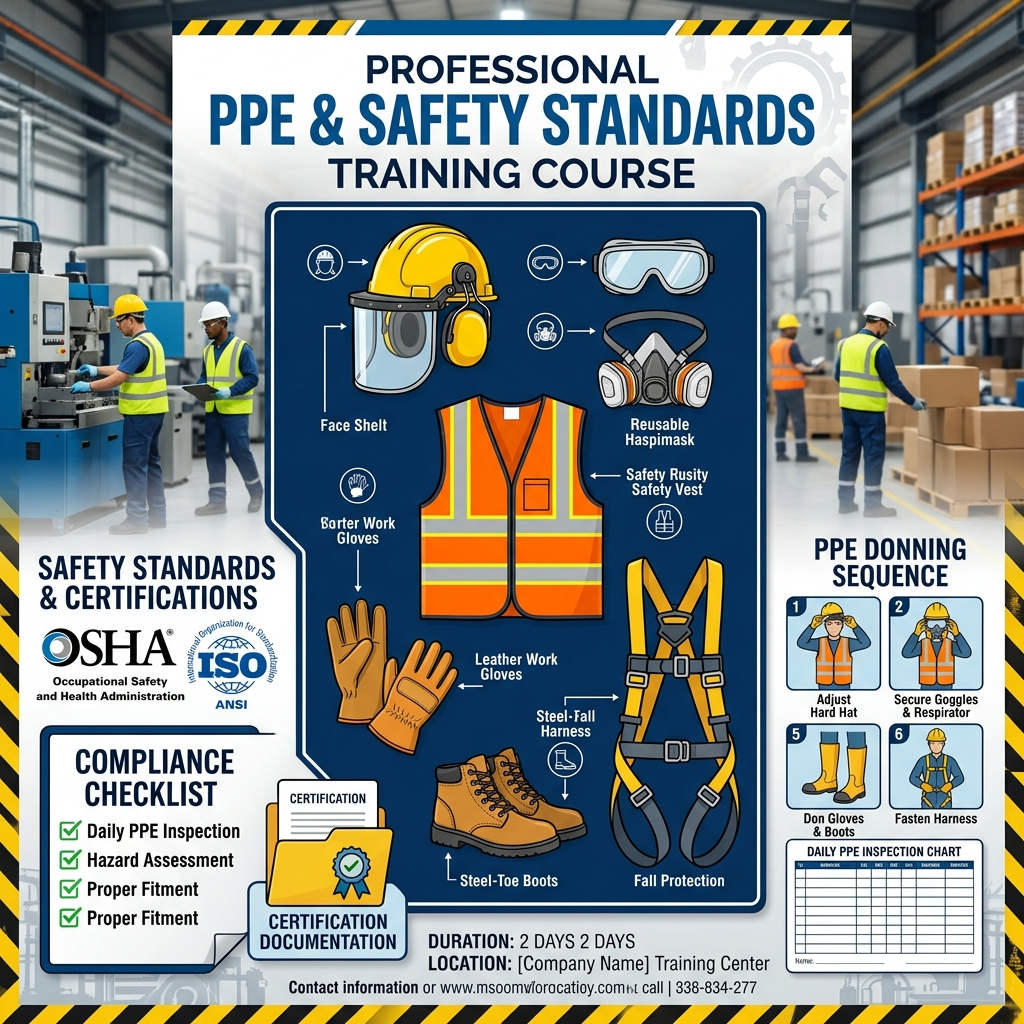
Comprehensive strategies for effective PPE training programs, user compliance enforcement, and performance monitoring systems. Topics include proper donning and doffing procedures for respiratory protection, eye and face protection, hand and foot protection, body protection, and fall prevention equipment. Delegates learn storage, maintenance, inspection, and replacement schedules compliant with regional standards. The day covers training documentation, competency assessment, and ongoing refresher program development. Participants examine OSHA’s 2026 Safety Champions Program model adaptable to KSA and African workplaces, emphasizing behavioral safety and worker engagement. Case studies highlight successful compliance programs in high-hazard industries including petroleum, construction, and manufacturing sectors common across target regions.
Day 5: Advanced Applications, Auditing & Continuous Improvement
Topics Covered:
The final day focuses on advanced PPE applications for specialized hazards including arc flash, extreme temperatures, biological hazards, and confined space entry relevant to GCC’s petrochemical and construction sectors. Comprehensive auditing methodologies aligned with ISO standards and regional regulatory bodies enable participants to conduct PPE compliance assessments. The module covers gap analysis, findings documentation, corrective actions, and audit reporting. Participants develop customized PPE programs, update safety policies reflecting 2026 regulatory changes, and establish metrics for measuring safety performance. Interactive capstone project involves developing an organization-wide PPE and safety management system applicable to multinational operations. Discussion includes emerging trends including digital safety solutions, predictive hazard analysis, and integration with EHS software platforms popular in KSA, GCC, and African enterprises.
Course Benefits & Key Outcomes
Participants will obtain practical competency in PPE hazard assessment and product selection. They’ll master regional compliance requirements including Saudi Arabia’s Technical Regulation 2025, GCC harmonization initiatives, and African regulatory frameworks. Delegates develop implementation strategies, auditing capabilities, and training program expertise. Certificate of completion demonstrates recognized expertise in occupational safety standards valued across Gulf Cooperation Council nations, Saudi Arabia, and African labor markets.
Target Audience
Safety managers, occupational health professionals, HR specialists, site supervisors, compliance officers, and facility managers operating in KSA, UAE, Qatar, Kuwait, Bahrain, Oman, and African nations.