OSHA 30-Hour Training
$1500.00
OSHA 30-Hour Training 5-Day Course Outline - KSA, Oman & GCC
Master Workplace Safety with OSHA 30-Hour Certification in Saudi Arabia, Oman & Gulf Region
The OSHA 30-Hour Training is the globally recognized safety qualification from the United States Occupational Safety and Health Administration, essential for supervisors and safety professionals across Saudi Arabia (KSA), Oman, UAE, Qatar, Kuwait, and Bahrain. This comprehensive 5-day program provides in-depth workplace hazard recognition and prevention strategies for GCC industries.
Why OSHA 30-Hour Certification for GCC Professionals?
International recognition - accepted by global companies in Middle East
Required by Saudi Aramco, SABIC, ADNOC, PDO, and major GCC contractors
Essential for Vision 2030, NEOM, Red Sea Project international HSE standards
25-40% salary premium for OSHA-certified supervisors
Pathway to OSHA Outreach Trainer authorization
Complements Saudi MHRSD and Oman PASR local compliance
Choose Your Industry Track
OSHA 30 Construction: Building, infrastructure, oil & gas construction, civil works, MEP
OSHA 30 General Industry: Manufacturing, warehousing, logistics, petrochemical, healthcare
Who Should Attend?
Supervisors and foremen in construction/industrial operations
Safety officers implementing HSE programs
Project managers on GCC mega-developments
Site engineers and maintenance supervisors
HSE professionals seeking international certification
5-Day OSHA 30-Hour Course Structure
Day 1: OSHA Foundation & Safety Management (6 Hours)
Introduction to OSHA
OSHA history, mission, and relevance to GCC workplaces
OSH Act 1970: employer and employee rights
Worker rights: safe conditions, training, complaint filing
OSHA inspection process and citations
Applying OSHA within Saudi, Omani, GCC legal frameworks
Safety and Health Programs
Elements of effective safety management systems
Management leadership and employee participation
Hazard identification, assessment, and control
Integration with ISO 45001 and GCC requirements
Safety culture in multicultural Middle East workforces
Fall Protection
Leading cause of workplace fatalities
Guardrail systems, safety nets, personal fall arrest
Ladder and scaffold safety
Fall protection for high-rise GCC projects
Equipment inspection and maintenance
Emergency Action Plans
Emergency action plan (EAP) development
Evacuation procedures for GCC buildings
Fire prevention and housekeeping
Coordination with Saudi Civil Defense, Oman emergency services
Ramadan and prayer time emergency considerations
Day 2: Hazard Recognition & Control (6 Hours)
Personal Protective Equipment (PPE)
PPE assessment, selection, and provision
PPE for harsh GCC climate: cooling vests, UV protection
Head, eye, hand, foot, respiratory, hearing protection
Cultural considerations: hijab-compatible safety equipment
Electrical Safety
Electrical hazards: shock, arc flash, fire
Grounding, GFCI requirements
Lockout/Tagout (LOTO) principles
Power line safety in humid coastal GCC environments
Materials Handling
Manual and mechanical handling techniques
Forklift, crane, hoist safety
Safe stacking and warehouse storage
Heat stress prevention during Gulf summer labor
Ergonomics and MSD prevention
Health Hazards
Chemical exposures and GHS labeling
Silica dust from concrete work
Asbestos in older GCC buildings
Welding fumes and noise exposure
Safety Data Sheets (SDS) interpretation
Day 3: Specialized Hazards (6 Hours)
Excavations/Confined Spaces
Construction: Trenching, protective systems, competent person requirements
General Industry: Permit-required confined spaces, atmospheric testing, entry procedures
Cranes and Rigging
Mobile and tower crane safety
Rigging equipment: slings, chains, hooks
Load calculations and hand signals
Critical lifts for GCC mega-projects
Vehicle and Equipment Safety
Forklift operation and training
Pedestrian-vehicle segregation
Heavy equipment and ROPS
Port and marine terminal safety
Hand and Power Tools
Tool selection and inspection
Grinders, saws, drills safety
Power tool guarding requirements
Portable generator safety for remote locations
Day 4: Advanced Construction/Industry Topics (6 Hours)
Welding and Hot Work
Arc and gas welding hazards
Hot work permits for refineries
Compressed gas cylinder safety
Ventilation and PPE requirements
Ladders and Stairways
Portable ladder setup: 4-to-1 rule, three-point contact
Fixed ladder fall protection
Stairway design requirements
Concrete/Steel Construction
Formwork and shoring systems
Steel erection fall protection
Structural stability during construction
Relevant for Saudi Arabia’s construction boom
Safety Program Management
Written safety program development
Job hazard analysis (JHA)
Contractor safety management
Incident investigation and root cause analysis
Safety performance metrics and KPIs
Day 5: Health, Wellness & Assessment (6 Hours)
Ergonomics
Work-related musculoskeletal disorders
Workstation design and tool selection
Job rotation and work-rest schedules
Ergonomics in extreme heat conditions
Bloodborne Pathogens
Universal precautions and exposure control
Sharps safety and needlestick prevention
Post-exposure protocols
Relevant for healthcare and first aid providers
Heat Stress - Critical for GCC
Heat exhaustion and heat stroke recognition
WBGT monitoring and heat index
Shade structures, cooling stations, ventilation
Work-rest cycles and hydration programs
Summer work restrictions in Saudi Arabia and GCC
Emergency response for heat-related illness
Workplace Violence & Substance Abuse
Violence prevention strategies
De-escalation techniques
Drug-free workplace programs
Cultural considerations in Middle East
Final Examination
Comprehensive multiple-choice exam
70% pass mark required
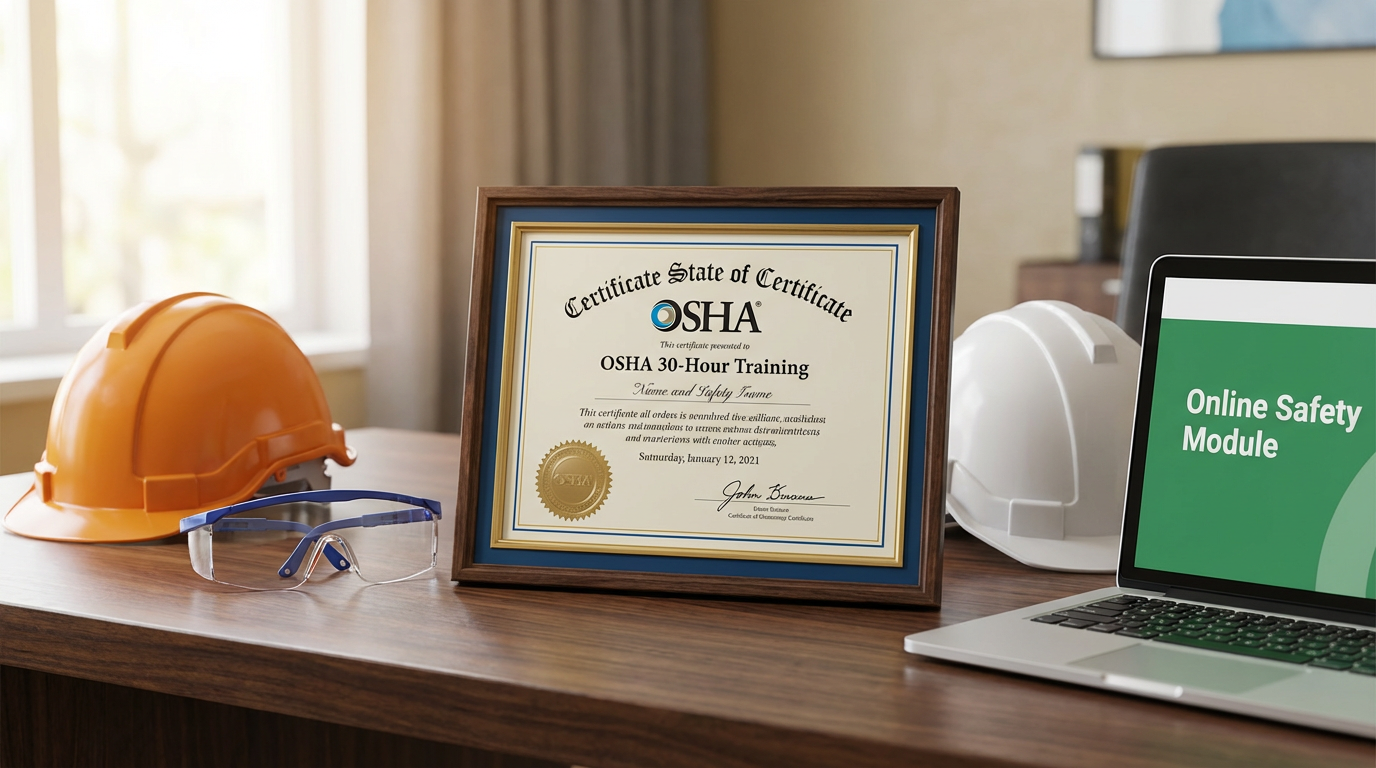
Official OSHA 30-Hour Wallet Card issued by US Department of Labor
Valid for 5 years internationally
OSHA 30-Hour Certification Benefits
Your Official Credentials
US Department of Labor wallet card
Valid 5 years across international projects
Online verification available
Recognized by multinational contractors worldwide
Career Advantages in GCC
Priority hiring for international projects
Essential for EPC contractors: Bechtel, Fluor, KBR, Petrofac
Required by Aramco, SABIC, ADNOC, PDO operations
International career mobility across 180+ countries
Enhanced safety leadership credibility
Training Delivery Options
Classroom intensive: Riyadh, Jeddah, Dammam, Jubail, Muscat, Dubai, Abu Dhabi, Doha
Virtual instructor-led: Live online with GCC scheduling
Hybrid format: E-learning with practical assessments
In-company programs: Minimum 10 participants
Industry-specific: Construction or General Industry tracks
Lead Safety Excellence Across the Gulf
OSHA 30-Hour certification positions supervisors across Saudi Arabia, Oman, and the GCC as world-class safety leaders managing complex operations to international standards. As the region pursues Vision 2030 and attracts global investment, OSHA-trained professionals are indispensable for project success and workforce protection.
Elevate your safety credentials and protect workers on the world’s most ambitious projects.