Oil & Gas Geology, Exploration and Production
$3500.00
Oil & Gas Geology, Exploration and Production: 5-Day Professional Training Course
Course Overview
This comprehensive 5-day training program delivers integrated knowledge of petroleum geology, exploration techniques, and production operations for oil and gas professionals. Specifically designed for the Kingdom of Saudi Arabia (KSA), Oman, GCC countries, and Africa, this course covers geological fundamentals, basin analysis, exploration technologies, drilling operations, and production optimization essential for discovering and developing hydrocarbon resources in diverse geological settings.
Target Audience
Geologists and geoscientists entering oil and gas industry
Petroleum engineers requiring geological knowledge
Exploration geophysicists and seismic interpreters
Reservoir engineers and production technologists
Drilling engineers and operations personnel
Asset managers and field development planners
Technical professionals from Saudi Aramco, PDO, ADNOC, and African operators
Graduate geoscience professionals
Non-geologists requiring petroleum geology understanding
Day 1: Petroleum Geology Fundamentals
Morning Session: Origin and Occurrence of Hydrocarbons
Module 1.1: Introduction to Petroleum Geology
Petroleum geology role in upstream operations
Hydrocarbon exploration and production workflow
Integration with geophysics, petrophysics, and engineering
Geological time scale and sedimentary basin evolution
Plate tectonics and basin formation mechanisms
Regional geological settings: Arabian Plate, African rift systems
Persian Gulf geological evolution
Red Sea and East African rift petroleum systems
Module 1.2: Source Rocks and Hydrocarbon Generation
Organic matter types: kerogen classification (I, II, III, IV)
Source rock evaluation: TOC, Rock-Eval pyrolysis
Thermal maturity and hydrocarbon generation windows
Oil vs. gas generation zones
Primary and secondary migration mechanisms
Major source rocks in Middle East: Tuwaiq Mountain, Hanifa formations
African source rocks: Cretaceous shales, Tertiary deltaic deposits
Unconventional source rock potential
Module 1.3: Reservoir Rocks and Properties
Reservoir rock types: sandstones, carbonates, fractured basement
Porosity types and development: primary, secondary, vuggy
Permeability and flow characteristics
Rock quality and reservoir heterogeneity
Diagenesis and reservoir quality evolution
Arab D limestone reservoirs in Saudi Arabia
Haushi and Khuff formations in Oman
Niger Delta sandstone reservoirs
Afternoon Session: Petroleum Systems
Module 1.4: Traps, Seals, and Petroleum Systems
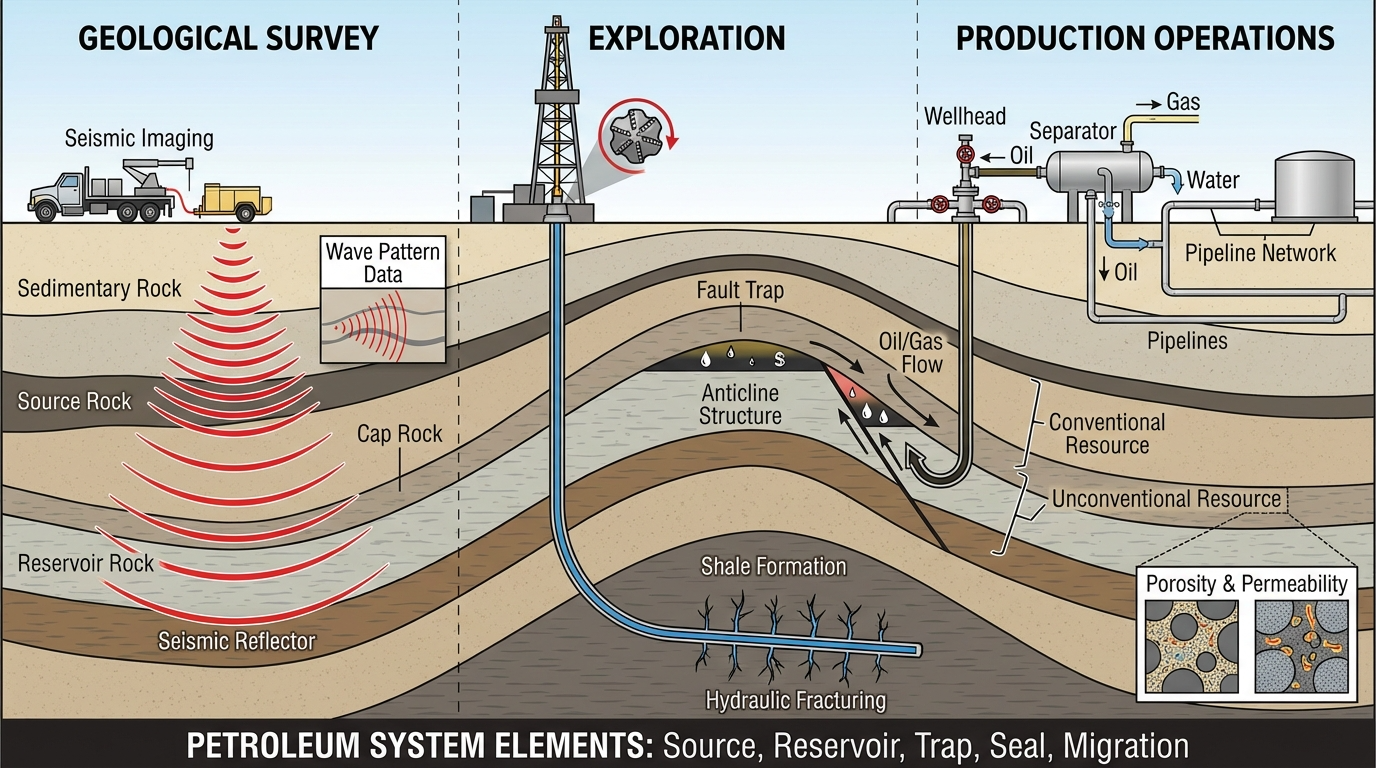
Structural traps: anticlines, fault traps, salt domes
Stratigraphic traps: pinch-outs, unconformities, reefs
Combination and hydrodynamic traps
Seal rocks and capillary pressure concepts
Cap rock integrity and seal capacity
Petroleum system elements: source, reservoir, seal, trap, timing
Critical moment and preservation
Play concepts and basin modeling
Module 1.5: Regional Petroleum Geology
Arabian Peninsula geology: Paleozoic to Cenozoic sequences
Ghawar field geological model (world’s largest oil field)
Oman geology: Salt basins, Pre-Khuff play, tight gas carbonates
GCC offshore: Arab formation carbonates, Jurassic sequences
North Africa: Triassic reservoirs, Cretaceous source rocks
West Africa: Deepwater turbidites, pre-salt plays
East Africa: Tertiary gas discoveries, rift systems
Unconventional plays: tight oil, shale gas, coal bed methane
Day 2: Exploration Methods and Technologies
Morning Session: Seismic Exploration
Module 2.1: Seismic Acquisition Fundamentals
Seismic wave propagation: P-waves, S-waves, surface waves
Reflection and refraction principles
2D, 3D, and 4D seismic survey design
Land vs. marine acquisition techniques
Source types: dynamite, vibroseis, airguns
Receiver arrays and recording systems
Survey planning and permit acquisition
Desert seismic challenges in Saudi Arabia and North Africa
Module 2.2: Seismic Data Processing and Interpretation
Processing workflow: deconvolution, stacking, migration
Velocity analysis and depth conversion
Seismic attributes and amplitude analysis
Direct hydrocarbon indicators (DHI)
Bright spots, flat spots, and AVO analysis
Seismic stratigraphy and facies analysis
Structural interpretation and fault mapping
Time-lapse (4D) seismic for reservoir monitoring
Afternoon Session: Exploration Strategy
Module 2.3: Integrated Exploration Techniques
Gravity and magnetic surveys
Electromagnetic and magnetotelluric methods
Geochemical exploration: soil gas, seep analysis
Remote sensing and satellite imagery
Basin modeling and petroleum system analysis
Exploration risk assessment and probability mapping
Prospect evaluation and ranking
Play-based exploration strategies
Module 2.4: Well Planning and Exploration Drilling
Exploration well types: wildcat, appraisal, delineation
Well location selection and targeting
Pre-drill geological models and prognosis
Drilling program development
Geological operations during drilling
Mudlogging and formation evaluation
Coring operations and core analysis
Well testing and fluid sampling
Offshore exploration in GCC waters
Day 3: Formation Evaluation and Reservoir Characterization
Morning Session: Petrophysics and Logging
Module 3.1: Wireline Logging Fundamentals
Logging tool principles and applications
Resistivity logs: laterolog, induction, microresistivity
Porosity logs: density, neutron, sonic
Gamma ray and spontaneous potential logs
Nuclear magnetic resonance (NMR) logging
Formation imaging and dip determination
Log interpretation workflows
Quick-look and advanced interpretation methods
Module 3.2: Core Analysis and Rock Properties
Coring methods: conventional, sidewall, pressure coring
Routine core analysis: porosity, permeability, saturation
Special core analysis (SCAL): relative permeability, capillary pressure
Rock mechanics and geomechanical properties
Thin section and SEM analysis
Fluid analysis: PVT properties, composition
Integration of core and log data
Digital rock physics applications
Afternoon Session: Reservoir Characterization
Module 3.3: Geological Modeling
Depositional environment interpretation
Facies analysis and electrofacies
Sequence stratigraphy and correlation
Structural framework building
Geostatistical property modeling
Deterministic vs. stochastic approaches
Uncertainty quantification in geological models
Static model validation
Module 3.4: Reservoir Architecture
Clastic reservoir architecture: fluvial, deltaic, turbidite systems
Carbonate reservoir architecture: platforms, reefs, shoals
Naturally fractured reservoir characterization
Flow unit identification and zonation
Heterogeneity analysis and modeling
Connectivity assessment
Upscaling for reservoir simulation
Middle East carbonate complexity examples
Day 4: Drilling and Well Completion
Morning Session: Drilling Operations
Module 4.1: Drilling Engineering Basics
Rotary drilling system overview
Drilling rig types and capabilities
Drill string and bottom hole assembly (BHA)
Drilling fluids: types, properties, functions
Drilling hydraulics and hole cleaning
Directional and horizontal drilling
Measurement while drilling (MWD) and logging while drilling (LWD)
Drilling challenges in Middle East and Africa
Module 4.2: Well Control and Safety
Formation pressure prediction
Pore pressure and fracture gradient
Kick detection and well control procedures
Blowout preventer (BOP) systems
H2S and sour gas drilling protocols
High-pressure/high-temperature (HPHT) operations
Lost circulation management
Stuck pipe prevention and fishing operations
Afternoon Session: Well Completion
Module 4.3: Completion Design and Operations
Completion types: openhole, cased-hole, liner
Perforating strategies and techniques
Sand control: gravel pack, frac-pack, screens
Tubing and packer selection
Well stimulation: acidizing and hydraulic fracturing
Horizontal well completions
Intelligent completions and downhole monitoring
Multi-zone and multilateral completions
Module 4.4: Well Testing and Evaluation
Drill stem testing (DST) procedures
Pressure transient analysis basics
Production testing and well deliverability
Fluid sampling and PVT analysis
Well productivity assessment
Formation damage evaluation
Data acquisition and interpretation
Exploration well evaluation workflow
Day 5: Production Operations and Field Development
Morning Session: Production Systems
Module 5.1: Production Operations Fundamentals
Natural flow and artificial lift systems
Wellhead and Christmas tree equipment
Surface facilities: separators, treaters, storage
Oil and gas processing overview
Production monitoring and optimization
Water handling and injection systems
Gas compression and export
Production operations in harsh environments
Module 5.2: Reservoir Management Basics
Primary, secondary, and tertiary recovery
Reservoir drive mechanisms
Pressure maintenance and waterflooding
Enhanced oil recovery (EOR) overview
Production forecasting and decline analysis
Reservoir surveillance techniques
Integrated reservoir studies
Field development optimization
Afternoon Session: Field Development and Case Studies
Module 5.3: Field Development Planning
Appraisal program design
Development concept selection
Well spacing and pattern design
Facilities planning and engineering
Economic evaluation and project sanctioning
Phased development strategies
Offshore vs. onshore development considerations
Environmental and regulatory compliance
Module 5.4: Regional Geological Case Studies
Saudi Arabia - World-Class Reservoirs:
Ghawar field: structural geology and Arab D reservoir
Safaniyah offshore field: stratigraphic architecture
Shaybah field: aeolian reservoir development
Jafurah unconventional shale play
Manifa field: complex carbonate reservoir
Integration of geology and production performance
Oman - Diverse Petroleum Systems:
Fahud field: naturally fractured carbonate reservoir
Yibal field: Shuaiba limestone characteristics
Khazzan tight gas: Khuff formation stimulation
Mukhaizna heavy oil: reservoir characterization
Pre-Khuff deep gas exploration
Salt tectonics and petroleum trapping
UAE - Offshore Giant Fields:
Upper Zakum field: carbonate reservoir heterogeneity
Bu Hasa field: geological model evolution
Offshore sour gas fields: reservoir challenges
Onshore and offshore integration strategies
Kuwait - Heavy Oil Systems:
Greater Burgan complex: Cretaceous sandstones
Heavy oil reservoir characterization
Horizontal well applications
Reservoir management strategies
Qatar - Gas Condensate Leadership:
North Field geology: world’s largest non-associated gas field
Khuff formation reservoir properties
Gas condensate behavior and management
LNG development geological considerations
Africa - Emerging and Established Basins:
Nigeria Niger Delta: depositional systems and stratigraphy
Angola deepwater: turbidite reservoir architecture
Egypt Western Desert: structural play types
Mozambique Rovuma Basin: Tertiary gas discoveries
Ghana Jubilee field: deepwater turbidite development
Senegal/Mauritania: emerging offshore plays
East African rift: exploration potential
Interactive Workshop Session
Geological map interpretation exercises
Seismic interpretation practical session
Well log analysis workshop
Prospect generation and risking exercise
Field development scenario planning
Integration of geology, geophysics, and engineering
Regional play assessment activity
Group presentations and peer discussions
Expert Q&A panel session
Course summary and action planning
Course Learning Outcomes
Participants will achieve:
Fundamental understanding of petroleum geology principles
Technical skills in exploration methods and data interpretation
Practical knowledge of drilling and completion operations
Integration capabilities across geology, geophysics, and engineering
Regional expertise in KSA, Oman, GCC, and African geological settings
Exploration mindset for prospect generation and evaluation
Production awareness of field development and operations
Risk assessment abilities for exploration and development decisions
Multidisciplinary collaboration skills for upstream projects
Regional Geological Focus: KSA, Oman, GCC & Africa
Kingdom of Saudi Arabia: Arabian Platform geology, super-giant carbonate reservoirs, Paleozoic to Tertiary sequences, unconventional shale plays, structural and stratigraphic trap diversity, and Saudi Aramco’s geological expertise.
Oman: Salt basin tectonics, naturally fractured carbonates, Pre-Khuff deep plays, tight gas formations, heavy oil accumulations, and PDO’s geological innovations.
GCC Region: Regional stratigraphic framework, offshore carbonate platforms, sour gas reservoirs, Jurassic source-reservoir systems, and integrated development approaches.
Africa: Niger Delta clastic systems, West Africa deepwater turbidites, North African structural plays, East African rift exploration, pre-salt carbonates, and emerging frontier basins across Nigeria, Angola, Egypt, Mozambique, Ghana, and Senegal.
Training Methodology
Interactive technical lectures with visual aids
3D seismic interpretation demonstrations
Well log analysis practical exercises
Core and outcrop sample examination
Geological software demonstrations
Field trip opportunities (where available)
Regional geological case studies
Group problem-solving workshops
Video demonstrations of field operations
Comprehensive course materials and atlases
Duration: 5 days (40 comprehensive training hours)
Delivery: In-person preferred, hybrid available
Language: English (Arabic support available)
Materials: Geological maps, well logs, seismic sections, reference guides
Certification: Professional development certificate
Keywords: petroleum geology training, oil and gas exploration course KSA, geological exploration Oman, GCC petroleum geology, African basin exploration, seismic interpretation training, reservoir characterization Middle East, drilling operations course, formation evaluation training, Saudi Aramco geology, PDO exploration, ADNOC reservoir geology, petroleum systems analysis, hydrocarbon exploration Africa, geological modeling course