Management of Oil Recovery Mechanisms
$3500.00
Management of Oil Recovery Mechanisms: 5-Day Professional Training Course
Course Overview
This intensive 5-day training program delivers essential knowledge of oil recovery mechanisms and field management strategies for maximizing hydrocarbon recovery. Designed for professionals in the Kingdom of Saudi Arabia (KSA), Oman, GCC countries, and Africa, this course covers primary recovery optimization, waterflooding, enhanced oil recovery (EOR), and integrated reservoir management for improving recovery factors across diverse reservoir types.
Target Audience
Reservoir and production engineers
EOR specialists and field managers
Asset managers and development planners
Petroleum engineers in mature field operations
Technical professionals from Saudi Aramco, PDO, ADNOC, and African operators
Graduate engineers specializing in reservoir management
Prerequisites: Basic reservoir engineering knowledge or 2+ years upstream experience.
Day 1: Fundamentals of Recovery Mechanisms
Morning Session: Natural Drive Mechanisms
Module 1.1: Recovery Fundamentals
Primary, secondary, and tertiary recovery definitions
Recovery factor concepts and global benchmarks
Drive mechanism selection and economics
Regional recovery challenges in Middle East and Africa
Module 1.2: Reservoir Drive Systems
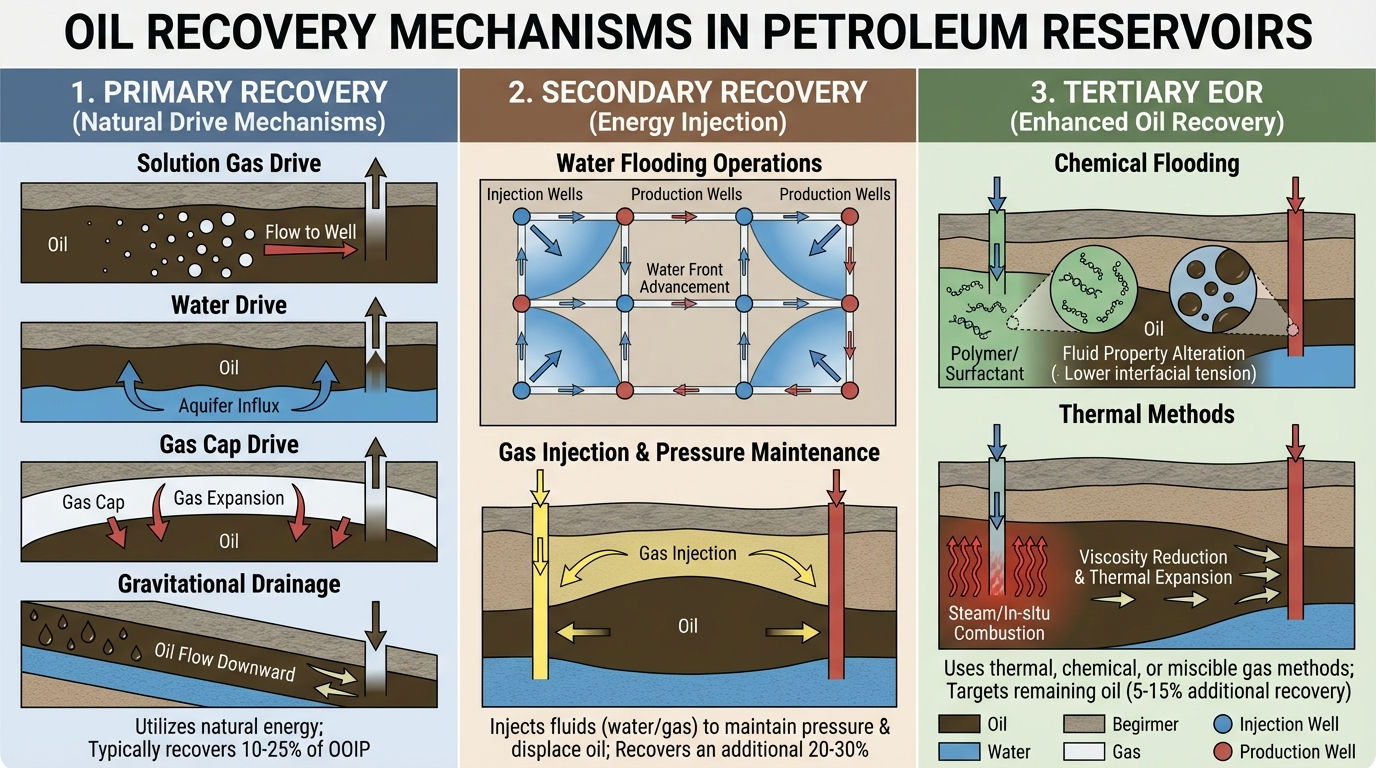
Solution Gas Drive: mechanics, recovery 5-30%, optimization strategies
Gas Cap Drive: expansion physics, recovery 20-40%, gas coning control
Water Drive: aquifer types, recovery 35-60%, water breakthrough management
Combination drives and Saudi Arabian examples
Gravity drainage and compaction drive mechanisms
Afternoon Session: Performance Analysis
Module 1.3: Material Balance and Drive Index
Material balance equation applications
Drive mechanism identification from production data
OOIP determination and aquifer modeling
Havlena-Odeh analysis techniques
Module 1.4: Production Forecasting
Decline curve analysis: exponential, hyperbolic, harmonic
EUR calculation and economic limits
Drive mechanism impact on decline behavior
Oman mature field decline examples
Day 2: Waterflooding Management
Morning Session: Waterflood Design
Module 2.1: Waterflooding Theory
Displacement and sweep efficiency fundamentals
Buckley-Leverett fractional flow theory
Mobility ratio and heterogeneity effects
Pattern design: line drive, five-spot, seven-spot, nine-spot
Injection water quality and compatibility
Module 2.2: Implementation Strategies
Injection well design and facilities requirements
Voidage replacement and pressure maintenance
Startup procedures and rate optimization
Saudi Aramco waterflooding best practices
Afternoon Session: Performance Optimization
Module 2.3: Surveillance and Monitoring
Production and injection data analysis
Water cut prediction and breakthrough timing
Hall plot analysis for injectors
Tracer studies and 4D seismic monitoring
Production logging for conformance assessment
Module 2.4: Waterflood Enhancement
Infill drilling and pattern balancing
Water shutoff treatments
Profile modification techniques
Simulation-based optimization
Kuwait Burgan field waterflood case study
Day 3: Chemical Enhanced Oil Recovery
Morning Session: Polymer Flooding
Module 3.1: Polymer Flooding Fundamentals
Mobility control mechanisms
Polymer types: HPAM, xanthan, associative
Rheology and viscosity behavior
Screening criteria and economics
Incremental recovery estimation
Module 3.2: Polymer Implementation
Polymer selection and quality control
Injection strategy and slug design
Injectivity management
Surface facilities and mixing systems
Oman PDO Marmul and Harweel projects
Afternoon Session: Surfactant and ASP
Module 3.3: Advanced Chemical Methods
Surfactant flooding: IFT reduction, microemulsion behavior
Alkaline flooding: in-situ soap generation
ASP flooding: synergistic effects and design
Laboratory testing and pilot design
Module 3.4: Chemical EOR Optimization
Coreflooding experiments and scale-up
Simulation of chemical floods
Economic evaluation frameworks
Middle East and African opportunities
Day 4: Gas Injection and Thermal EOR
Morning Session: Gas Injection Methods
Module 4.1: Miscible Gas Flooding
CO2 flooding: miscibility, MMP determination, phase behavior
Hydrocarbon gas injection: vaporizing vs. condensing drive
Nitrogen injection: pressure maintenance applications
Saudi Arabia Uthmaniyah CO2 EOR project
Module 4.2: Gas Injection Management
WAG (Water-Alternating-Gas) optimization
Gas breakthrough control strategies
Conformance improvement techniques
Simulation of miscible displacement
UAE nitrogen injection examples
Afternoon Session: Thermal Recovery
Module 4.3: Steam-Based Methods
Cyclic steam stimulation (CSS): huff-n-puff mechanics
Steam flooding: continuous injection principles
SAGD: horizontal well configuration and optimization
Oman Mukhaizna heavy oil steamflood
Module 4.4: Advanced Thermal Methods
In-situ combustion processes
Hot water flooding
Electromagnetic heating
Thermal recovery economics
Kuwait heavy oil thermal opportunities
Day 5: Integrated Management and Emerging Technologies
Morning Session: Integrated Asset Management
Module 5.1: Reservoir Management Integration
Multidisciplinary workflow and team collaboration
Static-dynamic model integration
Production optimization under constraints
Real-time reservoir management
Digital oilfield integration in GCC
Module 5.2: Advanced Surveillance
Permanent downhole monitoring systems
4D seismic for recovery management
Intelligent well systems for conformance
Production allocation optimization
Fiber optic distributed sensing
Afternoon Session: Emerging Technologies
Module 5.3: Advanced EOR Technologies
Nanotechnology: nanoparticles for IFT and wettability alteration
Low salinity waterflooding mechanisms and applications
Foam flooding for mobility control
Microbial EOR (MEOR) methods
Field implementation examples
Module 5.4: Digitalization and AI
Machine learning for production forecasting
AI-assisted history matching
Big data analytics for optimization
Digital twin applications
Automated well control systems
Module 5.5: Carbon Management
CCUS (Carbon Capture, Utilization, Storage)
CO2-EOR with permanent sequestration
Reservoir engineering for storage
Saudi Arabia’s circular carbon economy
Integration with energy transition
Case Studies Workshop
Regional Applications:
Saudi Arabia: Ghawar pressure maintenance, Shaybah peripheral injection, Uthmaniyah CO2 EOR
Oman: Yibal recovery challenges, Marmul polymer flooding, Mukhaizna steamflood
UAE: Bu Hasa waterflood, ADNOC EOR roadmap, offshore optimization
Kuwait: Greater Burgan waterflood, heavy oil recovery evaluation
Qatar: North Field pressure maintenance, gas condensate optimization
Africa: Nigeria water drive management, Angola deepwater injection, Egypt EOR opportunities
Interactive Exercises:
Recovery mechanism identification
Waterflood design simulation
EOR screening workshop
Economic evaluation exercise
Strategy development presentation
Learning Outcomes
Participants will gain:
Comprehensive understanding of recovery mechanisms
Waterflood design and optimization expertise
EOR screening and implementation knowledge
Surveillance and monitoring capabilities
Economic evaluation skills
Integration and decision-making frameworks
Regional expertise in KSA, Oman, GCC, and Africa
Regional Focus
KSA: Super-giant field management, CO2 EOR, carbonate optimization, Aramco practices
Oman: Mature field rejuvenation, polymer flooding excellence, PDO systematic EOR
GCC: Offshore challenges, sour gas management, ADNOC recovery strategies
Africa: Water drive optimization, deepwater production, marginal field economics
Training Details
Duration: 5 days (40 hours)
Delivery: In-person, virtual, or hybrid
Language: English (Arabic support available)
Materials: Technical handouts, simulation tools, calculation templates
Certification: Professional development certificate
Keywords: oil recovery mechanisms training, EOR course KSA, waterflooding Oman, enhanced oil recovery GCC, polymer flooding Africa, CO2 EOR Middle East, thermal recovery, reservoir management, Saudi Aramco recovery, PDO EOR, waterflood optimization, chemical flooding, gas injection, mature field management