Introduction to Ammonia Plant Process Units
$3500.00
Introduction to Ammonia Plant Process Units: Complete 5-Day Training Course
Course Overview
This intensive 5-day ammonia plant training program provides participants with comprehensive knowledge of ammonia production processes, equipment operations, and industry best practices. Designed for chemical engineers, plant operators, maintenance personnel, and industry professionals, this course covers the complete ammonia synthesis process from feedstock preparation to final product storage.
Target Audience: Chemical engineers, process engineers, plant operators, maintenance technicians, production managers, and professionals seeking to understand ammonia manufacturing operations.
Prerequisites: Basic understanding of chemical engineering principles, process flow diagrams, and industrial plant operations.
Day 1: Ammonia Production Fundamentals and Feedstock Preparation
Morning Session: Introduction to Ammonia Industry
Understanding Ammonia Manufacturing
The opening session establishes the foundation for ammonia plant operations, covering the historical development of the Haber-Bosch process and its revolutionary impact on global agriculture and industrial chemistry. Participants explore the current global ammonia market, production capacity statistics, and major manufacturing hubs worldwide.
Key topics include:
Ammonia applications in fertilizer production, refrigeration, chemical synthesis, and industrial processes
Global production statistics and market trends
Environmental considerations and sustainability initiatives in ammonia production
Overview of modern ammonia plant configurations and capacities
Economic factors affecting ammonia manufacturing
Afternoon Session: Feedstock Preparation Systems
Natural Gas Desulfurization Process
This critical first step in ammonia production removes sulfur compounds that would poison downstream catalysts. The session covers:
Hydrodesulfurization (HDS) technology and reactor design
Zinc oxide polishing beds for trace sulfur removal
Sulfur specifications for catalyst protection
Operating parameters: temperature (350-400°C), pressure considerations
Catalyst life management and regeneration strategies
Alternative feedstock options: naphtha, coal, and renewable sources
Process Control and Monitoring
Participants learn about analytical instruments, online sulfur analyzers, and quality control procedures ensuring feedstock purity meets stringent ammonia plant requirements.
Day 2: Primary and Secondary Reforming Operations
Morning Session: Primary Reforming Technology
Steam Methane Reforming (SMR) Process
The primary reformer represents the heart of conventional ammonia plants, where natural gas reacts with steam over nickel catalysts to produce synthesis gas. This comprehensive module covers:
Reformer furnace design: top-fired, side-fired, and terrace wall configurations
Catalyst tube metallurgy and material selection for high-temperature operation
Reforming reactions and thermodynamic equilibrium
Steam-to-carbon ratio optimization (typically 3:1 to 4:1)
Operating conditions: 750-850°C, 25-40 bar pressure
Heat management and thermal efficiency optimization
Burner technology and fuel gas distribution systems
Catalyst Management
Detailed coverage of nickel-based reforming catalysts, including:
Catalyst activation procedures
Carbon formation prevention strategies
Catalyst life expectancy (4-8 years typical)
Performance monitoring and optimization techniques
Afternoon Session: Secondary Reforming and Air Introduction
Secondary Reformer Operations
The secondary reformer completes methane conversion while introducing nitrogen for ammonia synthesis. Training includes:
Autothermal reforming principles
Air compression and preheating systems
Combustion chamber design and refractory materials
Catalyst bed configuration and performance
Temperature control (950-1050°C typical outlet)
Achieving optimal hydrogen-to-nitrogen ratio (3:1 stoichiometric)
Process Integration
Understanding the thermal coupling between primary and secondary reformers, heat recovery systems, and overall energy efficiency optimization strategies.
Day 3: Shift Conversion and CO₂ Removal Systems
Morning Session: Water-Gas Shift Reaction
High-Temperature Shift (HTS) and Low-Temperature Shift (LTS)
These critical process units convert carbon monoxide to carbon dioxide and additional hydrogen through the water-gas shift reaction. Comprehensive coverage includes:
High-Temperature Shift Converter:
Iron-chromium oxide catalysts
Operating temperature range: 350-450°C
Equilibrium limitations and conversion efficiency
Heat recovery and steam generation
Catalyst deactivation mechanisms and prevention
Low-Temperature Shift Converter:
Copper-zinc oxide catalysts
Operating temperature: 190-235°C
Achieving low CO slip (0.2-0.3% typical)
Temperature control criticality for catalyst protection
Pyrophoric catalyst handling procedures
Afternoon Session: Carbon Dioxide Removal Technologies
CO₂ Absorption and Stripping
Removing carbon dioxide to parts-per-million levels protects ammonia synthesis catalysts. Training covers multiple technologies:
Chemical Absorption Processes:
Benfield process (hot potassium carbonate)
Amine-based systems (MEA, DEA, MDEA)
Absorber and stripper column design
Solution circulation rates and regeneration energy
Corrosion management and inhibitor programs
Physical Absorption Alternatives:
Pressure swing adsorption (PSA) technology
Membrane separation systems
Cryogenic separation methods
Comparative economics and efficiency analysis
Day 4: Gas Purification and Ammonia Synthesis
Morning Session: Methanation and Final Purification
Trace CO and CO₂ Removal
The methanation reactor provides final purification, converting residual carbon oxides to methane over nickel catalysts:
Methanation reaction chemistry and thermodynamics
Catalyst specifications and operating conditions (250-350°C)
Achieving synthesis gas purity requirements (<10 ppm CO+CO₂)
Temperature control and exotherm management
Catalyst poisoning prevention
Synthesis Gas Compression
Detailed coverage of centrifugal and reciprocating compressor technology for achieving synthesis pressures (150-250 bar typical):
Compressor selection criteria
Inter-stage cooling and condensate removal
Energy efficiency optimization
Mechanical considerations and maintenance requirements
Afternoon Session: Ammonia Synthesis Loop
The Synthesis Reactor - Core of Ammonia Production
This intensive session covers the ammonia converter where nitrogen and hydrogen combine over iron catalysts:
Reactor Technology:
Quench-type converters with multiple catalyst beds
Horizontal converters (Kellogg design)
Radial flow designs for improved efficiency
Internal heat exchanger configurations
Synthesis Conditions and Chemistry:
Operating pressure: 150-300 bar depending on design
Temperature profiles: 350-550°C across catalyst beds
Iron-based catalyst composition and promoters
Conversion per pass: 15-25% typical
Recycle loop operation and purge gas management
Process Optimization:
Synthesis loop efficiency maximization
Inert gas (methane, argon) management
Ammonia separation and refrigeration
Energy recovery from exothermic synthesis reaction
Day 5: Product Recovery, Utilities, and Process Integration
Morning Session: Ammonia Separation and Refrigeration
Product Recovery Systems
Comprehensive training on ammonia separation technologies:
Condensation and refrigeration systems
Multi-stage cooling and phase separation
Ammonia refrigeration cycle design
Flashing and vapor recovery
Product purity specifications (>99.5% typical)
Ammonia Storage and Handling:
Refrigerated storage tank design and safety systems
Pressure vessel specifications
Loading and unloading procedures
Safety considerations and emergency response
Environmental protection measures
Afternoon Session: Utilities and Process Integration
Essential Utility Systems
Understanding support systems critical for ammonia plant operations:
Steam and Power Generation:
High-pressure steam systems and turbine drives
Waste heat recovery boilers
Combined heat and power (CHP) integration
Energy efficiency metrics and optimization
Cooling Water and Process Water:
Cooling tower operations
Boiler feed water treatment
Demineralization systems
Water conservation strategies
Compressed Air and Nitrogen:
Instrument air systems
Plant air requirements
Nitrogen blanketing and inerting applications
Process Safety and Environmental Compliance
Safety Management Systems:
Hazard identification and risk assessment specific to ammonia plants
Process safety management (PSM) requirements
Emergency shutdown systems and interlocks
Ammonia leak detection and mitigation
Personal protective equipment requirements
Environmental Considerations:
Emission control technologies for NOx, CO₂, and ammonia
Wastewater treatment systems
Greenhouse gas reduction strategies
Carbon capture readiness in modern designs
Environmental monitoring and reporting
Course Conclusion: Future Trends and Career Development
Emerging Technologies in Ammonia Production:
Green ammonia production using renewable hydrogen
Electrolysis-based hydrogen generation
Small-scale and modular ammonia plants
Carbon-free ammonia synthesis pathways
Ammonia as energy carrier and fuel
Career Pathways:
Discussion of professional development opportunities in ammonia manufacturing, process engineering roles, and industry certifications.
Course Deliverables and Certification
Participants Receive:
Comprehensive course manual with process flow diagrams and technical specifications
Access to ammonia plant simulation software demonstrations
Case studies from operational facilities worldwide
Certificate of completion recognized by industry associations
Continuing education credits for professional engineers
Assessment Methods:
Daily knowledge checks and interactive quizzes
Practical problem-solving exercises
Group discussions on real-world operational challenges
Final comprehensive examination
Why Choose This Ammonia Plant Training Course?
This industry-leading ammonia production course combines theoretical knowledge with practical operational insights from experienced instructors with decades of ammonia plant experience. The program emphasizes hands-on learning, troubleshooting techniques, and best practices from world-class facilities.
Key Benefits:
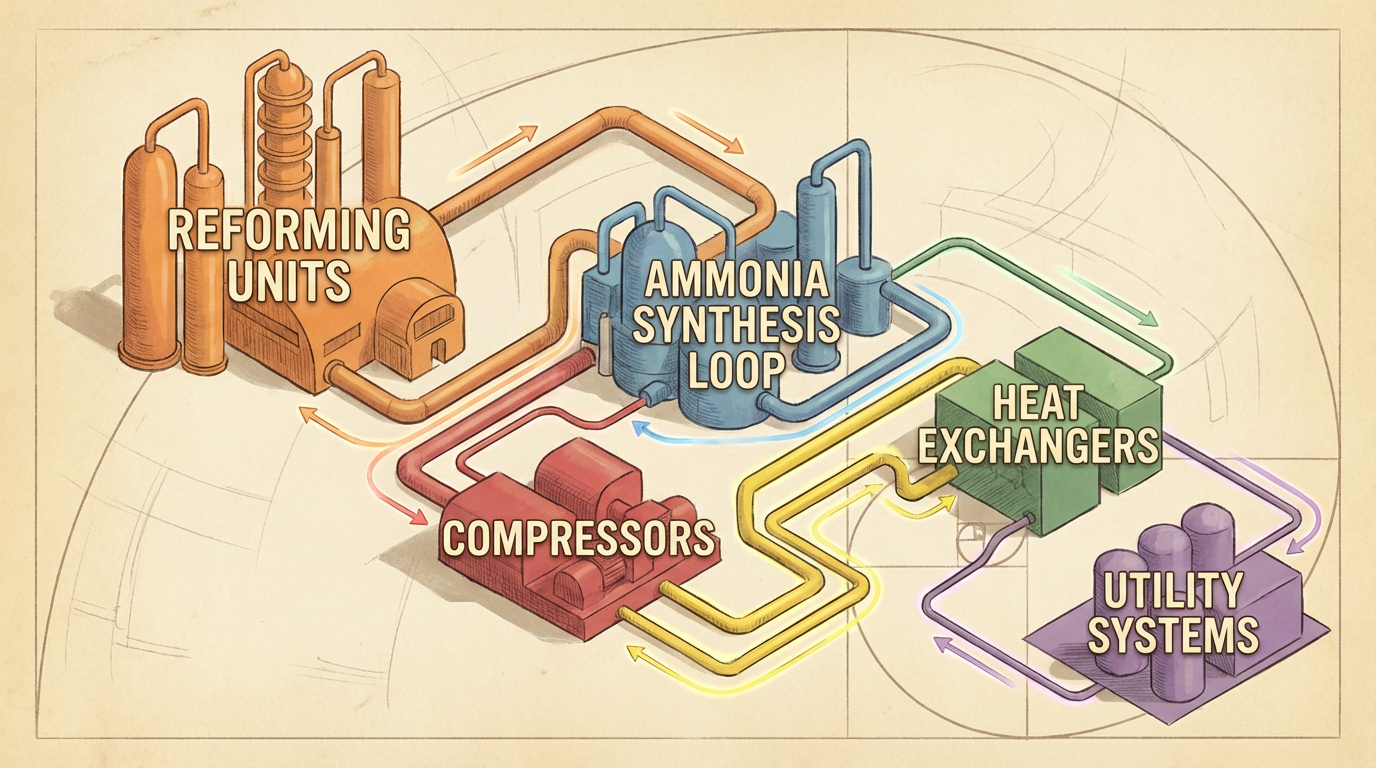
Comprehensive coverage of all major ammonia process units
Updated content reflecting latest technology advances
Practical focus on operational excellence and safety
Networking opportunities with industry professionals
Access to technical resources and ongoing support
Registration Information: Contact training coordinators for upcoming course schedules, customized in-plant training options, and group enrollment discounts.
Keywords: ammonia plant training, ammonia production process, Haber-Bosch process, steam reforming, synthesis loop, chemical engineering course, ammonia synthesis catalyst, green ammonia, process optimization, fertilizer production