Hydrocracking Process Technology
$5500.00
Hydrocracking Process Technology 5-Day Course Outline
Course Overview
This 5-day course provides a practical and technical understanding of hydrocracking process technology for refinery and hydroprocessing professionals. Hydrocracking converts heavy gas oils into lighter, higher-value products such as jet fuel, diesel, and gasoline in the presence of hydrogen and catalyst, while also helping refineries upgrade lower-value, higher-sulfur streams into cleaner transportation fuels. EIA
The course is highly relevant across KSA, GCC and Africa. Saudi Arabia’s National Industrial Strategy aims to strengthen industrial competitiveness through advanced technology and value-added industries. The UAE Industry 4.0 program targets higher industrial productivity, efficiency and technology adoption. In Africa, AFREC reports a major refining gap, with only about a quarter of crude refined locally, creating strong demand for refinery modernization, conversion technologies and cleaner fuels. Saudi Vision 2030 UAE Industry 4.0 AFREC
Who Should Attend
Process engineers, operations engineers, refinery operators, production supervisors, technical service staff, planning engineers, maintenance personnel and young professionals involved in hydroprocessing, distillate upgrading or refinery conversion units.
Learning Outcomes
By the end of the course, participants will be able to:
Explain hydrocracking chemistry, objectives and refinery role
Understand feedstocks, pretreatment and catalyst requirements
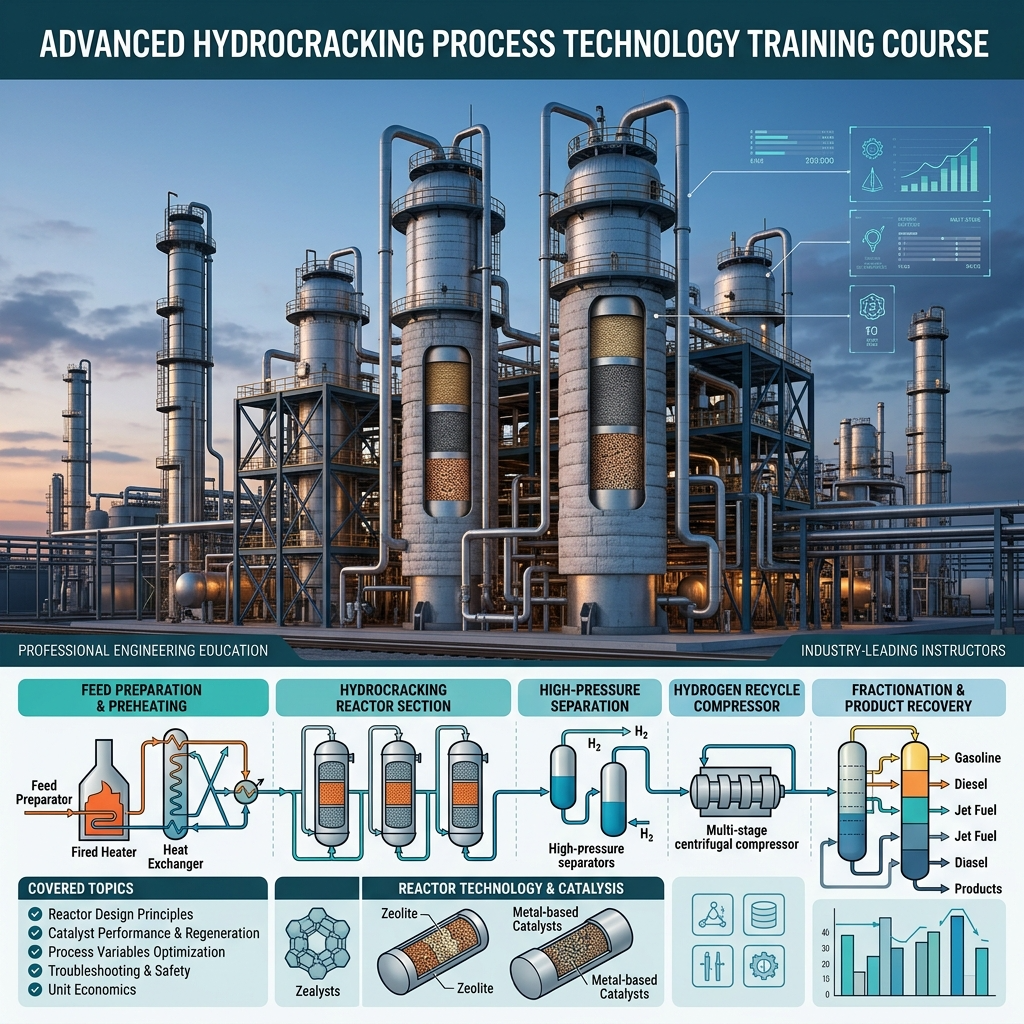
Interpret major unit sections and process flow
Monitor reactor performance, hydrogen balance and product quality
Troubleshoot common operational issues
Improve yield, safety, reliability and unit economics
5-Day Course Outline
Day 1: Fundamentals of Hydrocracking
Role of hydrocracking in modern refineries
Difference between hydrocracking, hydrotreating and catalytic cracking
Feedstocks: VGO, coker gas oil, FCC cycle oils and other heavy streams
Main reactions: cracking, saturation, desulfurization and denitrogenation
Products and refinery value: naphtha, jet, kerosene, diesel and unconverted oil
Workshop: Read a simplified hydrocracker process flow and identify key sections.
Day 2: Feed Preparation, Catalysts and Reactor Section
Feed quality and contaminants affecting performance
Importance of feed pretreatment before hydrocracking
Catalyst functions: acidic cracking and hydrogenation functions
Fixed-bed reactor basics, temperature profile and quench control
Hydrogen partial pressure, recycle gas and reactor severity
Workshop: Evaluate how feed properties influence catalyst life and product slate.
Day 3: Process Flow, Fractionation and Hydrogen Management
Charge heating, reaction section and high-pressure separation
Fractionation and product recovery systems
Recycle gas compressor and hydrogen system overview
Balancing conversion, selectivity and product quality
Mass balance and energy balance awareness for hydrocracking units
Workshop: Build a simple unit performance picture using operating data.
Day 4: Operations, Troubleshooting and Safety
Start-up, shutdown and normal operating practices
Common issues: pressure drop, temperature runaway, catalyst deactivation, fouling and off-spec products
Managing ammonia, H2S and impurities
High-pressure hydrogen safety and process hazards
Alarm response, operating envelopes and unit reliability
Workshop: Troubleshoot a case involving lower conversion and poor middle distillate yield.
Day 5: Optimization, Economics and Future Opportunities
Maximizing diesel and jet fuel yield
Operating flexibility for changing market demand
Severity optimization versus catalyst life
Energy efficiency and on-stream factor improvement
Co-processing opportunities and links to energy-transition applications
Final review and refinery improvement roadmap
Workshop: Develop a 90-day action plan for hydrocracker performance improvement.
Available as online, onsite or in-house training across Saudi Arabia, UAE, Qatar, Kuwait, Oman, Bahrain, Egypt, Nigeria, Kenya, South Africa and wider Africa.