
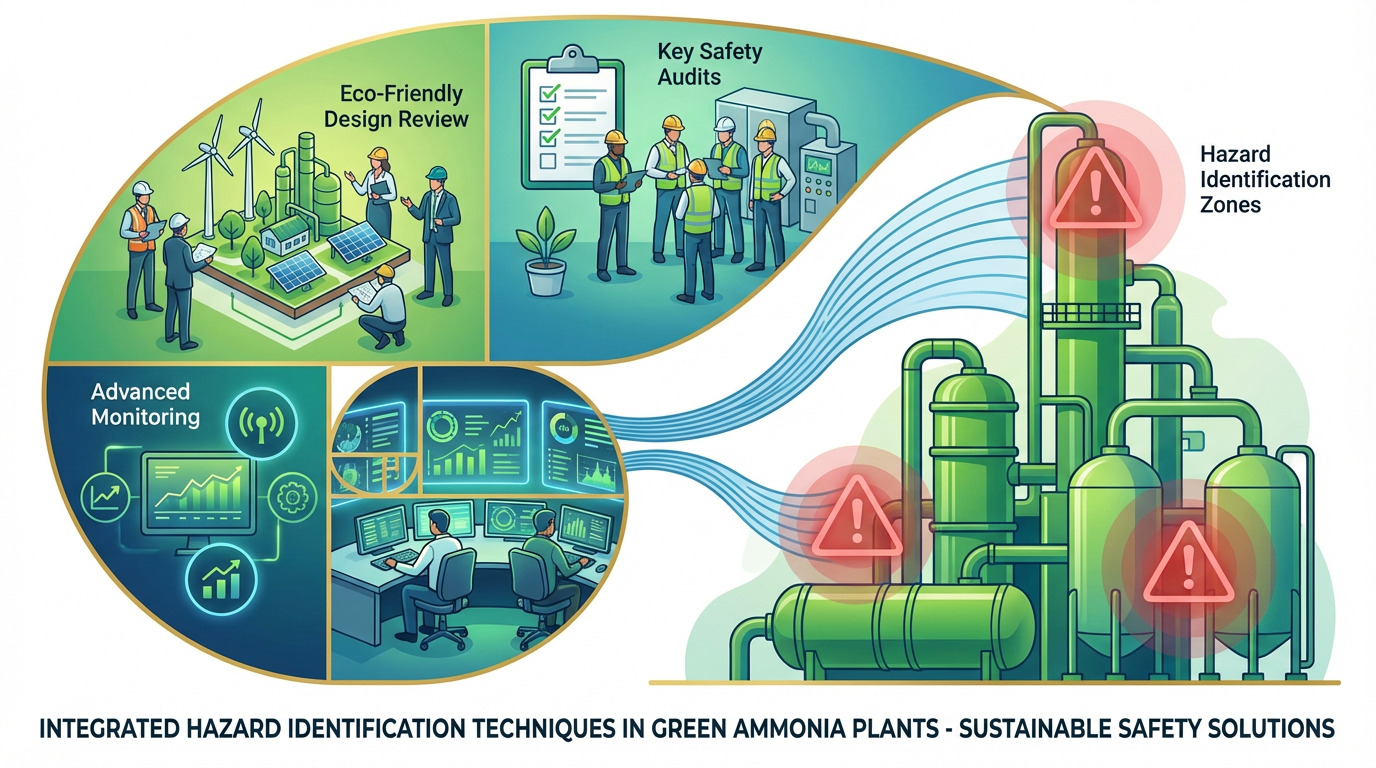
Hazard Identification Techniques for Green Ammonia Plants
$3500.00
Hazard Identification Techniques for Green Ammonia Plants: 5-Day Professional Safety Training Course
Course Overview
This specialized 5-day green ammonia safety training provides comprehensive knowledge of hazard identification methodologies specifically tailored for renewable hydrogen-based ammonia production facilities. As the industry transitions toward sustainable ammonia production, understanding unique safety challenges in green ammonia plants becomes critical for process safety professionals, plant designers, and operations personnel.
Target Audience: Process safety engineers, HSE managers, plant design engineers, operations supervisors, risk assessment specialists, project managers, regulatory compliance officers, and professionals involved in green ammonia project development and operations.
Course Objectives:
Master hazard identification techniques specific to green ammonia production
Understand unique risks in electrolysis and renewable energy integration
Apply systematic safety analysis methodologies (HAZOP, LOPA, FMEA)
Develop comprehensive risk mitigation strategies
Ensure regulatory compliance and industry best practices
Integrate safety-by-design principles in green ammonia facilities
Day 1: Green Ammonia Fundamentals and Emerging Hazards
Morning Session: Introduction to Green Ammonia Technology
Understanding Green Ammonia Production
Establishing foundation knowledge of green ammonia manufacturing and its distinct safety profile:
Technology Overview:
Green hydrogen production via water electrolysis (PEM, alkaline, SOEC)
Air separation units for nitrogen production
Haber-Bosch synthesis with renewable feedstock
Comparison with conventional ammonia plants: safety differentials
Modular and distributed production concepts
Integration with renewable energy sources (solar, wind, hydro)
Green Ammonia Value Chain:
Renewable electricity generation and grid integration
Water treatment and demineralization systems
Electrolysis operations and hydrogen management
Ammonia synthesis and downstream applications
Storage, distribution, and end-use considerations
Ammonia as energy vector and fuel applications
Afternoon Session: Unique Hazards in Green Ammonia Facilities
Identifying Novel Risk Profiles
Understanding emerging hazards not present in conventional ammonia plants:
Hydrogen-Specific Hazards:
Hydrogen embrittlement of materials and equipment
Wide flammability range (4-75% in air) versus natural gas
Low ignition energy and invisible flame characteristics
High diffusivity and leak propagation potential
Buoyancy effects and accumulation in confined spaces
Detonation risks in confined or partially confined areas
Compatibility issues with traditional materials
Electrolysis System Hazards:
High-purity oxygen co-production and fire acceleration risks
Electrolyte management (caustic potash in alkaline, acidic in PEM)
High-voltage DC electrical systems
Membrane failures and cross-contamination scenarios
Thermal runaway in electrolyzer stacks
Water quality impacts on safety performance
Renewable Energy Integration Hazards:
Intermittent power supply and dynamic operation challenges
Rapid load changes and equipment cycling stress
Grid instability and power quality issues
Battery energy storage system (BESS) fire risks
Lightning and electrical surge protection requirements
Scale and Modularity Considerations:
Distributed production facility risks
Multiple small-scale units versus centralized operations
Transportation of modular equipment
Site-specific hazard variations
Day 2: Systematic Hazard Identification Methodologies
Morning Session: HAZOP Study for Green Ammonia Plants
Hazard and Operability Study Fundamentals
Mastering HAZOP methodology adapted for green ammonia facilities:
HAZOP Principles and Structure:
Study team composition and leadership
Node selection and system boundaries definition
Guide word application (No, More, Less, Reverse, Other Than)
Parameter selection (Flow, Pressure, Temperature, Composition, pH)
Deviation analysis and consequence evaluation
Safeguard identification and recommendation development
Green Ammonia-Specific HAZOP Nodes:
Electrolyzer systems: water feed, power supply, gas separation
Hydrogen compression and purification
Hydrogen storage (compressed, liquid, or carrier-based)
Air separation units and nitrogen supply
Ammonia synthesis loop with hydrogen feedstock
Renewable energy interface and control systems
Battery storage and power management systems
Practical HAZOP Exercises:
Conducting HAZOP on electrolyzer package
Hydrogen storage and distribution system analysis
Ammonia synthesis with variable hydrogen supply
Emergency shutdown system design verification
Documentation and action tracking methodologies
Afternoon Session: What-If Analysis and Checklist Methods
Complementary Hazard Identification Techniques
Applying alternative assessment methods for comprehensive coverage:
What-If Analysis:
Brainstorming potential failure scenarios
“What if” question development strategies
Scenario consequence evaluation
Green ammonia-specific questions library:
What if electrolyzer loses cooling water?
What if hydrogen purity degrades?
What if renewable power suddenly drops?
What if oxygen accumulates in hydrogen system?
What if ammonia synthesis catalyst is exposed to oxygen?
Safety Checklist Approach:
Industry-standard checklists adapted for green ammonia
API, NFPA, and ISO standards compliance verification
Hydrogen facility safety requirements (ISO 22734, NFPA 2)
Ammonia safety standards (IIAR, ANSI/ASHRAE 15)
Electrical safety in hazardous areas (NEC, IEC)
Pressure equipment directives and codes
Preliminary Hazard Analysis (PHA):
Early-stage project risk identification
Technology selection safety considerations
Site-specific hazard evaluation
Frequency and severity ranking matrices
Risk prioritization for detailed study
Day 3: Advanced Risk Assessment Techniques
Morning Session: Layer of Protection Analysis (LOPA)
Quantitative Risk Evaluation
Implementing LOPA methodology for green ammonia risk scenarios:
LOPA Fundamentals:
Initiating event frequency determination
Independent protection layer (IPL) identification
Probability of failure on demand (PFD) calculations
Risk tolerance criteria and acceptable risk levels
Scenario risk calculation and evaluation
Determining need for additional safeguards
Green Ammonia LOPA Scenarios:
Hydrogen leak and ignition in enclosed spaces
Electrolyzer overpressure and rupture scenarios
Oxygen contamination in hydrogen systems
Ammonia release from synthesis loop failure
Battery thermal runaway and fire propagation
Loss of cooling in critical equipment
Simultaneous loss of power and backup systems
Safety Instrumented Systems (SIS):
SIL (Safety Integrity Level) determination
SIS design and verification for green ammonia
Proof testing and functional safety management
Common cause failures in redundant systems
Afternoon Session: Failure Mode and Effects Analysis (FMEA)
Equipment-Centric Hazard Identification
Applying FMEA and FMECA (Criticality Analysis) to green ammonia equipment:
FMEA Methodology:
Component failure mode identification
Failure effect analysis on system and plant level
Severity, occurrence, and detection ranking
Risk Priority Number (RPN) calculation
Mitigation strategy development
Critical Equipment Analysis:
Electrolyzer stack failures: membrane degradation, cell shorts, leaks
Hydrogen compressor seal failures and internal leaks
Pressure vessel and piping integrity failures
Heat exchanger tube failures and cross-contamination
Control valve failures in critical service
Instrumentation failures and spurious trips
Power supply and converter failures
Reliability-Centered Maintenance Integration:
Linking FMEA results to maintenance strategies
Predictive maintenance for critical safety equipment
Inspection and testing program development
Spare parts strategy based on criticality
Day 4: Specialized Hazard Analysis for Green Ammonia
Morning Session: Hydrogen Safety and Dispersion Modeling
Hydrogen-Specific Risk Assessment
Deep dive into hydrogen hazard analysis techniques:
Hydrogen Leak and Dispersion:
Leak rate calculations for various scenarios
Computational Fluid Dynamics (CFD) modeling applications
Flammable cloud formation and extent prediction
Ventilation requirements and design verification
Detector placement optimization using modeling
Indoor versus outdoor release scenarios
Hydrogen Fire and Explosion Analysis:
Jet fire modeling and radiation hazard zones
Flash fire scenarios and impact assessment
Vapor cloud explosion (VCE) overpressure calculations
Deflagration-to-detonation transition (DDT) potential
Confined space explosion modeling
Building and equipment spacing requirements
Consequence Modeling Tools:
Software applications: PHAST, ALOHA, FLACS
Input parameter selection and validation
Weather and site-specific considerations
Interpreting results for safety design
Afternoon Session: Electrical and Battery Storage Hazards
Energy Storage and Electrical System Safety
Analyzing electrical hazards unique to green ammonia facilities:
High-Voltage DC Systems:
Arc flash hazard analysis
Electrical safety in hydrogen-classified areas
Grounding and bonding requirements
Electromagnetic compatibility (EMC) considerations
Personnel training and qualification requirements
Battery Energy Storage Systems (BESS):
Lithium-ion battery thermal runaway mechanisms
Off-gas generation and toxicity (HF, CO, CO₂)
Fire suppression challenges and strategies
Explosion venting requirements
Battery management system (BMS) safety functions
NFPA 855 compliance and best practices
Lightning and Static Electricity:
Lightning protection system design
Bonding requirements for hydrogen systems
Static accumulation in non-conductive materials
Ignition source control in hazardous areas
Day 5: Integrated Safety Management and Regulatory Compliance
Morning Session: Quantitative Risk Assessment (QRA)
Facility-Wide Risk Profiling
Conducting comprehensive QRA for green ammonia plants:
QRA Methodology:
Event tree and fault tree analysis
Frequency assessment using historical data and predictive methods
Consequence modeling integration
Individual and societal risk calculations (F-N curves)
Risk contour mapping and land-use planning
Risk communication to stakeholders
Green Ammonia Risk Scenarios:
Major hydrogen release and multi-consequence events
Ammonia refrigeration system failure
Cascading failures from loss of power scenarios
Natural hazard impacts (earthquakes, floods, extreme weather)
External events (vehicle impact, adjacent facility incidents)
Cyber-security incidents affecting safety systems
Risk Mitigation Hierarchy:
Inherently safer design principles application
Engineering controls and passive protection
Active protection systems and SIS
Administrative controls and procedures
Emergency response and mitigation
Afternoon Session: Regulatory Compliance and Safety Management Systems
Compliance Framework for Green Ammonia
Navigating regulatory requirements and industry standards:
Process Safety Management (PSM):
OSHA PSM 1910.119 applicability to green ammonia
EPA Risk Management Program (RMP) requirements
Process hazard analysis (PHA) regulatory compliance
Management of change (MOC) for novel technologies
Pre-startup safety review (PSSR) protocols
Incident investigation requirements
International Standards and Codes:
ISO standards: ISO 22734 (Hydrogen systems), ISO 14687 (Hydrogen quality)
IEC 60079 (Explosive atmospheres)
ATEX directives for European operations
Pressure Equipment Directive (PED) compliance
Machinery Directive requirements
National and regional hydrogen strategies
Green Ammonia-Specific Guidance:
Emerging regulations for renewable hydrogen production
Sustainability certification and safety integration
Maritime fuel safety standards for ammonia
Transportation and storage regulations (ADR, IMDG)
Safety Management Systems:
Safety culture development in new technology facilities
Competency requirements for green ammonia personnel
Training programs for hydrogen and ammonia safety
Contractor safety management
Behavioral-based safety programs
Performance monitoring and continuous improvement
Final Session: Case Studies and Practical Applications
Real-World Applications
Learning from industry experience and incidents:
Green Ammonia Project Case Studies:
Hazard identification in operating green ammonia facilities
Design phase safety studies and lessons learned
Pilot plant incidents and scaling considerations
Integration challenges with existing infrastructure
Community engagement and safety communication
Incident Analysis:
Hydrogen incidents in industrial facilities
Electrolyzer failures and safety system performance
Ammonia releases and emergency response effectiveness
Lessons applicable to green ammonia operations
Workshop Exercise:
Participants conduct complete hazard identification study on simplified green ammonia facility:
Team-based HAZOP facilitation
Risk ranking and prioritization
Recommendation development
Management presentation preparation
Course Deliverables and Certification
Participants Receive:
Comprehensive hazard identification manual for green ammonia
HAZOP, LOPA, and FMEA templates and worksheets
Green ammonia-specific safety checklists
Regulatory compliance matrix and guidance documents
Consequence modeling software tutorials
Industry case study compilation
Professional certificate of completion
Access to online resources and expert network
Interactive Learning Methods:
Facilitated hazard identification workshops
Simulation-based scenario analysis
Software demonstrations (dispersion modeling, QRA)
Group exercises and peer learning
Expert Q&A sessions with industry practitioners