Electrical Grounding Training
$5500.00
Electrical Grounding Training Course in KSA, GCC & Africa | 5-Day Certified Earthing and Bonding Program
Course Overview
This 5-day Electrical Grounding Training course is designed for engineers, technicians, inspectors, and maintenance professionals working in industrial, commercial, utility, and infrastructure projects across KSA, GCC, and Africa. The program focuses on safe grounding and bonding practices, earthing system selection, fault protection, testing methods, and practical troubleshooting. The course aligns with widely used frameworks such as IEC 60364 for low-voltage installations, GCC adoption through GSO IEC 60364-5-54, Saudi Electrical Code principles under SBC 401, African low-voltage guidance based on IEC 60364, and IEEE guidance for AC substation grounding. Source Source Source Source
Introduction
Effective electrical grounding is essential for personnel safety, equipment protection, power quality, and reliable fault clearing. Saudi guidance states that SBC 401 is based on SASO standards derived from IEC 60364, while GCC standards formally adopt IEC 60364-5-54 for earthing arrangements, protective conductors, and bonding conductors. African LV guidance also references IEC 60364 to improve safety and reliability, and IEEE Std 80 remains a key reference for AC substation grounding practices. Source Source Source Source
Target Audience
This course is ideal for electrical engineers, maintenance engineers, plant supervisors, project engineers, consulting engineers, HSE professionals, electricians, utility staff, testing and commissioning teams, and facility managers involved in electrical installation, operation, or inspection in KSA, GCC, and African markets.
Learning Outcomes
By the end of the course, participants will be able to:
Explain the purpose of grounding, bonding, and equipotential bonding in electrical safety.
Identify TN, TT, and IT earthing systems and select the right arrangement for different facilities.
Interpret grounding requirements for low-voltage installations and understand their practical application.
Calculate key grounding parameters such as fault current path, earth resistance, touch voltage, and step voltage.
Apply testing methods for soil resistivity, earth electrode resistance, continuity, and loop impedance.
Evaluate grounding systems for buildings, industrial plants, generators, transformers, and substations.
Troubleshoot common grounding failures, nuisance tripping, corrosion issues, and unsafe bonding practices.
Improve compliance, reliability, and safety performance in regional projects.
Learning Methods
The training uses instructor-led lectures, code-based discussion, worked examples, design exercises, case studies, calculation workshops, group discussion, fault analysis, and practical demonstrations using grounding test instruments. Participants learn through both classroom theory and application-focused problem solving.
5-Day Course Outline
Day 1: Fundamentals of Electrical Grounding and Bonding
The first day builds a strong foundation in grounding principles. Participants learn why grounding is required, the difference between grounding and bonding, types of faults, fault current return paths, electric shock hazards, and the relationship between grounding and protective devices. The session also introduces regional and international reference frameworks used in KSA, GCC, and Africa.
Modules: grounding purpose, bonding basics, shock protection, terminology, regulatory landscape, common system components.
Day 2: Earthing Systems and Code Requirements
Day two focuses on TN, TT, and IT systems, including their advantages, limitations, and application areas. Saudi and IEC-based concepts such as automatic disconnection of supply, loop impedance, and equipotential bonding are covered in a practical way. Participants compare grounding approaches for commercial buildings, industrial plants, hospitals, oil and gas sites, and utilities.
Modules: TN-S, TN-C, TN-C-S, TT, IT systems; protective conductors; main and supplementary bonding; compliance interpretation. Saudi code discusses loop impedance and automatic disconnection requirements, while GSO IEC 60364-5-54 covers earthing arrangements and protective conductors. Source Source
Day 3: Grounding Design, Calculations, and Equipment Selection
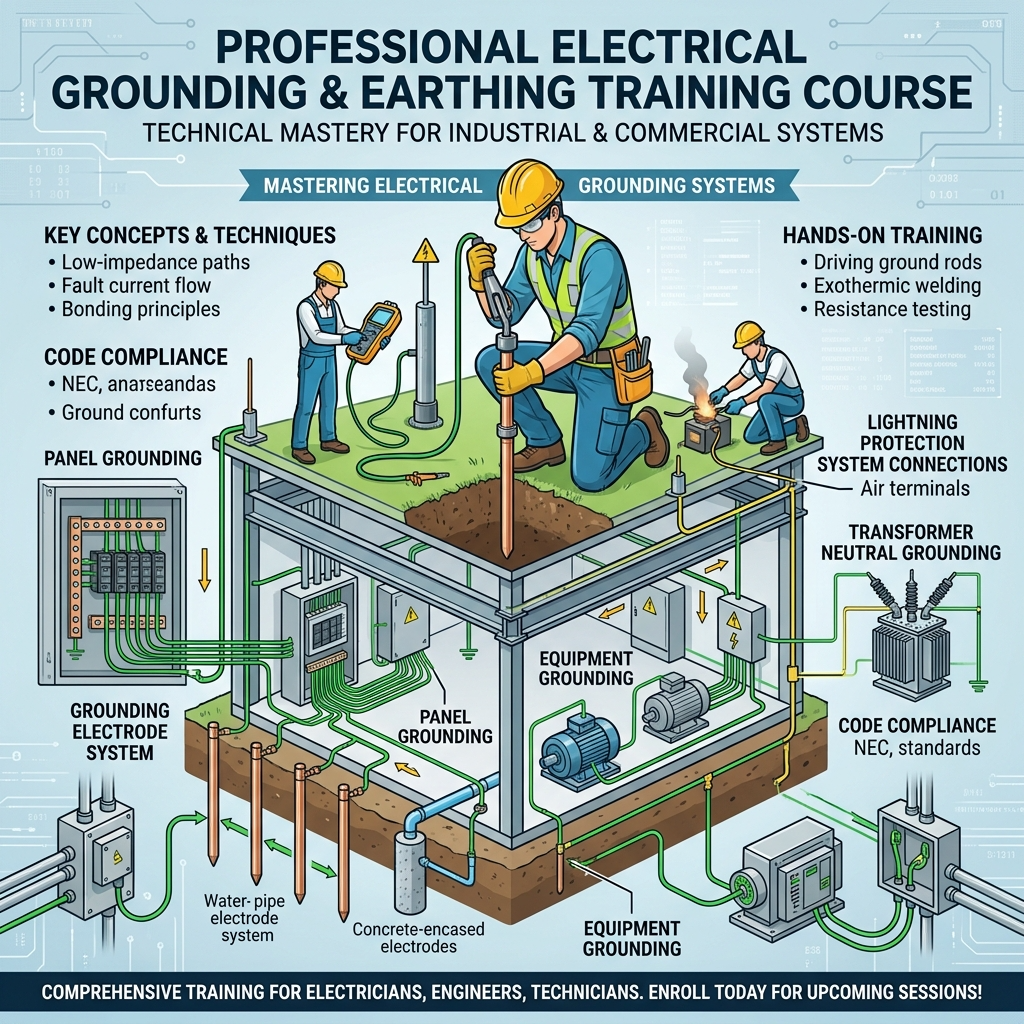
Day three develops design competence. Participants learn how to size grounding conductors, choose electrode types, evaluate soil conditions, and design grounding for transformers, generators, switchgear, MCCs, and buildings. Special attention is given to soil resistivity, corrosion, lightning interface, and practical material selection for harsh desert, coastal, and high-resistivity environments common across KSA, GCC, and Africa.
Modules: electrode selection, conductor sizing, soil resistivity basics, ground grid concepts, design criteria, lightning and surge considerations.
Day 4: Testing, Inspection, and Troubleshooting
This day is practical and field-oriented. Participants study earth resistance testing, fall-of-potential testing, clamp-on testing, continuity checks, and loop impedance verification. They also learn how to inspect existing installations, identify poor bonding, detect corrosion and loose connections, and investigate repeated electrical faults or equipment damage related to bad grounding. African guidance emphasizes safe and reliable installations through proper design and protection coordination. Source
Day 5: Industrial and Substation Grounding Applications
The final day extends learning into higher-risk and utility environments. Participants review grounding for substations, generators, transformers, LV/MV interfaces, data centers, telecom sites, and renewable energy facilities. Key concepts include touch voltage, step voltage, ground potential rise, grid design philosophy, and safety review. IEEE identifies substation grounding as a core safety discipline for AC substations, making this module valuable for utility and industrial professionals. Source
Suggested Certification Statement
Certificate: Certificate of Completion in Electrical Grounding, Earthing, Bonding, Testing, and Safety Applications for KSA, GCC, and Africa.