
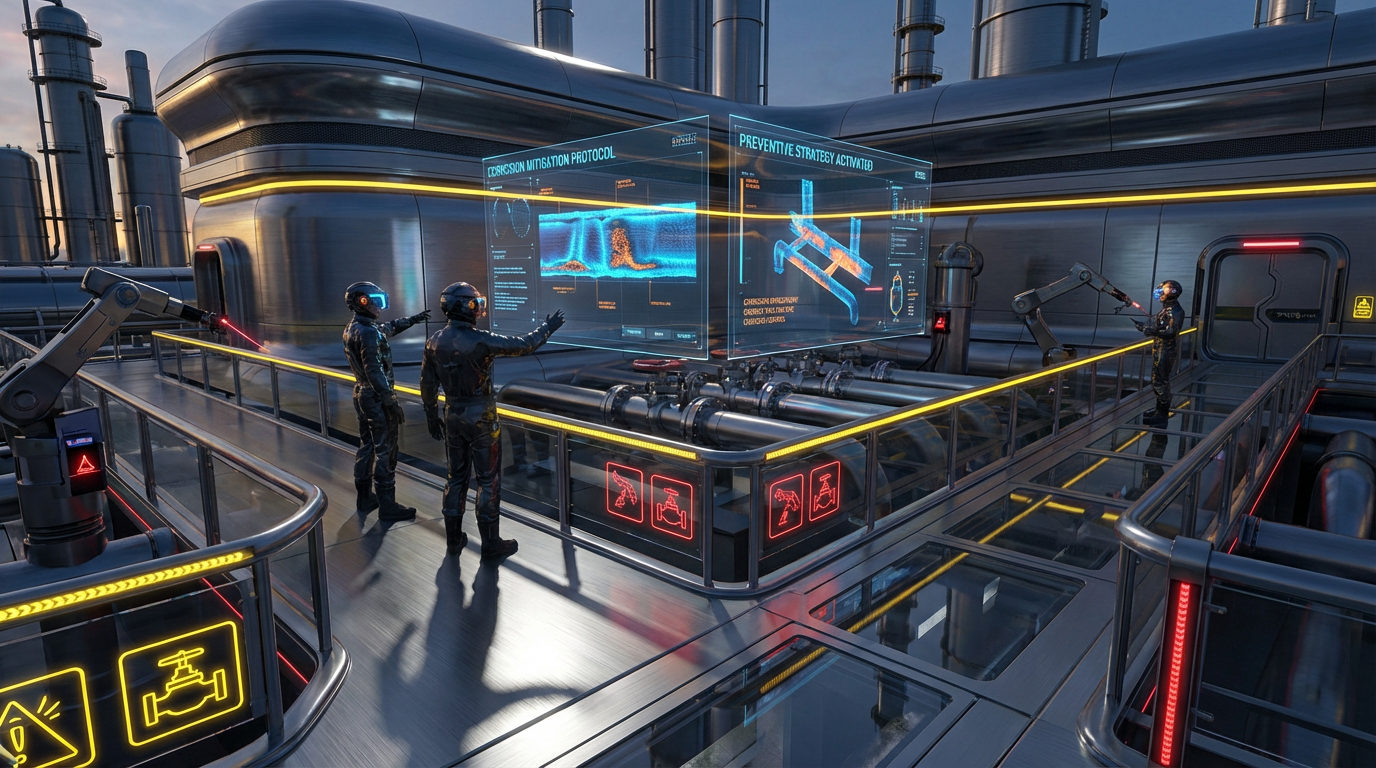
Corrosion Prevention in Oil and Gas Industry
$3500.00
Corrosion Prevention in Oil and Gas Industry
5-Day Professional Training Course
Course Overview
This 5-day Corrosion Prevention course provides comprehensive knowledge of corrosion mechanisms, prevention strategies, monitoring techniques, and materials selection specific to upstream, midstream, and downstream oil & gas operations. Covers practical solutions for corrosion control in production, processing, transportation, and storage facilities.
Target Audience: Corrosion engineers, production engineers, operations engineers, maintenance engineers, inspection engineers, integrity engineers, materials engineers, and technical professionals in oil & gas operations.
5-Day Course Outline
Day 1: Corrosion Fundamentals and Oil & Gas Environments
Morning:
Course introduction and objectives
Corrosion fundamentals and electrochemistry
Forms of corrosion: uniform, pitting, crevice, galvanic, erosion-corrosion
Economic impact of corrosion in oil & gas (NACE impact study)
Major corrosion-related failures and incidents
Oil & Gas Corrosion Environments:
Upstream: wellbore, downhole, production tubing
Midstream: pipelines, gathering systems, processing
Downstream: refining, storage, distribution
Offshore vs. onshore challenges
Afternoon:
CO₂ corrosion (sweet corrosion):
Mechanisms and chemistry
Partial pressure calculations
De Waard-Milliams prediction model
Temperature and pH effects
Protective iron carbonate scales
H₂S corrosion (sour corrosion):
Sour service environment definition
Sulfide film formation
Weight loss corrosion
Hydrogen damage mechanisms
Combined CO₂/H₂S corrosion
Organic acid corrosion
Day 2: Corrosion Mechanisms and Damage Types
Morning:
Localized corrosion:
Pitting corrosion mechanisms
Crevice corrosion
Under-deposit corrosion
Top-of-line corrosion (TLC)
Microbiologically Influenced Corrosion (MIC):
Sulfate-reducing bacteria (SRB)
Acid-producing bacteria (APB)
Iron-oxidizing bacteria
Detection and monitoring
Biocide treatment programs
Galvanic corrosion:
Galvanic series
Mixed metallurgy issues
Prevention strategies
Afternoon:
Environmental cracking:
Stress Corrosion Cracking (SCC)
Sulfide Stress Cracking (SSC) - NACE MR0175/ISO 15156
Hydrogen-Induced Cracking (HIC)
Stress-Oriented Hydrogen-Induced Cracking (SOHIC)
Hydrogen blistering
Corrosion fatigue
Erosion-corrosion and flow-induced corrosion:
Sand production effects
Velocity limits
Cavitation damage
Impingement attack
Workshop 1: Corrosion mechanism identification from case photos
Day 3: Materials Selection and Corrosion-Resistant Alloys
Morning:
Materials selection methodology:
Service condition analysis
Corrosion rate prediction
Design life considerations
Cost-benefit analysis
Carbon and low-alloy steels:
API grades and specifications
Limitations and applications
Corrosion allowance determination
Corrosion-Resistant Alloys (CRAs):
Stainless steels (martensitic, austenitic, duplex, super duplex)
Nickel alloys (Alloy 625, 825, C-276, Inconel)
Titanium alloys
PREN (Pitting Resistance Equivalent Number)
Critical Pitting Temperature (CPT)
Afternoon:
NACE MR0175/ISO 15156 compliance:
Sour service material requirements
SSC-resistant materials
Hardness limits (HRC 22 maximum for carbon steel)
Environmental limits and testing
Material selection for specific services:
High CO₂ environments
High H₂S environments
High temperature/high pressure (HTHP)
Produced water systems
Gas processing facilities
Non-metallic materials:
Glass-reinforced plastics (GRP/FRP)
Lined pipe and vessels
Coatings and linings
Workshop 2: Materials selection exercise for given conditions
Day 4: Corrosion Prevention Methods
Morning:
Corrosion inhibitors:
Inhibitor types: filming, neutralizing, scavenger
Application methods: batch, continuous, squeeze
Inhibitor selection criteria
Performance testing and monitoring
Dosage optimization
Green inhibitors and environmental considerations
Chemical treatment programs:
Scale inhibition
Oxygen scavengers
H₂S scavengers
pH control and buffering
Biocide programs for MIC control
Afternoon:
Protective coatings:
External coatings for pipelines:
Three-layer polyethylene (3LPE)
Fusion-bonded epoxy (FBE)
Polyurethane coatings
Coating selection and application
Internal coatings:
Epoxy coatings
Phenolic coatings
Polyurethane linings
Application and quality control
Surface preparation standards (NACE/SSPC)
Coating inspection and testing
Cathodic protection (CP):
Sacrificial anode systems:
Aluminum, zinc, magnesium anodes
Anode selection and design
Installation methods
Impressed current systems (ICCP):
Rectifier systems
Anode beds and groundbeds
Design calculations
CP criteria and monitoring
Pipeline CP systems
Offshore platform CP
Internal CP for storage tanks
Day 5: Monitoring, Inspection, and Management
Morning:
Corrosion monitoring techniques:
Online monitoring:
Electrical Resistance (ER) probes
Linear Polarization Resistance (LPR) probes
Galvanic probes
Sand monitors
Hydrogen probes
Biofilm monitors
Offline monitoring:
Corrosion coupons (weight loss)
Spool piece examination
Side-stream monitoring
Inspection methods:
Visual inspection
Ultrasonic thickness measurement (UT)
Radiographic testing (RT)
Magnetic flux leakage (MFL)
In-line inspection (smart pigging)
Electromagnetic inspection
Corrosion mapping
Afternoon:
Corrosion management programs:
Corrosion management framework
Integrity Operating Windows (IOW)
Key Performance Indicators (KPIs)
Data management and trending
Corrosion risk assessment
Failure investigation procedures
Specific applications:
Wellbore and downhole corrosion:
Tubing and casing protection
Packer fluid selection
Completion fluid corrosivity
Pipeline corrosion management:
External corrosion (soil corrosion)
Internal corrosion control
Pipeline integrity management (IMP)
Inline inspection planning
Production facility corrosion:
Separator systems
Produced water handling
Gas processing units
Storage tank corrosion
Refinery corrosion prevention:
Crude unit corrosion control
High-temperature units
Amine systems
Cooling water systems
Case Studies: Major corrosion failures and prevention strategies
Course Review and Assessment:
Key concepts summary
Q&A session
Final Exam: 50 questions, 90 minutes, 70% pass
Course evaluation
Certificate presentation
Learning Outcomes
✅ Understand corrosion mechanisms in oil & gas environments
✅ Identify and predict CO₂, H₂S, and MIC corrosion
✅ Select materials per NACE MR0175/ISO 15156
✅ Apply corrosion inhibitors effectively
✅ Design and implement coating systems
✅ Specify cathodic protection systems
✅ Implement corrosion monitoring programs
✅ Develop corrosion management strategies
✅ Investigate corrosion failures
✅ Optimize corrosion prevention economics
Course Features
Materials: 500+ page manual, standards guides, selection charts, calculation tools, USB resources
Assessment: Workshops, case studies, written exam
Certification: 40 CPD/CEU hours, industry-recognized certificate
Method: 55% theory, 45% practical exercises and case studies
Who Should Attend
Corrosion engineers and specialists
Production engineers
Operations engineers
Maintenance engineers
Inspection engineers
Integrity engineers
Materials engineers
Process engineers
Facility engineers
Pipeline engineers
Asset integrity managers
HSE professionals
Prerequisites: Engineering degree or technical diploma + 2 years relevant experience, OR 5+ years field experience