construction Management, Procedures and Implementation
$5500.00
Construction Management, Procedures and Implementation: 5-Day Professional Course
Course Overview
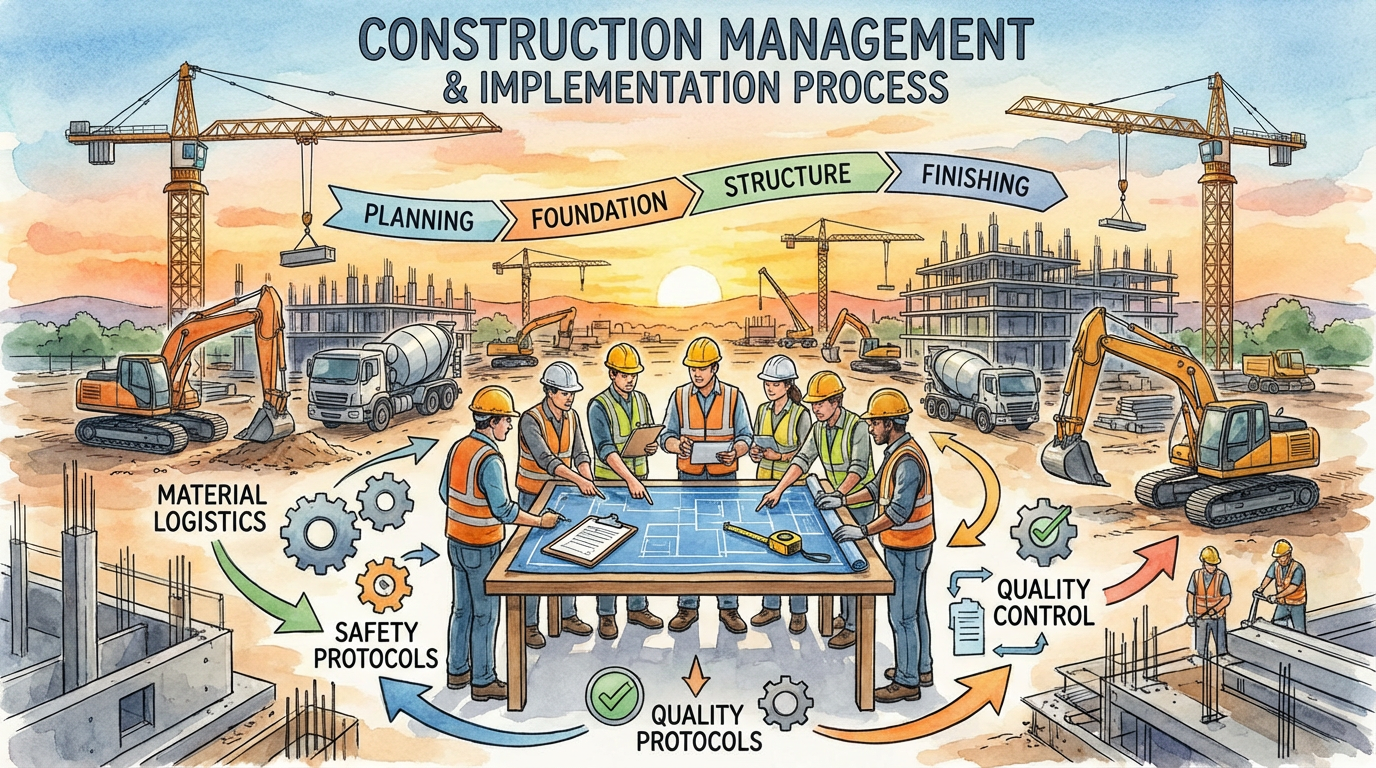
This intensive 5-day construction management training program equips professionals with practical skills, procedures, and implementation strategies for successful project delivery. Designed for construction managers, project coordinators, site engineers, contractors, and aspiring construction professionals, this course covers the complete project lifecycle from pre-construction through closeout, emphasizing real-world applications and industry best practices.
Target Audience: Construction managers, site supervisors, project engineers, quantity surveyors, contractors, facilities managers, architects transitioning to construction management, and anyone involved in construction project delivery.
Day 1: Construction Project Planning & Initiation
Morning Session: Project Management Fundamentals (9:00 AM - 12:00 PM)
Construction Management Framework:
Understanding the construction manager’s role in coordinating people, resources, equipment, and materials to deliver projects safely, on time, and within budget. Learn the difference between construction management, general contracting, and project management.
Key Topics:
Project delivery methods: Design-Bid-Build, Design-Build, Construction Manager at Risk (CMAR), Integrated Project Delivery (IPD)
Organizational structures and stakeholder identification
Construction project phases and lifecycle management
Contract types: lump sum, cost-plus, guaranteed maximum price (GMP), unit price
Pre-construction services and feasibility studies
Afternoon Session: Project Planning & Scheduling (1:00 PM - 5:00 PM)
Developing the Master Plan:
Creating comprehensive project schedules using Critical Path Method (CPM) and other scheduling techniques. Understanding dependencies, float, and resource allocation.
Essential Elements:
Work Breakdown Structure (WBS) development
Activity sequencing and duration estimation
Critical Path Method (CPM) and precedence diagramming
Scheduling software: Primavera P6, Microsoft Project basics
Milestone scheduling and look-ahead planning
Resource leveling and optimization
Schedule compression techniques: fast-tracking and crashing
Hands-On Exercise: Develop a project schedule for a sample construction project
Day 2: Cost Management & Procurement
Morning Session: Cost Estimating & Budgeting (9:00 AM - 12:00 PM)
Financial Control Systems:
Mastering construction cost estimation methods from conceptual to detailed estimates. Understanding how to develop, track, and control project budgets throughout construction.
Core Topics:
Estimating methods: parametric, analogous, bottom-up
Quantity takeoff procedures and measurement standards
Unit cost databases and historical cost data
Direct costs, indirect costs, and contingency planning
Cost coding systems and Work Breakdown Structure alignment
Budget development and cash flow projections
Earned Value Management (EVM) fundamentals
Afternoon Session: Procurement & Subcontractor Management (1:00 PM - 5:00 PM)
Supply Chain Management:
Implementing effective procurement strategies for materials, equipment, and subcontractor services. Learning bid evaluation, contract negotiation, and vendor management.
Key Areas:
Procurement planning and bid packaging strategies
Pre-qualification and subcontractor selection criteria
Bid analysis and evaluation matrices
Subcontract agreement preparation
Purchase order management and tracking
Material procurement and expediting
Supplier relationship management
Equipment rental vs. purchase decisions
Workshop: Subcontractor bid evaluation and selection exercise
Day 3: Construction Operations & Site Management
Morning Session: Site Organization & Logistics (9:00 AM - 12:00 PM)
Efficient Site Operations:
Establishing and managing construction sites for optimal productivity, safety, and quality. Understanding site layout planning, temporary facilities, and logistics coordination.
Topics Covered:
Site mobilization and layout planning
Temporary facilities: offices, utilities, storage
Material handling and staging areas
Equipment placement and access routes
Traffic management and public interface
Site security and access control
Environmental protection measures
Waste management and recycling programs
Afternoon Session: Construction Methods & Quality Control (1:00 PM - 5:00 PM)
Technical Implementation:
Understanding major construction methods, sequencing, and quality assurance procedures. Learning inspection protocols and testing requirements.
Essential Content:
Earthwork and site preparation procedures
Foundation construction methods
Structural systems: concrete, steel, masonry, wood
Building envelope and weatherproofing
MEP (Mechanical, Electrical, Plumbing) coordination
Quality control plans and inspection checklists
Material testing and acceptance criteria
Non-conformance management and corrective actions
Quality assurance documentation
Site Visit/Virtual Tour: Construction site walkthrough identifying quality control points
Day 4: Safety, Risk & Contract Administration
Morning Session: Construction Safety Management (9:00 AM - 12:00 PM)
Zero-Harm Philosophy:
Implementing comprehensive safety management systems that protect workers, the public, and property. Understanding regulatory compliance and creating a strong safety culture.
Critical Topics:
OSHA regulations and compliance requirements
Safety planning and Job Hazard Analysis (JHA)
Site-Specific Safety Plans (SSSP) development
Toolbox talks and safety meetings
Personal Protective Equipment (PPE) requirements
Fall protection, excavation safety, scaffold safety
Emergency response planning and procedures
Incident investigation and reporting
Safety performance metrics and KPIs
Afternoon Session: Risk Management & Contract Administration (1:00 PM - 5:00 PM)
Protecting Project Interests:
Identifying, assessing, and mitigating construction risks. Managing contracts, changes, claims, and disputes effectively.
Key Components:
Risk identification and assessment matrices
Risk mitigation and contingency planning
Insurance requirements: builders risk, liability, workers compensation
Contract administration and document control
Request for Information (RFI) management
Change order procedures and pricing
Claims prevention and resolution
Payment applications and lien waivers
Dispute resolution: mediation and arbitration
Case Studies: Analyzing construction claims and change order scenarios
Day 5: Project Controls, Technology & Closeout
Morning Session: Project Monitoring & Control (9:00 AM - 12:00 PM)
Performance Management:
Implementing systems to monitor progress, control costs, and maintain schedules. Using Key Performance Indicators (KPIs) and dashboard reporting.
Essential Tools:
Progress measurement and reporting systems
Schedule updates and variance analysis
Cost tracking and forecasting
Earned Value Management implementation
Dashboard development and KPI selection
Productivity tracking and improvement
Meeting management: daily huddles, weekly coordination
Delay analysis and schedule recovery strategies
Document management systems
Afternoon Session: Construction Technology & BIM (1:00 PM - 3:00 PM)
Digital Construction:
Leveraging modern technology for improved project delivery. Understanding Building Information Modeling (BIM), drones, mobile apps, and construction management software.
Technology Topics:
Building Information Modeling (BIM) for construction management
4D scheduling and 5D cost modeling
Mobile applications for field management
Drones and photogrammetry for progress monitoring
Cloud-based collaboration platforms: Procore, Autodesk Construction Cloud, PlanGrid
Reality capture and laser scanning
Prefabrication and modular construction
Artificial Intelligence and machine learning applications
Closing Session: Project Closeout & Commissioning (3:00 PM - 5:00 PM)
Successful Project Completion:
Managing the final phase including testing, commissioning, documentation, and handover. Ensuring proper closeout and warranty management.
Closeout Procedures:
Substantial completion and punch list management
Systems testing and commissioning
As-built drawings and O&M manuals
Final inspections and certificate of occupancy
Warranty documentation and management
Financial closeout and final payments
Project archives and documentation
Lessons learned and post-project reviews
Client training and handover procedures
Capstone Exercise: Complete project closeout checklist for sample project
Course Conclusion:
Industry trends and future of construction management
Professional development and certification paths (CCM, PMP)
Q&A with experienced construction executives
Certificate award ceremony
Learning Outcomes
Participants will gain the ability to:
Plan and schedule construction projects using industry-standard methods
Develop and control project budgets and cost estimates
Manage procurement and subcontractor relationships effectively
Implement safety programs and ensure regulatory compliance
Administer contracts and handle changes professionally
Utilize technology tools for enhanced project delivery
Close projects properly with complete documentation
Lead construction teams with confidence and competence
Course Materials
Comprehensive training manual with templates and checklists
Sample project documents and forms
Construction management software trial access
Industry standard reference guides
Certificate of Completion (35 PDH/CEU credits)
Prerequisites
Basic understanding of construction processes recommended. No specific educational requirements, though technical or construction experience is beneficial.
Keywords: construction management course, project management training, construction procedures, site management, construction planning, project controls, construction scheduling, cost management, contract administration, construction safety, BIM construction, construction technology, project closeout, construction professional development