
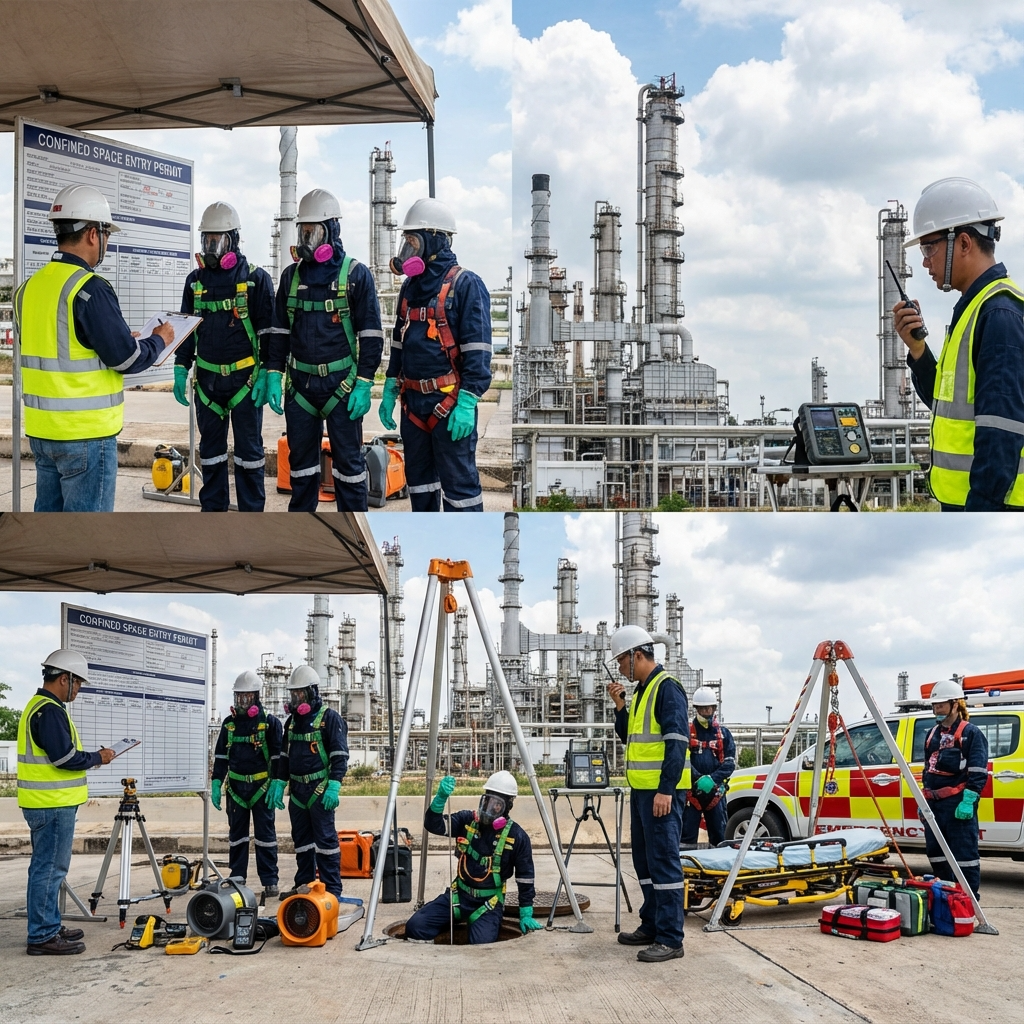
Confined space and gas monitoring
$5500.00
Confined Space & Gas Monitoring: Essential 5-Day Training Course
Course Overview
This critical Confined Space and Gas Monitoring training program delivers comprehensive expertise for HSE and operations professionals across the Kingdom of Saudi Arabia (KSA), Oman, GCC countries (UAE, Qatar, Kuwait, Bahrain), and Africa. The course covers confined space identification, hazard assessment, entry procedures, atmospheric testing, gas detection technologies, rescue operations, and regulatory compliance essential for preventing fatalities and injuries in refineries, petrochemical plants, construction, mining, utilities, and industrial facilities.
With confined spaces causing 60% of fatalities among would-be rescuers and accounting for substantial workplace deaths globally, this training addresses vital competencies for professionals at Saudi Aramco, SABIC, PDO (Petroleum Development Oman), ADNOC, Ma’aden, Qatar Energy, Dangote, Sasol, complying with OSHA 1910.146, Saudi Civil Defense, OSHAD regulations, supporting Saudi Vision 2030 zero-harm objectives.
Target Audience
Safety Officers managing confined space programs across Saudi Arabia, Oman, GCC, Africa
Entry Supervisors authorizing and overseeing confined space entries
Authorized Entrants working inside confined spaces
Attendants/Hole Watchers monitoring entries and initiating rescue
HSE Managers developing confined space procedures
Operations Supervisors ensuring safe entry practices
Maintenance Engineers conducting tank, vessel, pipeline work
Emergency Response Teams performing confined space rescue
Day 1: Confined Space Regulations & Hazard Recognition
Morning Session: Confined Space Fundamentals
Confined space definition: limited entry/exit, not designed for continuous occupancy, adequate size for entry
Permit-required confined spaces (PRCS): atmospheric hazards, engulfment hazards, internal configuration, other recognized serious hazards
Non-permit spaces: meeting criteria but lacking serious hazards
Common confined spaces: tanks, vessels, reactors, silos, pits, sewers, manholes, digesters, bins
Refinery/petrochemical: crude tanks, process vessels, columns, heat exchangers, sewer systems
Regional examples: Saudi Aramco tank farms, ADNOC storage facilities, mining operations (Ma’aden, African mines)
Statistics: confined space fatalities (60% rescuers), incident patterns, root causes
Case studies: major confined space incidents (permit violations, atmospheric testing failures, inadequate rescue)
Afternoon Session: Regulatory Requirements
OSHA 1910.146: permit-required confined space standard, applicability, exemptions
Saudi Arabia: Saudi Aramco SAEP, Royal Commission standards, Civil Defense requirements
UAE OSHAD: confined space entry requirements, permit systems, training mandates
Oman: Ministry of Labour regulations, PDO confined space procedures
GCC standards: regional harmonization efforts, best practices across Gulf states
International standards: ANSI Z117.1, BS 5345, CSA Z1006
Employer responsibilities: written program, hazard assessment, equipment, training, rescue
Employee rights: information access, training, refusing unsafe entry
Permit system: authorization, documentation, posting, cancellation
Entry supervisor duties: verifying conditions, authorizing entry, terminating entry
Reclassification: converting PRCS to non-permit through hazard elimination
Workshop: Identifying confined spaces at your facility
Day 2: Atmospheric Hazards & Testing
Morning Session: Atmospheric Hazards
Oxygen deficiency: <19.5% dangerous, causes (displacement, consumption, absorption)
Oxygen enrichment: >23.5% fire/explosion risk, oxygen cylinders prohibition
Flammable atmospheres: Lower Explosive Limit (LEL), flammable gases/vapors in refineries
Hydrocarbon vapors: crude oil, gasoline, diesel in storage tanks across GCC facilities
Toxic gases: hydrogen sulfide (H2S), carbon monoxide (CO), benzene, ammonia, chlorine
H2S hazards: sour crude/gas common in Saudi Arabia (Ghawar, Khuff), Oman fields, immediate danger concentrations
Carbon dioxide: asphyxiant, heavier than air, accumulation in low points
Combustible dust: grain silos, chemical plants, accumulation and explosion risks
Sources of hazards: residual materials, adjacent processes, purging operations, welding/hot work
Biological hazards: sewage, wastewater treatment, decomposition producing methane/H2S
Physiological effects: oxygen deficiency symptoms, toxic gas exposure, unconsciousness, death
Afternoon Session: Atmospheric Testing Procedures
Testing requirements: before entry, continuous monitoring during entry
Testing sequence: oxygen (first), combustible gases/vapors, toxic gases/vapors
Acceptable entry conditions: 19.5-23.5% oxygen, <10% LEL, toxics below PEL/TLV
Testing locations: all levels (stratification), remote areas, representative sampling
Sampling techniques: remote probes, pump-based sampling, diffusion instruments
Ventilation impact: testing after ventilation stabilization, ongoing monitoring
Pre-entry checklist: atmospheric testing, isolation, ventilation, communication, rescue equipment
Continuous monitoring: maintaining safe atmosphere during work, alarm response
Hot work considerations: fire watch, additional LEL monitoring, spark-producing operations
Regional challenges: extreme heat in GCC (45-50°C) affecting instrument performance
Documentation: test results recorded on permit, calibration records, instrument maintenance
Workshop: Atmospheric testing simulation with multi-gas monitors
Day 3: Gas Detection Equipment & Technologies
Morning Session: Gas Detection Principles
Sensor technologies: electrochemical, catalytic bead (LEL), infrared, photoionization (PID)
Electrochemical sensors: toxic gases (H2S, CO, Cl2, NH3), specificity, lifespan considerations
Catalytic sensors: combustible gas detection, calibration with pentane/methane
Infrared sensors: LEL measurement, immune to poisoning, higher cost
PID sensors: volatile organic compounds (VOCs), benzene detection in refineries
Multi-gas monitors: typical 4-gas (O2, LEL, H2S, CO), 5-gas adding VOC capability
Portable vs. fixed systems: personal monitors, area monitors, permanently installed detection
Instrument specifications: detection range, resolution, accuracy, response time, alarm setpoints
Alarm levels: low alarm (warning), high alarm (immediate action), TWA, STEL
Afternoon Session: Equipment Selection & Maintenance
Selecting monitors: hazards present, concentrations expected, environmental conditions (heat, humidity in GCC)
Calibration: bump testing (daily), full calibration (monthly or per manufacturer), span gas
Calibration gas standards: certified concentrations, storage, shelf life
Zero calibration: fresh air or nitrogen, frequency
Span calibration: known gas concentration, adjusting instrument response
Maintenance: sensor replacement schedules, battery management, cleaning, repair
Pre-use checks: battery level, sensor status, alarm function, calibration currency
Environmental factors: temperature extremes (GCC heat), humidity, pressure, altitude affecting readings
Instrument limitations: sensor poisoning, interference gases, response time delays
Documentation: calibration logs, maintenance records, inventory management
Regional suppliers: gas detection equipment availability in Saudi Arabia, UAE, Oman
Hands-on: Calibrating gas monitors, interpreting readings, troubleshooting common issues
Day 4: Entry Procedures, Ventilation & Isolation
Morning Session: Confined Space Entry Procedures
Entry permit system: written authorization, conditions verification, duration limits
Permit contents: space identification, hazards, controls, acceptable conditions, authorized personnel
Entry supervisor responsibilities: completing permit, verifying conditions, authorizing entry
Authorized entrant duties: understanding hazards, proper equipment use, communication, evacuation
Attendant/hole watcher: continuous presence, monitoring entrants, preventing unauthorized entry, initiating rescue
Communication systems: visual, voice, radio, phone, signal lines appropriate for space
Pre-entry verification: isolation complete, atmospheric testing acceptable, ventilation operating, equipment available
Hot work permits: additional authorization when welding, cutting, grinding inside confined spaces
Entry/exit procedures: controlled access, number limitations, tracking personnel
Emergency response: stopping work, evacuating, attendant alerting rescue team
Afternoon Session: Ventilation & Isolation
Ventilation methods: natural (inadequate for PRCS), mechanical (forced air, exhaust)
Ventilation equipment: blowers, fans, ducting, explosion-proof for flammable atmospheres
Air supply: clean, uncontaminated source, avoiding engine exhaust, compressor oils
Ventilation strategy: purging (initial cleaning), ventilating (maintaining during work), air changes calculation
Effectiveness: continuous atmospheric monitoring confirming adequate ventilation
Isolation methods: blanking/blinding (absolute), double block and bleed, lockout/tagout
Energy isolation: electrical (LOTO), mechanical (blocked), pneumatic (depressured), hydraulic
Line breaking: safely disconnecting piping, flange isolation, preventing backflow
Hazardous material isolation: valves closed and locked, blanks installed, verified zero energy/material
Cleaning and purging: removing residues, flushing, steaming, inerting (nitrogen purging)
Inerting considerations: oxygen deficiency by design, special entry procedures, supplied air required
Workshop: Developing confined space entry permit and pre-entry checklist
Day 5: PPE, Rescue Operations & Program Management
Morning Session: Personal Protective Equipment
Respiratory protection: air-purifying (inadequate for IDLH), supplied-air, SCBA
IDLH atmospheres: immediately dangerous to life or health, requiring SCBA or airline with escape SCBA
Supplied-air respirators: continuous air flow, pressure-demand, escape provisions, hose length limitations
SCBA: self-contained breathing apparatus for rescue, limited duration (30-60 minutes)
Fit testing: quantitative/qualitative, annual requirements, facial hair prohibition
Fall protection: harnesses, lanyards, retrieval systems, anchor points, clearance requirements
Full-body harness: required for vertical entries, retrieval capability, attachment points
Retrieval systems: tripods, winches, mechanical advantage, non-entry rescue capability
Lighting: explosion-proof for flammable atmospheres, adequate illumination, battery-powered
Communication equipment: intrinsically safe radios, wired systems for metal spaces
PPE for specific hazards: chemical-resistant suits, insulated gloves (electrical), heat-resistant (hot work)
Regional considerations: heat stress in GCC requiring cooling vests, hydration
Afternoon Session: Emergency Response & Rescue
Rescue planning: every entry requiring rescue capability, on-site vs. off-site rescue
Non-entry rescue: preferred method, retrieval systems, mechanical advantage
Entry rescue: trained teams, proper equipment (SCBA, harnesses), backup personnel
Rescue team requirements: training, equipment, practice drills (annually), medical evaluation
Self-rescue: entrant recognizes danger, exits immediately, emergency egress
Rescue scenarios: unconscious entrant, toxic exposure, oxygen deficiency, engulfment, injury
Would-be rescuer syndrome: 60% fatalities, untrained personnel attempting rescue
Emergency services coordination: fire department notification, medical response, hospital alerts
Drills and exercises: annual non-entry rescue practice, simulated scenarios, performance evaluation
Regional resources: Saudi Civil Defense, ADNOC emergency response, industrial mutual aid
Program management: written program, hazard assessment, inventory update, employee training
Training requirements: entry supervisors, authorized entrants, attendants, rescue teams
Contractor management: host employer responsibilities, informing contractors, coordinating entries
Audits and reviews: periodic program evaluation, incident investigation, continuous improvement
Record keeping: permits (1 year minimum), training records, equipment maintenance, atmospheric testing
Final exercise: Simulated confined space entry with full permit process, monitoring, and rescue drill
Learning Outcomes
Upon completion, participants will be able to:
Identify and classify confined spaces distinguishing permit-required from non-permit spaces
Recognize atmospheric hazards and understand physiological effects of oxygen deficiency, toxic gases
Conduct atmospheric testing using proper sequence, equipment, and documentation
Select and operate gas detection equipment including calibration and maintenance
Develop entry permits verifying controls, authorizing entry, managing entry procedures
Implement ventilation and isolation ensuring safe atmospheric and physical conditions
Select appropriate PPE including respiratory protection, fall protection, retrieval systems
Plan and execute rescue operations emphasizing non-entry rescue capabilities
Manage confined space programs ensuring regulatory compliance and continuous improvement
Course Delivery & Certification
Format: Technical lectures, hands-on equipment training, practical exercises, simulated entries, rescue drills
Equipment: Multi-gas monitors, calibration equipment, ventilation systems, rescue gear (tripods, harnesses, SCBAs)
Materials: Comprehensive manual, permit templates, checklists, regulatory references, gas detection guides
Certification: Professional certificate with practical competency verification recognized across KSA, Oman, UAE, Qatar, Kuwait, Bahrain, Africa
Language: English (Arabic support available)
CPD Credits: Continuing professional development for HSE professionals
Locations: Riyadh, Dhahran, Jubail, Yanbu (KSA), Muscat, Sohar (Oman), Dubai, Abu Dhabi, Doha, Lagos, Cairo, Johannesburg
Why This Course is Life-Saving
Confined space fatalities remain persistent across GCC and African industries despite regulations. 60% of deaths involve untrained rescuers, emphasizing proper training criticality. Atmospheric testing failures cause immediate fatalities. H2S in sour crude/gas facilities (Saudi Arabia, Oman) creates lethal risks. Regulatory compliance mandatory (OSHA, OSHAD, Saudi standards). Proper procedures prevent 90%+ incidents. Leading operators (Saudi Aramco, Shell) maintain zero confined space fatalities through rigorous programs.
This training delivers life-saving knowledge incorporating OSHA best practices, Saudi Aramco confined space excellence, hands-on competency development, addressing regional hazards: H2S prevalence, extreme heat, diverse workforces, supporting zero-harm goals and protecting lives in high-risk environments.
Train thoroughly. Test properly. Save lives.