Concession, Production Sharing and JV Contracts
$5500.00
Concession, Production Sharing and JV Contracts: 5-Day Professional Training Course
Course Overview
This intensive 5-day training program provides comprehensive knowledge of upstream petroleum contracts, fiscal systems, and joint venture agreements. Designed for professionals in the Kingdom of Saudi Arabia (KSA), Oman, GCC countries, and Africa, this course covers concession agreements, production sharing contracts (PSCs), joint operating agreements (JOAs), and commercial frameworks essential for successful upstream partnerships and operations.
Target Audience
Legal counsel and contract managers
Commercial analysts and negotiators
Petroleum engineers and reservoir managers
Government officials from petroleum ministries
Business development professionals
Joint venture partners and NOC/IOC representatives
Finance and tax specialists
Technical professionals from Saudi Aramco, PDO, ADNOC, and African operators
Investment analysts and asset managers
Day 1: Petroleum Contract Fundamentals
Morning Session: Contract Framework and Evolution
Module 1.1: Introduction to Upstream Contracts
Petroleum contract role in upstream operations
Historical evolution: from old concessions to modern agreements
Sovereignty over natural resources principles
Host government objectives and investor requirements
Risk allocation between parties
Contract types overview and selection criteria
Regional contractual frameworks: Middle East vs. Africa
International legal principles and best practices
Module 1.2: Key Contractual Elements
Contract area definition and coordinates
Contract duration and extension provisions
Work program and minimum expenditure commitments
Exploration, development, and production phases
Relinquishment obligations and area reduction
Ring-fencing provisions
Termination rights and force majeure
Dispute resolution mechanisms
Afternoon Session: Concession Agreements
Module 1.3: Concession System Fundamentals
Traditional concession agreement structure
License and lease systems
Ownership of petroleum in-place and produced
Exclusive rights and obligations
Royalty and tax-based fiscal terms
Bonuses: signature, discovery, production
Decommissioning and abandonment obligations
North African concession examples: Egypt, Algeria, Libya
Module 1.4: Modern Concession Frameworks
Progressive royalty structures
Sliding scale tax regimes
Resource rent tax mechanisms
Profit-based royalties
Cost recovery allowances in hybrid systems
State participation options
Local content requirements integration
GCC licensing rounds and bidding parameters
Day 2: Production Sharing Contracts
Morning Session: PSC Architecture
Module 2.1: PSC Fundamentals
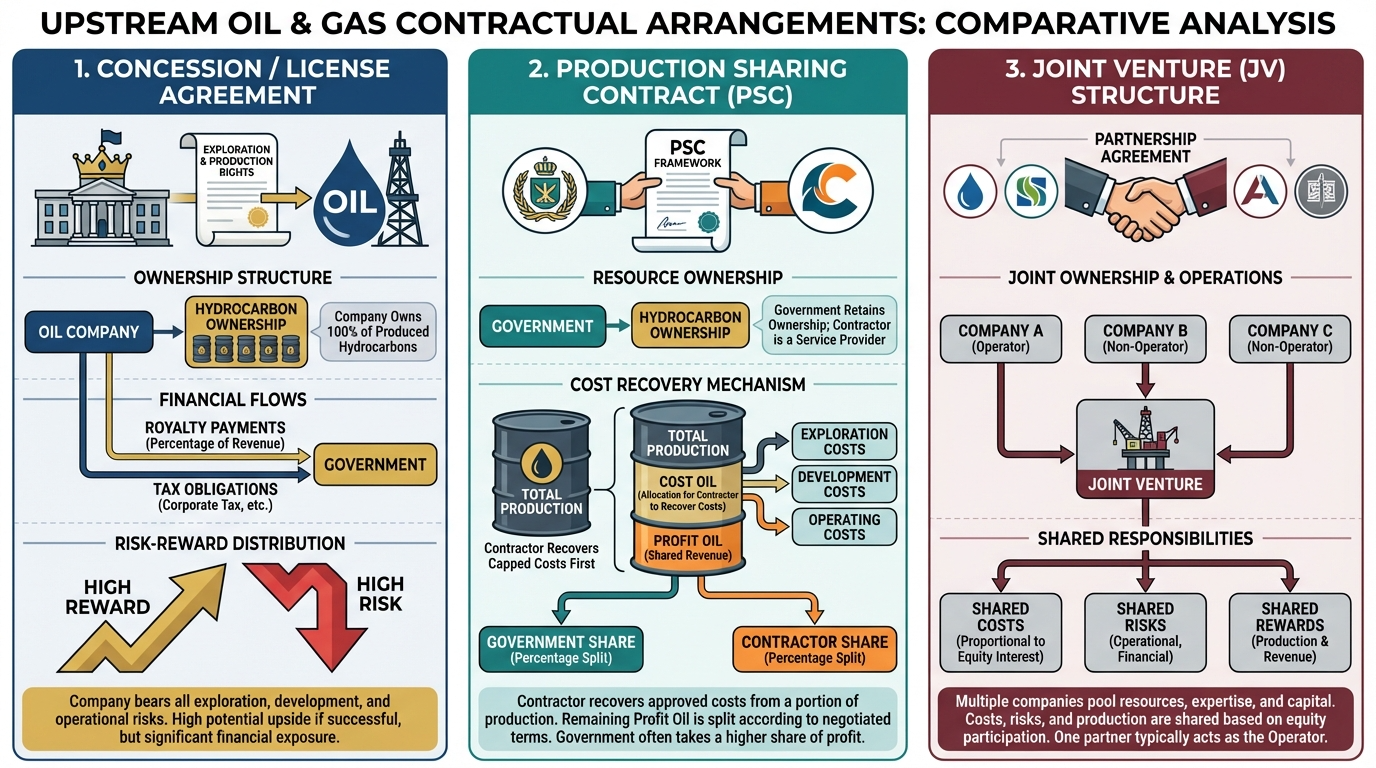
Production sharing philosophy and principles
Government ownership vs. contractor rights
PSC vs. concession comparison
Cost recovery mechanisms: limits and procedures
Profit oil/gas splitting formulas
Contractor entitlement calculation
Production bonuses and R-factor systems
Investment credit mechanisms
Module 2.2: Cost Recovery and Petroleum Costs
Recoverable vs. non-recoverable costs
Capital expenditure (CAPEX) recovery
Operating expenditure (OPEX) recovery
Cost pools and allocation methods
Cost recovery ceilings and limitations
Depreciation and amortization schedules
Abandonment cost recovery
Audit rights and cost verification procedures
Afternoon Session: Profit Sharing and Fiscal Terms
Module 2.3: Profit Oil/Gas Mechanisms
Fixed split vs. variable split formulas
Production-based sliding scales
R-factor (cumulative revenue/cost) systems
Rate of return-based sharing
Price-responsive sharing mechanisms
Gas vs. oil profit sharing differences
Domestic market obligation (DMO) pricing
Indonesian, Malaysian, and African PSC models
Module 2.4: Taxation in PSCs
Income tax provisions in PSCs
Tax paid by government vs. contractor
Withholding taxes on services
Indirect taxes: VAT, import duties
Tax consolidation and ring-fencing
Thin capitalization rules
Transfer pricing considerations
Double taxation treaties
Oman PSC fiscal framework
Day 3: Joint Venture Agreements and JOAs
Morning Session: Joint Venture Structures
Module 3.1: Joint Venture Fundamentals
Incorporated vs. unincorporated joint ventures
Equity joint ventures vs. contractual JVs
Consortium arrangements
Participating interests and working interests
Carried interest provisions
Farm-in and farm-out agreements
Sole risk and non-consent operations
Government participation mechanisms
Module 3.2: Operator Selection and Responsibilities
Operator appointment and removal
Operatorship criteria and qualifications
Operator duties and standard of care
Prudent oilfield practices
Technical and administrative responsibilities
Exclusive operations vs. joint operations
Operator liability and indemnification
Performance metrics and KPIs
Afternoon Session: Joint Operating Agreements
Module 3.3: JOA Structure and Key Provisions
AIPN Model JOA overview
Operating committee composition and authority
Voting rights and decision-making thresholds
Annual work programs and budgets (AFE)
Cash calls and funding procedures
Default provisions and remedies
Withdrawal and abandonment rights
Confidentiality and data ownership
Module 3.4: Financial and Accounting Procedures
Joint account structure
Charging principles and cost allocation
Direct vs. indirect costs
Overhead and administrative charges
Material and equipment procurement
Lifting and marketing of production
Production imbalances and balancing
Audit rights and procedures
COPAS accounting standards
Day 4: Commercial Terms and Negotiation
Morning Session: Fiscal Design and Economics
Module 4.1: Fiscal System Design
Government take vs. contractor take
Progressive vs. regressive fiscal terms
Fiscal stability and neutrality
Investment attractiveness metrics
Economic modeling and sensitivity analysis
Breakeven analysis under different fiscal terms
Marginal field fiscal incentives
Deepwater and HPHT fiscal concessions
Module 4.2: Bonuses and Financial Commitments
Signature bonuses: timing and amount
Discovery bonuses and thresholds
Production milestone bonuses
Commercial discovery declarations
Minimum work program commitments
Bank guarantees and performance bonds
Financial capacity requirements
Abandonment fund contributions
Afternoon Session: Contract Negotiation
Module 4.3: Negotiation Strategy and Tactics
Pre-bid analysis and due diligence
Bid strategy development
BATNA (Best Alternative to Negotiated Agreement)
Win-win negotiation approaches
Government vs. IOC/NOC perspectives
Negotiation team composition
Red lines and negotiable terms
Cultural considerations in Middle East and Africa
Module 4.4: Local Content and Social Obligations
Local content definitions and requirements
Goods and services procurement obligations
Employment and training commitments
Technology transfer provisions
In-Country Value (ICV) programs: Oman, UAE
Nigerian Content Development Act
Angola’s Angolanization requirements
Community development obligations
Compliance monitoring and penalties
Day 5: Risk Management and Special Topics
Morning Session: Risk Allocation and Management
Module 5.1: Contractual Risk Management
Geological and technical risk allocation
Commercial and price risk management
Political risk and stabilization clauses
Force majeure provisions and interpretation
Environmental liability allocation
Third-party claims and indemnification
Insurance requirements
Change in law and economic equilibrium clauses
Module 5.2: Decommissioning and Abandonment
Abandonment obligations and standards
Cost estimation and funding mechanisms
Abandonment security and guarantees
Asset retirement obligations (ARO)
Technology for cost reduction
Regional regulatory requirements
Transfer of abandonment liability
North Sea lessons for Middle East and Africa
Afternoon Session: Dispute Resolution and Special Contracts
Module 5.3: Dispute Resolution Mechanisms
Negotiation and expert determination
Mediation and conciliation
Arbitration: institutional vs. ad hoc
ICSID, ICC, LCIA arbitration rules
Applicable law and seat of arbitration
Enforcement of arbitral awards
Sovereign immunity considerations
Recent petroleum arbitration cases
Module 5.4: Special Contract Types
Service Contracts:
Risk service contracts: Iraq model
Technical service agreements (TSAs)
Pure service contracts vs. PSCs
Fee structures: fixed, per barrel, incentive-based
Remuneration mechanisms
Gas Contracts:
Gas sales agreements (GSAs)
Take-or-pay provisions
Price review and arbitration
LNG SPAs and pricing mechanisms
Domestic gas supply obligations
Unitization and Redetermination:
Cross-border reservoir management
Unit operating agreements
Redetermination of participating interests
GCC cross-border field examples
Case Studies and Practical Workshop
Regional Contract Analysis:
Saudi Arabia:
Saudi Aramco partnership models
Unconventional gas concessions
Joint venture structures with IOCs
Jafurah gas development agreements
Oman:
PDO concession agreement structure
Block PSC framework and variations
Exploration and production sharing terms
ICV requirements in contracts
UAE:
ADNOC offshore concession model
40-year concession extensions
Onshore license terms
Abu Dhabi competitive bidding framework
Kuwait:
Project Kuwait technical service agreements
Operating service agreements structure
Enhanced technical service agreements (ETSAs)
Qatar:
North Field partnership agreements
LNG joint ventures
Offshore concession framework
Africa:
Nigeria PSC and JOA structures: NNPC partnerships
Angola PSC evolution and local content
Egypt concession and PSC models
Ghana petroleum agreements
Mozambique LNG project contracts
Senegal/Mauritania cross-border cooperation
Interactive Workshop:
Contract drafting exercise
PSC economic modeling
JOA voting rights simulation
Negotiation role-play scenarios
Dispute resolution case analysis
Local content compliance planning
Red flag identification in contracts
Term sheet development
Group presentations and feedback
Learning Outcomes
Participants will gain:
Comprehensive understanding of concession and PSC structures
JOA expertise including operation and governance
Negotiation skills for petroleum agreements
Fiscal analysis capabilities for different contract types
Risk management knowledge for contractual issues
Regional expertise in KSA, Oman, GCC, and African frameworks
Drafting proficiency for key contractual clauses
Dispute resolution awareness and strategies
Regional Contract Focus
Saudi Arabia: Aramco partnership models, unconventional concessions, joint venture frameworks
Oman: Block PSC system, ICV integration, mature field contracts, PDO operating model
GCC: ADNOC concessions, Qatar partnerships, Kuwait service agreements, competitive licensing
Africa: Nigerian PSCs, Angolan local content, Egyptian licensing, cross-border unitization
Training Methodology
Expert-led contract analysis sessions
Template contracts and model agreements review
Interactive negotiation simulations
Case law and arbitration review
Economic modeling workshops
Drafting exercises
Regional contract comparison
Guest speakers from legal and commercial teams
Duration: 5 days (40 hours)
Delivery: In-person preferred, hybrid available
Language: English (Arabic support available)
Materials: Sample contracts, templates, fiscal models
Certification: Professional petroleum contracts certificate
Keywords: petroleum contracts training, PSC course KSA, concession agreements Oman, JOA training GCC, production sharing Africa, joint venture oil gas, upstream contracts Middle East, Saudi Aramco partnerships, ADNOC concessions, PDO PSC, fiscal terms negotiation, petroleum legal framework, IOC NOC agreements, contract negotiation upstream