Boiler Operations and Maintenance
$5500.00
Boiler Operations and Maintenance – 5-Day Course Outline
Course Overview
This 5-day Boiler Operations and Maintenance course is designed for professionals working with industrial steam and hot-water systems in power, oil and gas, petrochemicals, food processing, manufacturing, utilities and district energy. The program combines boiler fundamentals, combustion control, routine maintenance, inspection awareness, water treatment, efficiency improvement and troubleshooting. It is especially relevant for organizations in KSA, GCC and Africa seeking safer operations, better fuel efficiency, stronger reliability and improved workforce capability in line with industrial modernization goals. U.S. DOE Steam Handbook Saudi Vision 2030 National Industrial Strategy UAE Industry 4.0 Program African Union Digital Transformation Strategy
Who Should Attend
This course is suitable for boiler operators, utility engineers, maintenance engineers, mechanical supervisors, facility managers, production staff, HSE personnel, shift leaders, reliability engineers and young professionals responsible for steam generation and boiler-room performance.
Learning Outcomes
By the end of the course, participants will be able to:
explain boiler types, components and steam-system basics
operate boilers more safely during startup, normal running and shutdown
understand combustion, draft, excess air and heat-transfer performance
recognize the role of boiler water treatment and blowdown control
plan preventive and routine maintenance activities
identify common faults such as low water level, scaling, soot buildup, poor combustion and steam losses
improve boiler efficiency, reliability and operating discipline
support safer inspection, documentation and operator response practices. DOE Steam System Sourcebook OSHA Boiler Safety Bulletin
5-Day Course Outline
Day 1 – Boiler Fundamentals and Safe Boiler-Room Practices
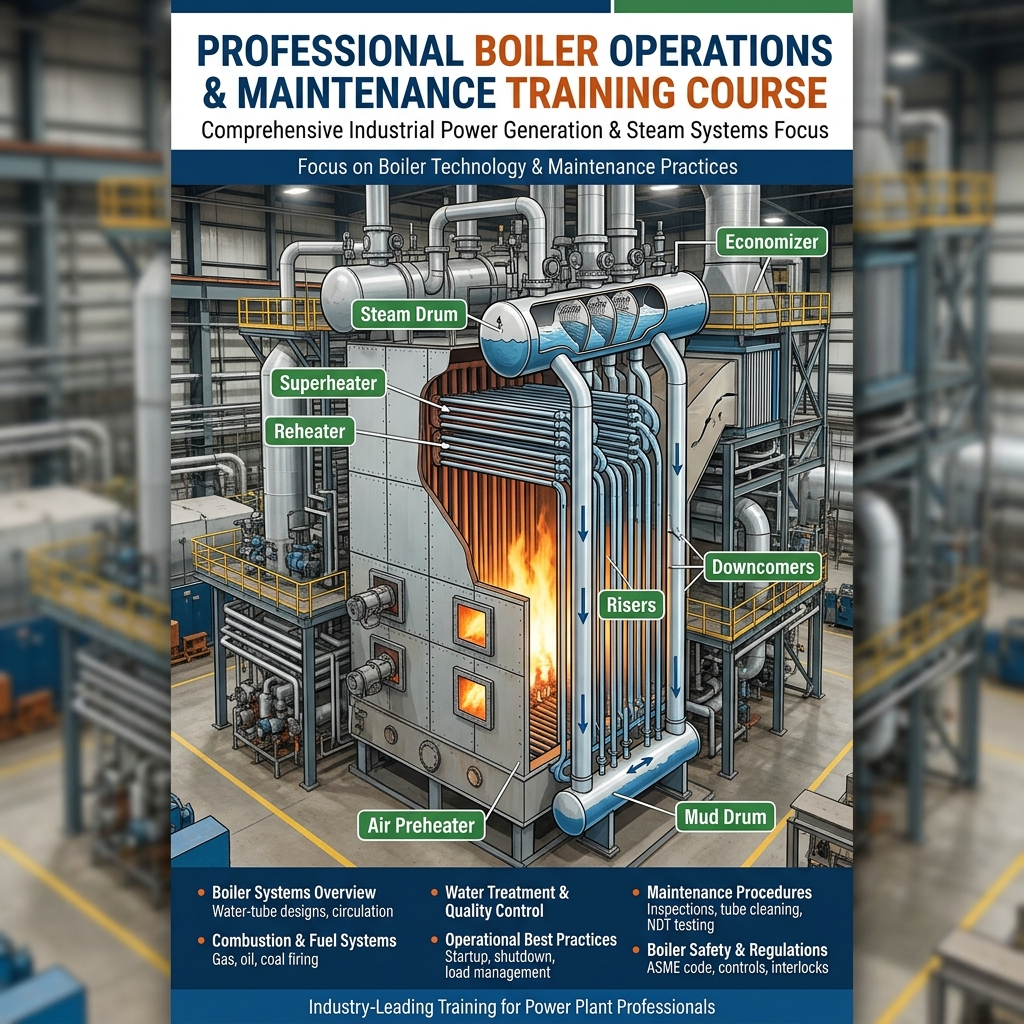
Introduction to boiler operations, types of boilers, major components, steam generation principles, boiler-room layout, fuel systems, burners, feedwater systems, deaeration basics, controls and instrumentation. Safety focus includes operator responsibilities, permits, alarms, interlocks, lockout/tagout awareness, low-water protection and safe housekeeping.
Workshop: Identify boiler components and explain the boiler steam cycle using plant schematics and sample diagrams. Steam Handbook OSHA
Day 2 – Boiler Operation, Combustion and Efficiency
Boiler startup checks, warm-up principles, load management, combustion fundamentals, air-fuel ratio, excess air, flame stability, draft control, stack losses and boiler efficiency drivers. Participants learn how poor tuning, fouling, steam leaks and bad operating practices increase fuel consumption.
Workshop: Review operating trends and identify causes of poor efficiency from typical boiler-room data. DOE Best Management Practice #8 Boiler Efficiency Guide
Day 3 – Boiler Water Treatment, Blowdown and Steam-System Reliability
Water quality requirements, scale formation, corrosion, carryover, condensate return, makeup water quality, chemical treatment basics, TDS control and blowdown management. Links between water chemistry and tube damage, heat-transfer loss and unplanned shutdowns are emphasized. The day also covers steam traps, condensate systems and heat losses in the wider steam network.
Workshop: Diagnose water- and steam-side reliability problems from symptoms such as wet steam, high blowdown, corrosion or deposits. Steam Handbook PNNL Operations & Maintenance Guide
Day 4 – Maintenance, Inspection Awareness and Troubleshooting
Routine, preventive and predictive maintenance for burners, fans, pumps, valves, gauges, controls, refractory, safety valves and water-level devices. Participants review boiler inspection awareness, documentation, shutdown planning and common operational faults such as flame failure, poor atomization, tube leaks, pressure instability and soot accumulation.
Workshop: Build a maintenance checklist and perform root-cause analysis for common boiler trips and repeat failures. Superior Boiler O&M Manual National Board Guidance
Day 5 – Performance Improvement, Shutdown Practices and Action Planning
Planned shutdown steps, cooldown considerations, post-shutdown inspection points, restart readiness, spare-parts planning and operator communication. The final day focuses on KPI tracking, fuel-use reduction, operator rounds, boiler logs, reliability culture and continuous improvement. Regional relevance is highlighted for industrial growth, utility resilience and skills development across Saudi Arabia, GCC and Africa.
Workshop: Develop a 90-day boiler improvement plan covering safety, efficiency, maintenance and operator competency. Saudi Vision 2030 National Industrial Strategy UAE Industry 4.0 Program African Union Digital Transformation Strategy
Delivery Options
Available as online, onsite or in-house training for clients across KSA, GCC and Africa.