
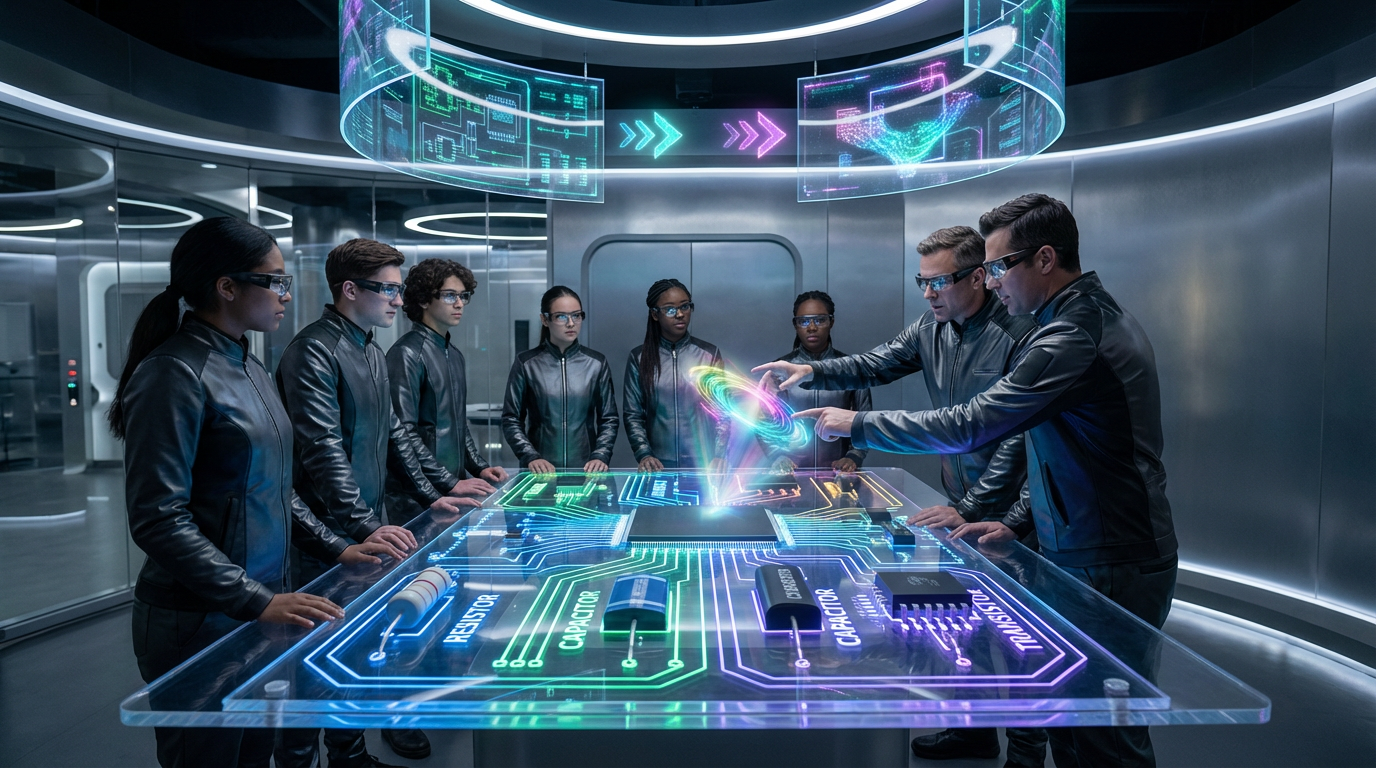
Basic Electronics Components and Circuits
$3500.00
Basic Electronics Components and Circuits: 5-Day Comprehensive Training Course
Course Overview
This foundational Basic Electronics Training provides essential knowledge of electronic components, circuit theory, analysis techniques, and practical circuit design. This intensive 5-day program covers resistors, capacitors, inductors, diodes, transistors, operational amplifiers, integrated circuits, digital logic, circuit analysis methods, and hands-on breadboarding skills for beginners and technicians entering electronics.
Who Should Attend This Electronics Course?
Electrical Technicians requiring electronics fundamentals
Maintenance Personnel working with electronic equipment
Engineering Students seeking practical electronics knowledge
Instrumentation Technicians in process industries
Hobbyists and Makers building electronic projects
IT Professionals transitioning to hardware roles
Quality Control Inspectors testing electronic assemblies
Career Changers entering electronics field
Apprentices starting electronics training
Course Objectives
Participants will master electronic component identification, circuit theory fundamentals, Ohm’s Law and Kirchhoff’s Laws, AC and DC circuit analysis, semiconductor devices operation, analog and digital circuit design, troubleshooting techniques, and hands-on circuit construction skills.
Day 1: Fundamentals and Passive Components
Morning Session: Electronics Fundamentals
Topics Covered:
Electricity basics: voltage, current, resistance, power
Conductors, insulators, and semiconductors
Atomic structure and electron flow
Direct Current (DC) vs. Alternating Current (AC)
Ohm’s Law: V = I × R calculations
Power calculations: P = V × I, P = I²R, P = V²/R
Series and parallel circuit configurations
Voltage dividers and current dividers
Safety Fundamentals:
Electrical safety practices and hazards
Electrostatic discharge (ESD) protection
Safe component handling procedures
Basic test equipment safety
Afternoon Session: Resistors and Applications
Topics Covered:
Resistor fundamentals and function in circuits
Resistor types: carbon composition, metal film, wire-wound, SMD
Color code reading (4-band and 5-band)
Resistor power ratings and heat dissipation
Tolerance and temperature coefficients
Variable resistors: potentiometers, rheostats, trimmers
Series and parallel resistor calculations
Practical applications and circuit examples
Hands-On Lab:
Resistor identification, color code reading, measuring resistance with multimeter, building resistor circuits on breadboard.
Day 2: Capacitors, Inductors, and AC Circuits
Morning Session: Capacitors
Topics Covered:
Capacitor fundamentals: energy storage in electric field
Capacitance unit: Farad (F) and practical values (μF, nF, pF)
Capacitor types: ceramic, electrolytic, tantalum, film, supercapacitors
Polarity and voltage ratings
Series and parallel capacitor calculations
Capacitor charging and discharging curves
Time constant (τ = RC) calculations
Applications: filtering, coupling, decoupling, timing circuits
Afternoon Session: Inductors and AC Theory
Topics Covered:
Inductor fundamentals: energy storage in magnetic field
Inductance unit: Henry (H) and core materials
Inductor types: air core, iron core, ferrite core, toroidal
Series and parallel inductor calculations
AC circuit theory: frequency, period, amplitude, phase
RMS and peak values relationships
Reactance: capacitive (Xc) and inductive (XL)
Impedance (Z) in AC circuits
Resonance in LC circuits
Practical Workshop:
Testing capacitors and inductors, observing RC time constants, breadboarding filter circuits.
Day 3: Semiconductor Devices
Morning Session: Diodes
Topics Covered:
Semiconductor physics basics: P-type and N-type materials
PN junction operation and energy band diagram
Diode characteristics: forward bias and reverse bias
Diode specifications: forward voltage drop, reverse breakdown voltage, current rating
Diode types: rectifier, Zener, LED, Schottky, signal diodes
Half-wave and full-wave rectifier circuits
Bridge rectifier configurations
Voltage regulation with Zener diodes
LED applications and current limiting resistors
Afternoon Session: Transistors
Topics Covered:
Bipolar Junction Transistor (BJT) structure: NPN and PNP
Transistor operation modes: cutoff, active, saturation
Base, collector, emitter functions
Current gain (β or hFE)
Common emitter, common collector, common base configurations
Transistor as switch and amplifier
Biasing circuits and operating point
Field Effect Transistor (FET) introduction: JFET and MOSFET
FET characteristics and applications
Hands-On Exercise:
Building transistor switching circuits, LED driver circuits, simple amplifier on breadboard.
Day 4: Operational Amplifiers and Analog Circuits
Morning Session: Operational Amplifiers (Op-Amps)
Topics Covered:
Operational amplifier fundamentals and ideal characteristics
Op-amp internal architecture overview
Inverting and non-inverting amplifier configurations
Gain calculations and design formulas
Input impedance and output impedance
Virtual ground concept
Common op-amp ICs: LM358, TL071, LM741
Single supply vs. dual supply operation
Op-amp specifications: offset voltage, slew rate, bandwidth
Op-Amp Applications:
Voltage followers (buffer amplifiers)
Summing amplifiers
Differential amplifiers
Integrators and differentiators
Comparator circuits
Afternoon Session: Analog Circuit Building Blocks
Topics Covered:
Power supply circuits: linear regulators (78xx, 79xx series)
Voltage divider bias and reference circuits
Signal conditioning and amplification
Active filters: low-pass, high-pass, band-pass
Oscillator circuits: RC, LC, crystal oscillators
Timer IC 555: astable and monostable configurations
Waveform generators: square wave, triangle wave
Signal rectification and peak detection
Practical Lab:
Building regulated power supply, 555 timer circuits, op-amp amplifier, testing with oscilloscope.
Day 5: Digital Electronics and Circuit Analysis
Morning Session: Digital Logic Fundamentals
Topics Covered:
Digital vs. analog signals
Binary number system and Boolean algebra
Logic gates: AND, OR, NOT, NAND, NOR, XOR, XNOR
Truth tables and logic gate symbols
Combinational logic circuits
Integrated Circuit families: TTL, CMOS specifications
Logic levels: HIGH (1) and LOW (0) voltage ranges
Flip-flops: SR, D, JK, T types
Counters and shift registers basics
Digital IC handling and breadboarding
Digital Applications:
LED flashers and sequencers
Debounce circuits for switches
Basic digital counters
Multiplexers and demultiplexers
Afternoon Session: Circuit Analysis and Troubleshooting
Topics Covered:
Circuit analysis techniques: nodal analysis, mesh analysis
Kirchhoff’s Current Law (KCL) and Voltage Law (KVL)
Thevenin’s and Norton’s theorems
Superposition principle
Maximum power transfer theorem
Troubleshooting methodology: systematic approach
Common circuit faults: opens, shorts, component failures
Using test equipment: multimeter, oscilloscope, function generator
Signal tracing and voltage measurements
Test Equipment:
Digital multimeter (DMM) operation
Oscilloscope basics and waveform observation
Function generator and signal injection
Logic probe for digital circuits
Power supply settings and current limiting
Practical Skills and Best Practices
Topics Covered:
Breadboard circuit construction techniques
Component lead forming and insertion
Wire management and neat layouts
Soldering basics and desoldering techniques
PCB (Printed Circuit Board) overview
Reading schematic diagrams and component symbols
Circuit simulation software introduction: Tinkercad, LTSpice
Documentation and circuit labeling
Component storage and organization
Industry Standards:
Electronic component standards and packages
SMD (Surface Mount Device) vs. through-hole components
Component datasheets reading and interpretation
ESD precautions and handling procedures
Final Project and Assessment
Comprehensive Electronics Project:
Design and build complete working circuit including:
Regulated power supply section
Signal generation using 555 timer or oscillator
Amplification stage with transistor or op-amp
LED indicator outputs
Complete schematic diagram creation
Component selection and bill of materials
Breadboard assembly and testing
Troubleshooting and optimization
Presentation of working circuit
Assessment Activities:
Written examination: circuit theory and component knowledge
Practical test: component identification and measurement
Circuit building exercise: construct circuit from schematic
Troubleshooting challenge: identify and fix circuit faults
Multimeter and oscilloscope operation demonstration
Group discussion: circuit analysis problem-solving
Certificate of Completion in Basic Electronics
Course Benefits and Learning Outcomes
Participants will identify electronic components, understand circuit theory fundamentals, apply Ohm’s and Kirchhoff’s Laws, analyze DC and AC circuits, use semiconductor devices, design basic analog and digital circuits, operate test equipment, build circuits on breadboard, and troubleshoot electronic faults.
Training Methodology
Instructor-led theory sessions with extensive hands-on laboratory work, component identification exercises, breadboard circuit building, oscilloscope demonstrations, troubleshooting scenarios, progressive skill development, and individual practice time.
Course Materials
Comprehensive electronics handbook, component identification guide, circuit symbol reference, formula sheets, breadboard layout examples, schematic reading guide, troubleshooting flowcharts, and certificate of completion.
Laboratory Equipment
Individual workstations with breadboards, component kits (resistors, capacitors, diodes, transistors, ICs), digital multimeters, oscilloscopes, function generators, power supplies, hand tools (wire strippers, cutters, pliers), and safety equipment.
Component Kit Included
Participants receive electronics kit containing resistors (various values), capacitors, diodes, LEDs, transistors (NPN/PNP), 555 timer ICs, op-amps, voltage regulators, breadboard, jumper wires, and basic components for projects.
Prerequisites
No prior electronics experience required. Basic mathematics knowledge (algebra) helpful. Logical thinking ability and willingness to learn hands-on skills. Safety awareness and careful attention to detail essential.
Keywords: basic electronics training, electronic components course, circuit theory fundamentals, resistors capacitors inductors, diodes transistors, operational amplifiers op-amps, digital logic gates, electronics for beginners, breadboard circuits, Ohm’s Law, circuit analysis, electronics troubleshooting, multimeter oscilloscope, analog circuits digital electronics, semiconductor devices, electronics fundamentals, practical electronics, electronics technician training