Arc flash hazards & protection
$5500.00
Arc Flash Hazards & Protection 5-Day Training Course Outline for KSA, Oman, GCC & Africa
A practical 5-day Arc Flash Hazards & Protection training outline for electrical, maintenance, and HSE teams in KSA, Oman, GCC, and Africa, covering risk assessment, PPE, safe isolation, incident energy, labels, emergency response, and compliance.
5-Day Training Outline
This 5-day course is designed for electrical engineers, technicians, supervisors, HSE professionals, utility staff, oil & gas teams, industrial maintenance personnel, and facility managers operating in Saudi Arabia, Oman, the wider GCC, and Africa. The structure reflects widely recognized electrical safety principles such as establishing an electrically safe work condition, applying the hierarchy of risk controls, conducting hazard/risk assessment, and selecting arc-rated PPE based on task risk and incident energy. NFPA OSHA
Day 1: Fundamentals of Arc Flash Hazards
Theme: Understanding the danger
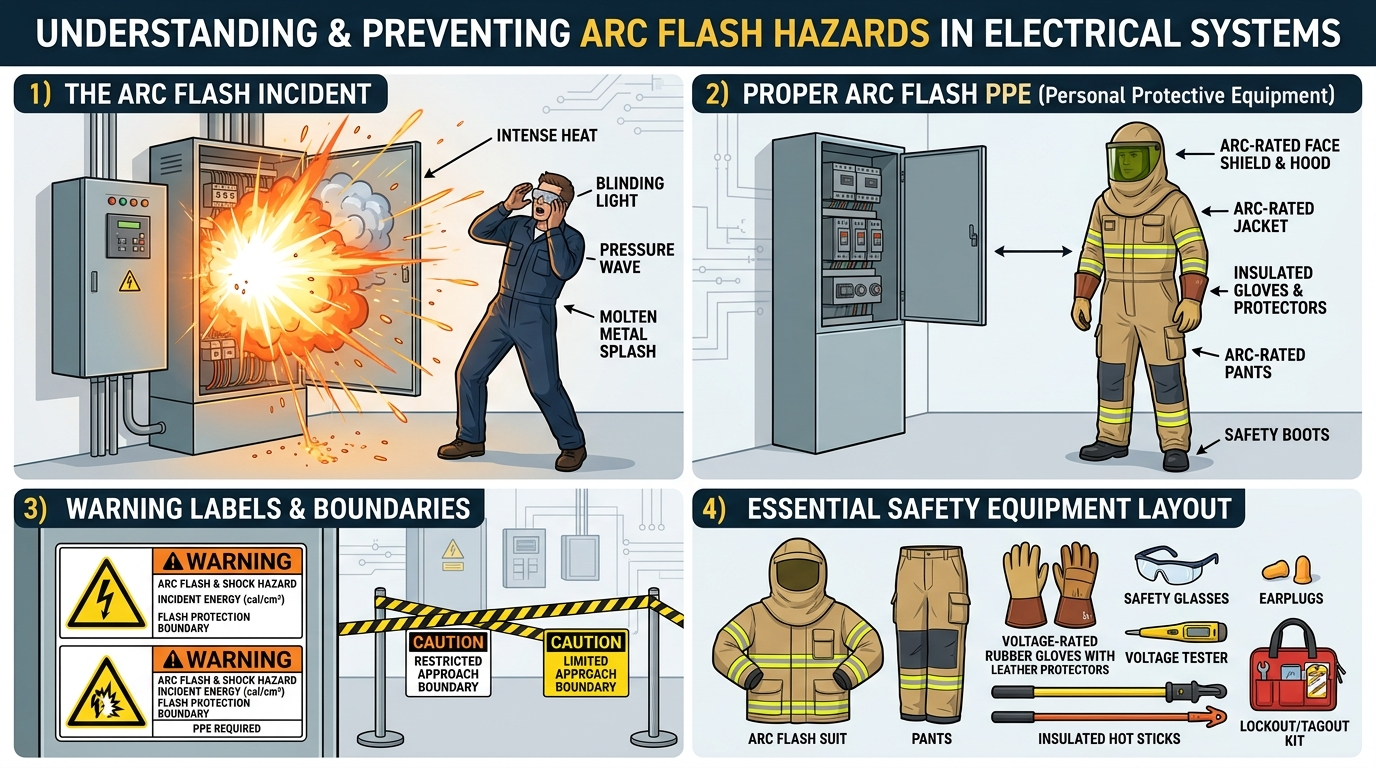
Introduction to electrical hazards: shock, arc flash, arc blast, burns, fire, and pressure effects
What causes an arc flash: equipment failure, human error, poor maintenance, contamination, and unsafe work practices
Why low voltage is not low risk
Basic terms: incident energy, arc boundary, limited/restricted approach, fault current, clearing time
Typical high-risk equipment: switchgear, MCCs, panelboards, transformers, UPS systems, generators
Case studies from industrial, utility, and oil & gas environments
Group exercise: identify arc flash exposure points in a plant or facility
Learning outcome: Participants understand arc flash mechanisms, consequences, and the equipment/tasks most likely to create exposure. OSHA notes that even 120/208V systems can generate dangerous arc energy, and that risk depends heavily on amperage, duration, and working distance. OSHA
Day 2: Standards, Responsibilities, and Safe Work Practices
Theme: Building a compliant safety culture
Overview of electrical safety responsibilities for employers, supervisors, and qualified workers
Electrically safe work condition (ESWC) and when de-energization is required
Lockout/tagout (LOTO) and verification of absence of voltage
Energized electrical work: justification, authorization, and controls
Qualified vs unqualified persons
Training, supervision, permits, signage, and documentation
Toolbox talk exercise: pre-job briefing for electrical maintenance
Learning outcome: Participants learn that de-energization is the preferred control, supported by lockout/tagout, testing, and documented procedures. NFPA places hazard elimination at the top of the hierarchy of risk controls, with PPE as the last line of defense. NFPA OSHA
Day 3: Arc Flash Risk Assessment and Label Interpretation
Theme: Turning data into protection
Steps in arc flash risk assessment
Hazard identification and task-based exposure review
Understanding short-circuit current, protective device coordination, and clearing time
Arc flash study basics and why system changes require review
Reading arc flash labels: incident energy, working distance, PPE level, shock boundaries
Selecting controls: engineering, administrative, awareness, and PPE
Workshop: interpret sample arc flash labels and decide safe actions
Learning outcome: Participants gain the ability to interpret studies and field labels, recognize when reassessment is needed, and understand how risk assessment supports safer work planning. OSHA emphasizes workplace hazard assessment, inspection, and selection of protection based on calculated incident energy. OSHA
Day 4: Arc-Rated PPE, Tools, and Human Performance
Theme: Protecting the worker
Arc-rated clothing and layering concepts
Face shields, hoods, balaclavas, gloves, helmets, hearing protection, footwear, and insulated tools
Correct use, care, inspection, storage, and replacement of PPE
Common PPE mistakes: open clothing, non-compliant undergarments, damaged face shields, poor fit
Human factors: fatigue, rushing, overconfidence, distractions, and communication failures
Practical demonstration: donning and doffing arc-rated PPE
Hands-on inspection of PPE and electrical test instruments
Learning outcome: Participants can select and use appropriate arc-rated PPE correctly and understand its limitations. OSHA states employers must provide suitable PPE, maintain it in safe condition, and select protection appropriate to calculated incident energy. OSHA OSHA
Day 5: Emergency Response, Auditing, and Implementation
Theme: From training room to workplace execution
Emergency response to arc flash incidents: first aid priorities, burns response, isolation, rescue precautions, and escalation
Incident reporting, root-cause analysis, and lessons learned
Electrical safety program improvement and audit checklist
Maintenance links to arc flash prevention: inspection, torqueing, thermography, cleaning, testing, and protective device upkeep
Creating a site action plan for KSA, Oman, GCC, and Africa operations
Final assessment, practical review, and certification criteria
Participant presentations: department-level arc flash improvement plans
Learning outcome: Participants finish with an implementable action plan covering prevention, response, and continual improvement. NFPA highlights electrical safety programs, worker training, maintenance, and regular evaluation of qualified persons as core program elements. NFPA