Applied Reservoir Engineering & Management
$3500.00
I’ll create a comprehensive 5-day course outline on Applied Reservoir Engineering & Management with SEO optimization for your target regions.
Applied Reservoir Engineering & Management: 5-Day Professional Training Course
Course Overview
This comprehensive 5-day training program delivers practical reservoir engineering principles and advanced reservoir management techniques for maximizing hydrocarbon recovery. Specifically designed for professionals in the Kingdom of Saudi Arabia (KSA), Oman, GCC countries, and Africa, this course covers reservoir characterization, performance analysis, simulation fundamentals, and field development strategies essential for optimizing asset value in diverse geological settings.
Target Audience
Reservoir engineers and analysts
Petroleum engineers and production technologists
Geoscientists working with reservoir teams
Asset managers and field development planners
Production optimization specialists
Enhanced oil recovery (EOR) engineers
Technical professionals from Saudi Aramco, PDO, ADNOC, and African operators
Graduate engineers entering reservoir engineering
Day 1: Reservoir Engineering Fundamentals
Morning Session: Reservoir Properties and Fluid Behavior
Module 1.1: Introduction to Reservoir Engineering
Role of reservoir engineering in upstream operations
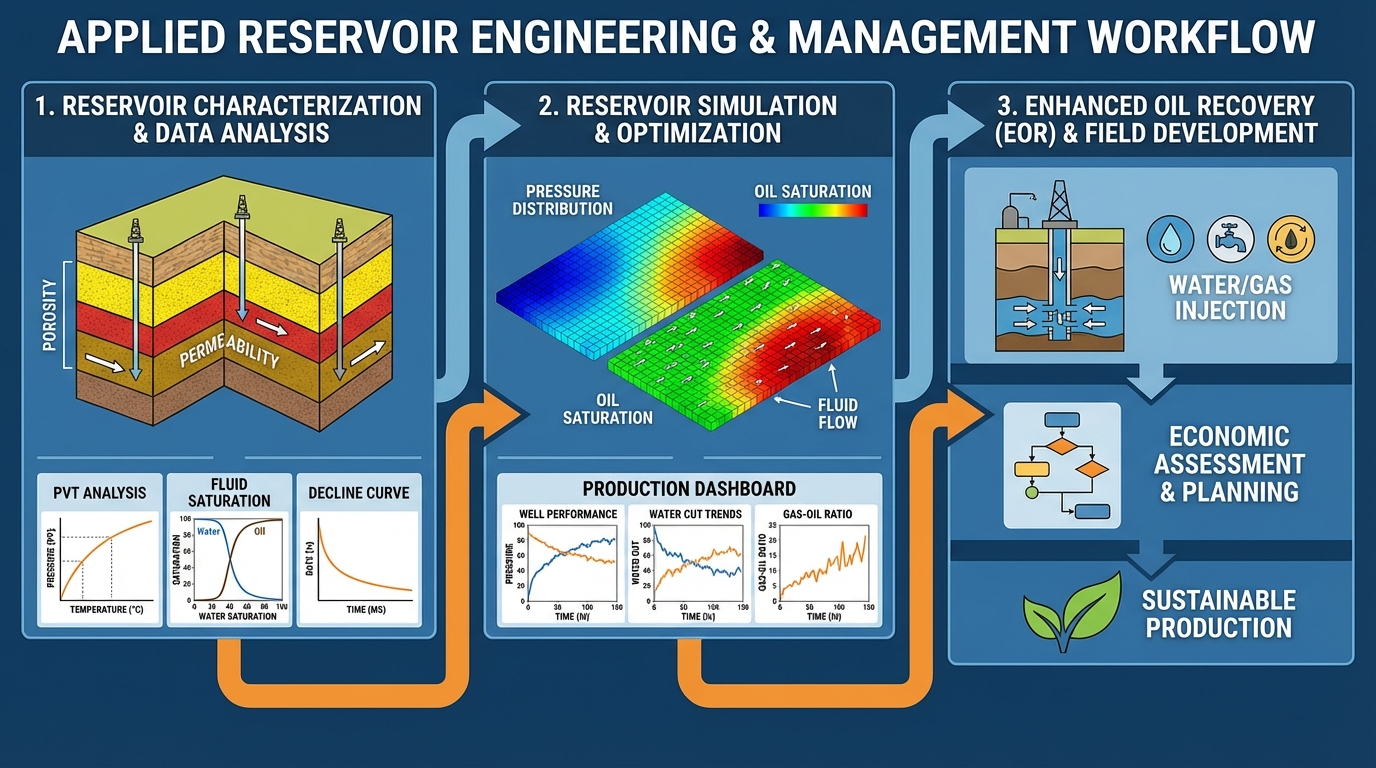
Reservoir management workflow and lifecycle
Integration with geology, geophysics, and production engineering
Regional reservoir types: Saudi Arabian carbonates, Omani sandstones, African deepwater turbidites
Super-giant fields: Ghawar, Safaniyah, Burgan, and their management challenges
Mature field management in GCC and African basins
Module 1.2: Reservoir Rock Properties
Porosity: types, measurement, and regional variations
Permeability: absolute, effective, and relative permeability
Rock compressibility and pore volume changes
Capillary pressure and wettability concepts
Saturation distribution and initial conditions
Core analysis and laboratory measurements
Carbonate reservoir heterogeneity in Middle East
Unconventional reservoir properties
Module 1.3: Reservoir Fluid Properties
Crude oil classification and PVT properties
Formation volume factors: oil, gas, and water
Solution gas-oil ratio and bubble point pressure
Gas properties: Z-factor, viscosity, density
Black oil vs. compositional fluid models
PVT sampling and laboratory testing
Fluid characterization for Saudi Arabian crudes
Heavy oil properties in Kuwait and African fields
Afternoon Session: Material Balance Concepts
Module 1.4: Material Balance Equation (MBE)
General material balance equation derivation
Drive mechanisms: solution gas, gas cap, water, compaction
Material balance for different reservoir types
Aquifer models: pot, Schilthuis, van Everdingen-Hurst
Reservoir pressure history matching
Original oil in place (OOIP) determination
Gas reservoir material balance
Practical applications in GCC fields
Module 1.5: Reservoir Drive Mechanisms
Solution gas drive characteristics and recovery
Gas cap drive optimization strategies
Natural water drive and aquifer support
Combination drive mechanisms
Drive mechanism identification from production data
Saudi Arabia’s water drive reservoirs
Depletion strategies for different drive types
Impact on recovery factor and field life
Day 2: Well Performance and Productivity Analysis
Morning Session: Well Testing and Analysis
Module 2.1: Transient Pressure Analysis
Diffusivity equation and flow regimes
Drawdown and buildup test analysis
Horner plot and MDH analysis methods
Wellbore storage and skin effects
Permeability and reservoir pressure determination
Interference and pulse testing applications
Fractured well analysis in Oman tight formations
Horizontal well pressure transient behavior
Module 2.2: Well Productivity Evaluation
Productivity index (PI) and specific productivity
Inflow performance relationships (IPR)
Vogel correlation for solution gas drive
Fetkovich method for water drive reservoirs
Composite and future IPR predictions
Formation damage assessment and quantification
Stimulation treatment evaluation
Multi-phase flow in wellbore
Afternoon Session: Decline Curve Analysis
Module 2.3: Production Decline Analysis
Arps decline curves: exponential, hyperbolic, harmonic
Decline curve type identification
Reserves estimation from decline analysis
EUR (Estimated Ultimate Recovery) calculations
Modified hyperbolic decline for shale/tight reservoirs
Forecasting production profiles
Economic limit and abandonment rate
Decline analysis for Saudi unconventional assets
Module 2.4: Rate Transient Analysis (RTA)
Flowing material balance concepts
RTA workflows and interpretation
Application to unconventional reservoirs
Comparison with traditional decline analysis
Diagnostic plots and type curves
Reserves estimation using RTA
Case studies from Oman tight gas fields
Software tools and practical exercises
Day 3: Recovery Mechanisms and Field Development
Morning Session: Primary and Secondary Recovery
Module 3.1: Primary Recovery Methods
Primary recovery mechanisms overview
Recovery factor estimation for different drive types
Depletion strategies and optimization
Pressure maintenance concepts
Infill drilling programs
Well spacing optimization
Saudi Arabia’s primary recovery experience
African marginal field development strategies
Module 3.2: Waterflooding Fundamentals
Waterflooding theory and displacement efficiency
Sweep efficiency: areal, vertical, volumetric
Buckley-Leverett fractional flow theory
Pattern design: line drive, five-spot, seven-spot, nine-spot
Injection rate optimization and voidage replacement
Water quality requirements and compatibility
Breakthrough prediction and water cut management
Waterflooding in Middle East carbonate reservoirs
Afternoon Session: Enhanced Oil Recovery (EOR)
Module 3.3: Chemical EOR Methods
Polymer flooding: mechanisms and applications
Surfactant and alkaline flooding
ASP (Alkaline-Surfactant-Polymer) flooding
Chemical EOR screening criteria
Economic evaluation and pilot design
Oman PDO polymer flooding projects in Marmul
Chemical EOR for mature GCC fields
African heavy oil chemical flooding opportunities
Module 3.4: Gas Injection and Thermal EOR
Gas injection processes: immiscible and miscible
CO2 flooding mechanisms and minimum miscibility pressure
Nitrogen and hydrocarbon gas injection
Huff-n-puff and cyclic injection strategies
Thermal methods: steam injection, SAGD, in-situ combustion
EOR screening and reservoir suitability
Saudi Arabia’s CO2 EOR initiatives at Uthmaniyah
Gas injection projects in UAE and Qatar
Day 4: Reservoir Simulation and Modeling
Morning Session: Reservoir Simulation Fundamentals
Module 4.1: Introduction to Reservoir Simulation
Reservoir simulation workflow and objectives
Types of simulators: black oil, compositional, thermal
Finite difference methods and grid systems
Model initialization and equilibration
History matching process and uncertainty
Prediction scenarios and development optimization
Simulation software: Eclipse, CMG, Petrel
Integrated modeling in digital oilfield environments
Module 4.2: Model Building and Characterization
Geological model construction
Geostatistical methods and property distribution
Upscaling from geological to simulation models
Structural framework and fault modeling
Petrophysical property modeling
Fluid contacts and saturation initialization
Aquifer modeling techniques
Quality control and validation procedures
Afternoon Session: History Matching and Forecasting
Module 4.3: History Matching Process
Objectives and workflow for history matching
Parameter sensitivity analysis
Automated and manual matching techniques
Matching pressure, production rates, and saturations
Well by well vs. field level matching
Handling uncertainty in reservoir models
Assisted history matching tools
Best practices from Saudi Aramco simulation studies
Module 4.4: Reservoir Performance Forecasting
Development scenario generation
Sensitivity analysis and risk assessment
Optimization of well placement and completion
Production forecasting and plateau management
Economic evaluation integration (NPV analysis)
Uncertainty quantification and P10-P50-P90 cases
Field development plan (FDP) preparation
Reserves booking and reporting standards (SPE-PRMS)
Day 5: Integrated Reservoir Management
Morning Session: Advanced Reservoir Management
Module 5.1: Reservoir Surveillance and Monitoring
Surveillance programs design and implementation
Pressure monitoring: buildup tests, MDT, permanent gauges
Production logging and well performance tracking
Saturation monitoring: RST, pulsed neutron logs
4D seismic and time-lapse monitoring
Tracer studies for waterflood surveillance
Real-time data integration and analytics
Digital twin technology in GCC operations
Module 5.2: Integrated Asset Management
Integrated reservoir studies workflow
Multidisciplinary team collaboration
Subsurface uncertainty management
Field development planning and economics
Facilities constraints and integration
Production optimization strategies
Portfolio management and prioritization
Asset value optimization frameworks
Afternoon Session: Special Topics and Case Studies
Module 5.3: Unconventional and Complex Reservoirs
Tight oil and gas reservoir engineering
Shale reservoir characterization
Hydraulic fracturing and EUR assessment
Naturally fractured reservoir management
Dual porosity/dual permeability modeling
Saudi Arabia’s Jafurah shale gas development
Oman’s Athel tight carbonate challenges
Heavy oil reservoirs in Kuwait and Africa
Module 5.4: Emerging Technologies and Digital Solutions
Machine learning applications in reservoir engineering
Big data analytics for production optimization
Artificial intelligence in history matching
Cloud computing and high-performance computing
Predictive analytics and prescriptive models
Blockchain for asset data management
Digital oilfield integration
Carbon capture and storage (CCS) reservoir engineering
Module 5.5: Regional Case Studies and Workshop
Saudi Arabia: Ghawar field water injection optimization
Oman: Harweel cluster polymer flooding implementation
UAE: Bu Hasa field pressure maintenance strategies
Kuwait: Greater Burgan reservoir management
Qatar: North Field gas condensate reservoir dynamics
Nigeria: Deepwater turbidite reservoir development
Angola: Pre-salt carbonate reservoir challenges
Egypt: Western Desert mature field revitalization
Interactive reservoir problem-solving exercises
Reserves estimation and classification workshop
Development strategy optimization scenarios
Group presentations and discussions
Course wrap-up and Q&A session
Course Learning Outcomes
Participants will achieve:
Mastery of reservoir engineering fundamentals and calculations
Practical skills in well test analysis and production forecasting
Technical expertise in material balance and decline curve analysis
Understanding of EOR screening and implementation strategies
Competency in reservoir simulation workflow and history matching
Strategic thinking for integrated asset management
Regional knowledge specific to KSA, Oman, GCC, and African reservoirs
Economic evaluation capabilities for field development planning
Decision-making skills for reservoir management optimization
Regional Focus: KSA, Oman, GCC & Africa
Kingdom of Saudi Arabia: Addressing super-giant carbonate reservoir management, Arab D reservoir heterogeneity, unconventional Jafurah basin development, water injection optimization, CO2 EOR initiatives, and Saudi Aramco’s advanced reservoir management practices.
Oman: Covering mature field rejuvenation, polymer flooding applications, tight carbonate characterization, Khazzan/Makarem tight gas reservoirs, and Petroleum Development Oman (PDO) integrated reservoir studies.
GCC Region: Including ADNOC’s offshore carbonate management, Qatar’s gas condensate reservoirs, Kuwait’s heavy oil challenges, Bahrain’s tight oil exploitation, and regional EOR screening criteria.
Africa: Encompassing deepwater turbidite reservoirs, pre-salt carbonates, Niger Delta mature fields, West African marginal field development, East African gas discoveries, and diverse geological settings across Nigeria, Angola, Egypt, Ghana, and Mozambique.
Training Methodology
Technical lectures with practical examples
Reservoir engineering software demonstrations
Hands-on calculation exercises and spreadsheet tools
Real field case studies from target regions
Group problem-solving workshops
Interactive simulation exercises
Industry best practices sharing
Comprehensive course materials and reference library
Duration: 5 days (40 training hours)
Delivery: In-person, online, or hybrid format
Language: English (Arabic support available)
Certification: Professional development certificate
Software: Access to reservoir engineering calculation tools
Keywords: reservoir engineering training, applied reservoir management course KSA, reservoir simulation Oman, GCC reservoir engineering, African reservoir management, material balance analysis, EOR training Middle East, waterflood optimization, production forecasting, Saudi Aramco reservoir practices, PDO reservoir studies, decline curve analysis, well testing training