
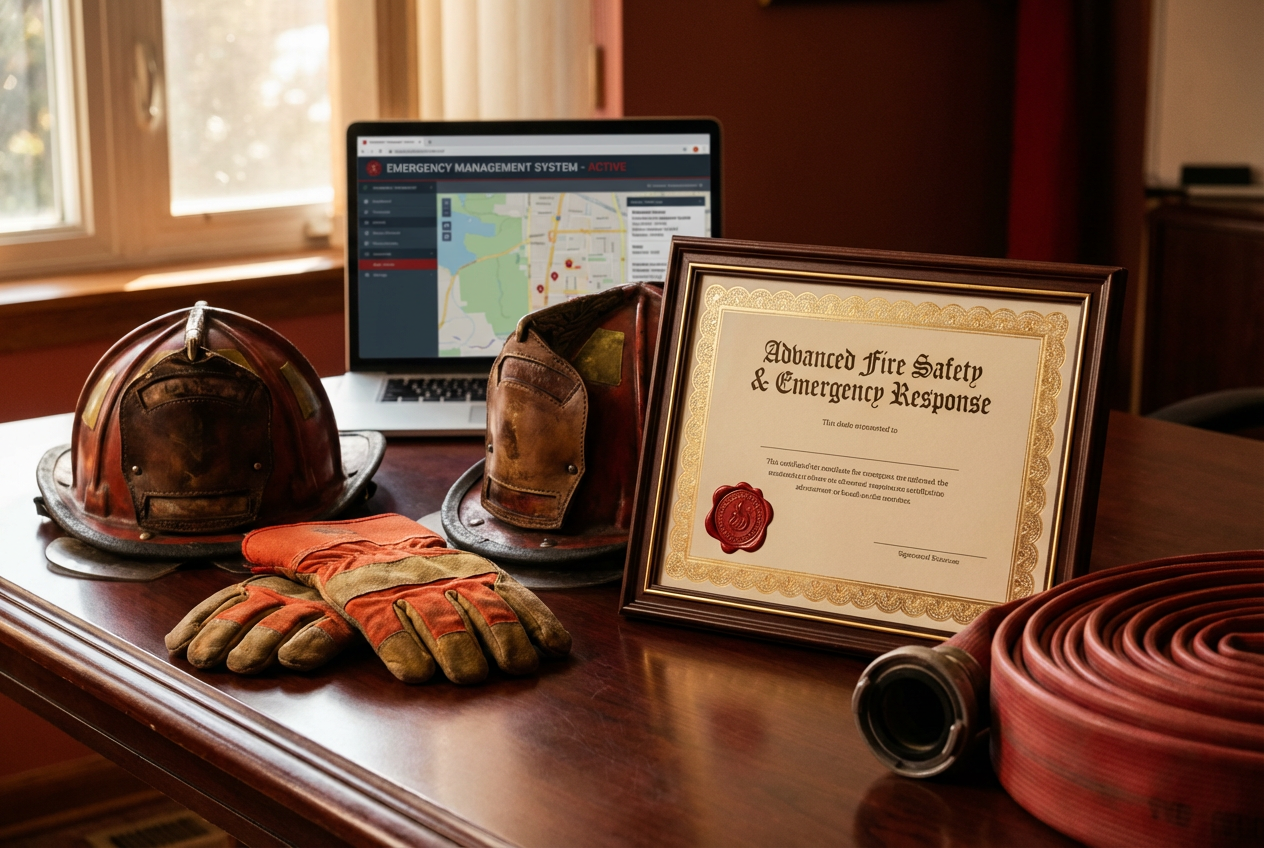
Advanced Fire Safety & Emergency Response
$2000.00
Advanced Fire Safety & Emergency Response 5-Day Course Outline - KSA, Oman & GCC
Master Fire Protection & Emergency Management in Saudi Arabia, Oman & Gulf Region
The Advanced Fire Safety & Emergency Response Course is a comprehensive 5-day program designed for safety professionals, facility managers, and emergency responders across Saudi Arabia (KSA), Oman, UAE, Qatar, Kuwait, and Bahrain. This specialized training covers fire science, advanced suppression systems, evacuation management, and emergency coordination essential for protecting lives and assets in high-rise buildings, industrial facilities, oil & gas installations, and commercial complexes throughout the GCC.
Why Advanced Fire Safety Training is Essential in the Middle East?
The GCC region faces unique fire safety challenges requiring specialized knowledge:
Extreme climate conditions: 45°C+ temperatures affecting fire behavior
High-rise mega-developments: NEOM, Burj Khalifa, Kingdom Tower
Saudi Civil Defense regulations and mandatory compliance
Oman Civil Defense Law requirements for fire safety systems
UAE Fire & Life Safety Code implementation
Oil & gas facilities: refineries, petrochemical plants, storage terminals
Major incidents: Marina Torch Dubai, Grenfell lessons applied to GCC
NFPA standards adoption across Gulf states
Vision 2030 safety infrastructure requirements
Who Should Attend This Course?
Fire safety managers and officers in commercial and industrial facilities
HSE professionals requiring advanced fire protection knowledge
Facility and building managers of high-rise and complex structures
Emergency response team leaders and coordinators
Safety engineers designing fire protection systems
Industrial firefighters at oil & gas and petrochemical facilities
Civil Defense liaisons coordinating with authorities
Project managers overseeing construction of GCC mega-developments
Anyone responsible for fire safety in Saudi Arabia, Oman, UAE, or GCC
5-Day Advanced Fire Safety Course Structure
Day 1: Fire Science & Behavior Fundamentals
Advanced Fire Chemistry and Physics
Fire tetrahedron: fuel, oxygen, heat, chemical chain reaction
Combustion process: premixed vs. diffusion flames
Products of combustion: smoke, toxic gases, heat
Heat transfer mechanisms: conduction, convection, radiation
Flame spread and fire growth patterns
Flashover, backdraft, and rollover phenomena
Fire dynamics in compartments and buildings
Influence of GCC climate on fire behavior
Classification of Fires and Extinguishing Agents
Class A: Ordinary combustibles (wood, paper, textiles)
Class B: Flammable liquids (gasoline, solvents, oils)
Class C: Energized electrical equipment
Class D: Combustible metals (magnesium, titanium, sodium)
Class K: Cooking oils and fats (commercial kitchens)
Extinguishing agent selection: water, foam, CO2, dry chemical, clean agents
Agent effectiveness and application methods
Environmental considerations in GCC operations
Flammable and Combustible Materials
Material properties: flash point, ignition temperature, flammability limits
LEL/UEL (Lower/Upper Explosive Limits) for vapors
Liquid fuel classifications and storage requirements
Combustible dust hazards in industrial settings
Reactive and pyrophoric materials handling
Special hazards: LPG, hydrogen, acetylene systems
Material Safety Data Sheets (SDS) fire information
Storage and segregation requirements per NFPA codes
Building Construction and Fire Resistance
Construction types: fire-resistive, non-combustible, combustible
Fire resistance ratings: walls, floors, structural elements
Passive fire protection: fire barriers, fire walls, fire doors
Compartmentation principles for limiting fire spread
Means of egress design and capacity calculations
High-rise building fire safety challenges
Cladding materials: lessons from recent GCC incidents
Building codes: Saudi Building Code (SBC), UAE Fire Code
Day 2: Fire Detection & Suppression Systems
Fire Detection and Alarm Systems
Detection technologies: smoke, heat, flame, gas detectors
Ionization vs. photoelectric smoke detection
Addressable vs. conventional fire alarm systems
Detector placement and spacing per NFPA 72
Alarm notification appliances: audible, visible, voice evacuation
Control panels and monitoring systems
Integration with building management systems (BMS)
Inspection, testing, and maintenance (ITM) requirements
False alarm prevention and management
Water-Based Fire Suppression Systems
Automatic sprinkler systems: wet, dry, pre-action, deluge
Sprinkler design: density, area/density, hydraulic calculations
NFPA 13 installation standards for GCC applications
Water supply requirements and fire pump sizing
Standpipe and hose systems: Class I, II, III
Fire hydrant systems and water storage
Seismic considerations for system installations
Freeze protection in air-conditioned GCC environments
System inspection and testing protocols
Special Hazard Fire Suppression Systems
Clean agent systems: FM-200, Novec 1230, Inergen
Carbon dioxide (CO2) total flooding and local application
Foam systems: low, medium, high expansion
Water mist systems for electronics and heritage sites
Kitchen hood suppression systems (wet chemical)
Industrial fire protection: powder systems for metal fires
Selection criteria based on hazard analysis
Environmental and health considerations
Installation per NFPA 2001, 12, 11, 17 standards
Fire Suppression in Oil & Gas Facilities
Hydrocarbon fire characteristics and challenges
Foam systems: AFFF, AR-AFFF for storage tanks
Fixed foam systems vs. mobile foam units
Deluge systems for process equipment protection
Water spray and monitor systems
Gas detection and automatic activation
Fire water ring mains and hydrant coverage
Saudi Aramco, ADNOC fire protection standards
Day 3: Emergency Planning & Evacuation Management
Emergency Response Planning
Comprehensive emergency response plan (ERP) development
Hazard identification and scenario planning
Emergency organization structure and roles
Incident Command System (ICS) implementation
Emergency control center setup and operations
Communication systems: alarms, PA, radios, emergency phones
Coordination with Saudi Civil Defense, Oman Police, GCC authorities
Business continuity and crisis management integration
Evacuation Strategy and Management
Evacuation vs. defend-in-place strategies
Phased evacuation in high-rise buildings
Horizontal vs. vertical evacuation procedures
Assembly point selection and management
Accountability systems: roll call, electronic tracking
Evacuation of vulnerable persons: mobility impaired, elderly
Elevator use during emergencies: prohibited except fire service
Stairwell capacity calculations and egress time analysis
Special considerations: Ramadan, prayer times, cultural events
Emergency Response Teams (ERT)
ERT structure: team leader, fire wardens, first aiders, evacuation coordinators
Roles and responsibilities definition
Training requirements and competency assessment
Fire warden duties: sweep, search, assist evacuation
Floor warden coordination in multi-story buildings
Equipment provision: flashlights, vests, communication devices
Drill participation and performance evaluation
Recognition and motivation programs
Emergency Drills and Exercises
Drill types: announced, unannounced, partial, full-scale
Drill planning and scenario development
Frequency requirements: quarterly, semi-annual, annual
Observer roles and evaluation criteria
Timing considerations: day/night, shift changes
Post-drill debriefing and lessons learned
Documentation and regulatory reporting
Continuous improvement based on drill findings
Day 4: Industrial Fire Fighting & Hazardous Materials
Industrial Fire Fighting Techniques
Size-up and risk assessment at incident scenes
Offensive vs. defensive fire attack strategies
Direct, indirect, and combination fire attack methods
Foam application techniques: bank down, rain down, roll-on
Ventilation tactics: natural, mechanical, positive pressure
Thermal imaging camera usage for hot spot detection
Utility control: gas, electricity, water systems
Salvage and overhaul operations
Post-fire investigation preservation
Storage Tank Fire Fighting
Fixed roof tank fire scenarios and tactics
Floating roof tank fires: rim seal, full surface
Cone roof tank fires and foam application
Tank boilover and slopover phenomena
Foam system operation and manual application
Exposure protection for adjacent tanks
Specialized equipment: foam monitors, nozzles
Coordination with facility operators
Training for Saudi Aramco, PDO terminal operations
Hazardous Materials Emergency Response
HAZMAT identification: UN numbers, placards, labels
GHS classification system for chemicals
Emergency Response Guidebook (ERG) usage
Isolation and evacuation distances
Personal protective equipment: Level A, B, C, D
Decontamination procedures and stations
Spill containment: dikes, booms, absorbents
Leak control and product transfer operations
Coordination with specialized HAZMAT teams
Reporting to Saudi PME, Oman Environment Authority
Breathing Apparatus and Rescue Operations
Self-Contained Breathing Apparatus (SCBA) operation
SCBA inspection, donning, and safety checks
Air management and low-air warnings
Search and rescue techniques in zero visibility
Victim removal methods: drags, carries, lifts
Rapid intervention team (RIT) protocols
Confined space rescue considerations
Heat stress management in protective equipment
Training requirements per NFPA 1404
Day 5: Advanced Topics & Practical Applications
High-Rise Building Fire Safety
Unique challenges: stack effect, elevator shafts, communication
Fire service access elevators operation and control
Stairwell pressurization systems
Smoke control and management systems
Firefighter communication enhancement systems
Standpipe system operations at height
Helicopter rescue operations from rooftops
Burj Khalifa, Kingdom Tower case studies
Residential vs. commercial high-rise considerations
Performance-Based Fire Safety Design
Prescriptive vs. performance-based approaches
Fire risk assessment methodologies
Fire modeling and simulation: FDS, Pathfinder
Smoke movement analysis
Egress time calculations (RSET/ASET)
Design fire scenarios development
Acceptance criteria and safety factors
Approval process with Saudi, UAE authorities
Application in complex GCC mega-projects
Fire Investigation Basics
Investigation objectives and legal considerations
Scene preservation and safety assessment
Evidence collection and documentation
Fire origin and cause determination
Burn patterns and indicators analysis
Electrical fire investigation techniques
Witness interviews and statement collection
Report writing and expert testimony
Coordination with Civil Defense investigators
Emerging Technologies and Trends
Smart building integration: IoT sensors, AI analytics
Video smoke detection (VSD) systems
Wireless fire alarm technologies
Drone usage in fire assessment and monitoring
Virtual reality (VR) for emergency training
Building Information Modeling (BIM) for fire safety
Lithium battery fire challenges and suppression
Electric vehicle (EV) charging infrastructure safety
Sustainability and green fire protection solutions
Practical Exercises and Simulations
Live fire extinguisher training (if facilities available)
Tabletop emergency exercises: realistic GCC scenarios
Evacuation drill planning workshop
Fire alarm panel operation demonstrations
Sprinkler system activation simulation
Incident command system role-playing
Emergency communication exercises
Case study analysis: real GCC fire incidents
Course Review and Assessment
Comprehensive review of all course modules
Key concept reinforcement through Q&A
Written examination covering technical knowledge
Practical assessment: emergency scenario response
Certificate of completion presentation
Action planning for workplace improvements
Resources for continued learning and development
Professional networking opportunities
Certification and Career Benefits
Professional Recognition
International certificate recognized across GCC fire safety sector
Enhanced credibility with regulators and insurers
25-40% salary increase for advanced fire safety specialists
Pathway to professional certifications: CFPS, NFPA practitioners
Compliance with Saudi Civil Defense, UAE Fire Code competency requirements
Organizational Advantages
Reduced fire losses and business interruption
Lower insurance premiums through demonstrated competency
Improved regulatory compliance and audit results
Enhanced emergency preparedness and response capability
Strengthened occupant confidence and organizational reputation
Training Delivery Options Across Middle East
Classroom training: Riyadh, Jeddah, Dammam, Jubail, Muscat, Dubai, Abu Dhabi, Doha, Kuwait City
Virtual instructor-led: Live online with video demonstrations
Blended learning: E-learning modules with hands-on practicals
In-company programs: Customized for facilities (minimum 8 participants)
Practical fire training: Live fire exercises at dedicated facilities
Industry-specific: Oil & gas, high-rise, industrial, healthcare focus
Protect Lives and Assets with Advanced Fire Safety Expertise
Advanced fire safety knowledge is critical for professionals managing complex fire risks across Saudi Arabia, Oman, and the GCC region. With rapid urbanization, increasing high-rise construction, and expanding industrial operations, specialized fire protection and emergency response capabilities ensure both regulatory compliance and operational resilience.
Elevate your fire safety expertise and lead world-class emergency preparedness programs.