
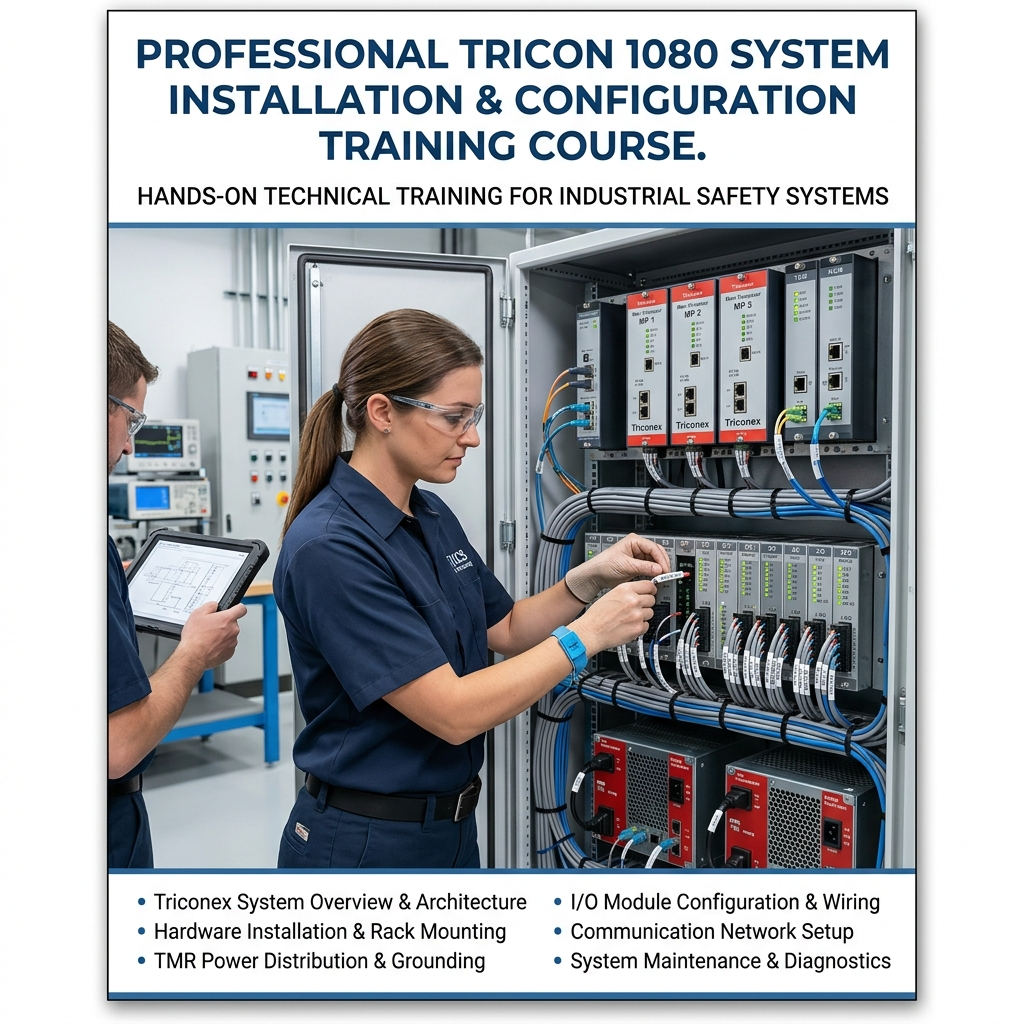
1080 Tricon System Installation
$5500.00
1080 Tricon System Installation Training Course | 5-Day Triconex SIS Installation Program
Tricon System Installation Course Overview
This 5-day 1080 Tricon System Installation Training Course is designed for professionals responsible for installing, wiring, integrating, and maintaining Tricon safety systems in industrial plants. The course focuses on practical installation knowledge for Tricon controllers, chassis, modules, communications, power distribution, grounding, field wiring, and startup readiness. The outline is based on Tricon planning and installation guidance and the Tricon technical product architecture used in safety-critical applications.
Introduction
The Tricon controller is described as a fault-tolerant programmable logic and process controller with Triple Modular Redundant (TMR) architecture. Its design integrates three isolated parallel control systems and two-out-of-three voting to support high-integrity, uninterrupted operation with no single point of failure. The platform also supports module-level replacement and maintenance while the controller remains online, which makes installation quality, wiring discipline, grounding, and diagnostics especially important for project success.
Target Audience
This course is suitable for instrument and electrical engineers, SIS engineers, maintenance engineers, installation technicians, commissioning personnel, control system specialists, project engineers, shutdown teams, and plant reliability staff who work on Tricon or Triconex-based safety systems in oil and gas, petrochemical, power, and process facilities.
Learning Outcomes
By the end of the course, participants will be able to:
Explain Tricon TMR architecture and core hardware layout.
Identify main, expansion, and RXM chassis and their installation requirements.
Install power modules, processor modules, communication modules, and I/O modules correctly.
Apply plant power, safety ground, signal ground, and shield grounding practices.
Perform field wiring and external termination panel connections with good engineering practice.
Configure chassis layout, slot allocation, node settings, and module addressing basics.
Verify readiness for startup, testing, and commissioning.
Troubleshoot common installation faults and support safe maintenance activities.
Learning Methods
The course uses instructor-led lectures, hardware walkthroughs, installation checklists, wiring interpretation, case-based discussion, practical demonstrations, troubleshooting exercises, and guided workshops. Participants learn through a mix of theory and installation-focused application covering chassis mounting, cable routing, grounding, module handling, and maintenance best practice.
5-Day Course Outline
Day 1: Tricon Architecture and System Fundamentals
Participants begin with the purpose of Tricon safety systems, TMR principles, fault tolerance, voting philosophy, processor architecture, and system components. The day also introduces main hardware families such as chassis assemblies, power modules, main processors, communication modules, and I/O modules.
Day 2: Chassis Installation, Layout, and Environmental Requirements
Day two focuses on physical installation. Topics include main chassis, expansion chassis, RXM chassis, rear-mounting, rack-mounting, clearances, cooling, cable access, slot keys, and hardware layout rules. Participants also review enclosure considerations, heat management, and installation planning for maintainability and safe access.
Day 3: Power Distribution, Grounding, and Field Wiring
This day covers plant power requirements, power module installation, controller grounding, system safety ground, signal ground, shield termination, and field wiring practices. Special attention is given to digital output precautions, external termination panels, fanned-out cables, and wiring discipline to prevent faults, noise, or unsafe installation errors.
Day 4: Module Installation and Communication Integration
Participants learn the correct installation and replacement of I/O modules, processor modules, and communication modules. The course reviews module types including digital, analog, pulse, relay, thermocouple, and HART-related hardware, plus communication integration concepts for system connectivity. Basic checks for module seating, addressing, compatibility, and diagnostic indication are included.
Day 5: Testing, Maintenance, Troubleshooting, and Startup Readiness
The final day consolidates installation knowledge into commissioning readiness. Topics include pre-startup verification, inspection checklists, online module replacement concepts, common wiring and grounding faults, power issues, diagnostic review, and maintenance planning. The course closes with practical troubleshooting scenarios and recommendations for reliable long-term operation. Schneider describes Triconex systems as delivering superior protection for people, production, and profitability, making proper installation essential to lifecycle performance.